Rusni Hassan - Böcker
Visar alla böcker från författaren Rusni Hassan. Handla med fri frakt och snabb leverans.
7 produkter
7 produkter
1 812 kr
Skickas inom 10-15 vardagar
The central idea of sustainability in the modern world is intricate and ever-changing. Closely related to the realm of finance and socioeconomic discussion, the phrase “sustainable impact finance” has become increasingly popular among bankers, practitioners, financial analysts, investors and the relevant experts seeking an impactful connection between the best financing mechanisms or tools and sustainable development related investments or projects.This book opens up the discussion by offering a Shari’ah-compliance perspective. It is a primer on how Islam addresses and offers solutions to the challenges facing us within the spirit of maqasid al-Shari’ah, among others, in tackling poverty, food supply, health and well-being, quality education, reducing inequalities, responsible consumption and production and climate action. It discusses the connection between Islamic sustainable finance and the Sustainable Development Goals (SDGs) and explains the strategic action-plan of Islamic banks towards achieving Islamic sustainable finance.The book considers the relevant policies and regulations, evaluating the role of regulators, discussing jurisprudential solutions and focusing on the role of Islamic banking standards in relation to Islamic sustainable finance. Further, it explores the issue of risk mitigation and the effective role of Takaful. It presents a practical case study from the banking industry in Malaysia, which evaluates the carbon footprint of bank loans and climate change risk mitigation. Finally, it highlights sustainable finance innovations in an Islamic concept.The book will appeal to advanced students, researchers and scholars of Islamic banking and finance, as well as those concerned with environmental social governance and Sustainable Development Goals research. Regulators, policy makers and Shari’ah-compliant practitioners will also find it to be a useful guide.
621 kr
Kommande
The central idea of sustainability in the modern world is intricate and ever-changing. Closely related to the realm of finance and socioeconomic discussion, the phrase “sustainable impact finance” has become increasingly popular among bankers, practitioners, financial analysts, investors and the relevant experts seeking an impactful connection between the best financing mechanisms or tools and sustainable development related investments or projects.This book opens up the discussion by offering a Shari’ah-compliance perspective. It is a primer on how Islam addresses and offers solutions to the challenges facing us within the spirit of maqasid al-Shari’ah, among others, in tackling poverty, food supply, health and well-being, quality education, reducing inequalities, responsible consumption and production and climate action. It discusses the connection between Islamic sustainable finance and the Sustainable Development Goals (SDGs) and explains the strategic action-plan of Islamic banks towards achieving Islamic sustainable finance.The book considers the relevant policies and regulations, evaluating the role of regulators, discussing jurisprudential solutions and focusing on the role of Islamic banking standards in relation to Islamic sustainable finance. Further, it explores the issue of risk mitigation and the effective role of Takaful. It presents a practical case study from the banking industry in Malaysia, which evaluates the carbon footprint of bank loans and climate change risk mitigation. Finally, it highlights sustainable finance innovations in an Islamic concept.The book will appeal to advanced students, researchers and scholars of Islamic banking and finance, as well as those concerned with environmental social governance and Sustainable Development Goals research. Regulators, policy makers and Shari’ah-compliant practitioners will also find it to be a useful guide.
2 172 kr
Skickas inom 10-15 vardagar
This book argues that focusing on the green economy and green finance is essential to counteract the catastrophic, socio-economic effects of the COVID-19 pandemic. Further, while numerous research initiatives in the context of the green economy and/or finance have been observed in different parts of the world, to date, no comprehensive work has been published on the topic of green finance in relation to the discipline of Shari’ah. This timely book provides a comprehensive guide and offers practical solutions to the core issues of green finance within the principles of Maqasid al-Shari’ah.It contends that Islamic green finance serves to promote global financial stability and mitigate the financial risks associated with climate change and environmental degradation: by integrating Islamic finance principles with sustainable and environmentally friendly practices; by encouraging ethical investments and prioritising long-term social and environmental benefits; and by redirecting capital towards sustainable projects and fostering a more sustainable and inclusive financial system. Islamic green finance’s emphasis on transparency, governance, risk-sharing, and responsible investing helps lessen systemic risks and supports the transition towards a more stable and sustainable global financial landscape. The book’s holistic approach to green finance in Maqasid al-Shari’ah aims to ensure that financial actions align with Islamic principles and help create a more sustainable and responsible economic system.The book is a detailed reference, which sheds light on the pressing issues of our time. It encompasses various aspects of Islamic economics and serves as a guide to implementing green financing in accordance with Islamic principles and ethics, and as such, it will appeal to academics, researchers, students and policymakers alike.
Islamic Finance and Sustainable Development
A Global Framework for Achieving Sustainable Impact Finance
Inbunden, Engelska, 2024
1 936 kr
Skickas inom 10-15 vardagar
The interest in improving Environmental, Social and Governance (ESG) outcomes among stakeholders of Islamic banking and finance has become front and centre in the discussions relating to Islamic sustainable finance.This book offers an expansive overview of the relevant issues, global initiatives and trends in the management, governance, and operation of Islamic sustainable impact finance. It identifies the models and mechanisms required to achieve sustainable impact finance in the context of Islamic investment and project development and collects and observes the latest approaches in maintaining and fulfilling the principles of Shariah-compliance in Sustainable Development Goals and Environmental, Social and Governance-oriented projects. The book also explores conventional financing instruments, which are being used in modern practice.While Islamic sustainable finance provides a positive change in the Islamic banking and finance industry globally, implementing it is not without its challenges. Such challenges, such as the fulfilment of Shariah-compliance requirements, both legally and jurisprudentially, and the application and development of modern innovative products and hybrid models of classical products are highlighted and addressed in the book. The book delves into the current management practices of Islamic banking and finance, which promote Islamic sustainable impact finance and outlines strategies for meeting sustainable investments and projects. Other factors, such as the latest technology, regulations and social, political and economic policies are also considered. Evidence is provided via case studies from selected countries that participate actively in the Islamic banking and finance industry globally.The book will attract a wide audience from researchers, scholars, and students to stakeholders of Islamic banking and finance, regulators, policy makers and Shariah-compliant practitioners.
Islamic Finance and Sustainable Development
A Global Framework for Achieving Sustainable Impact Finance
Häftad, Engelska, 2025
579 kr
Skickas inom 10-15 vardagar
The interest in improving Environmental, Social and Governance (ESG) outcomes among stakeholders of Islamic banking and finance has become front and centre in the discussions relating to Islamic sustainable finance.This book offers an expansive overview of the relevant issues, global initiatives and trends in the management, governance, and operation of Islamic sustainable impact finance. It identifies the models and mechanisms required to achieve sustainable impact finance in the context of Islamic investment and project development and collects and observes the latest approaches in maintaining and fulfilling the principles of Shariah-compliance in Sustainable Development Goals and Environmental, Social and Governance-oriented projects. The book also explores conventional financing instruments, which are being used in modern practice.While Islamic sustainable finance provides a positive change in the Islamic banking and finance industry globally, implementing it is not without its challenges. Such challenges, such as the fulfilment of Shariah-compliance requirements, both legally and jurisprudentially, and the application and development of modern innovative products and hybrid models of classical products are highlighted and addressed in the book. The book delves into the current management practices of Islamic banking and finance, which promote Islamic sustainable impact finance and outlines strategies for meeting sustainable investments and projects. Other factors, such as the latest technology, regulations and social, political and economic policies are also considered. Evidence is provided via case studies from selected countries that participate actively in the Islamic banking and finance industry globally.The book will attract a wide audience from researchers, scholars, and students to stakeholders of Islamic banking and finance, regulators, policy makers and Shariah-compliant practitioners.
Islamic Finance and Climate Action
Ethics, Environmental Stewardship and Sustainability
Inbunden, Engelska, 2025
2 167 kr
Skickas inom 10-15 vardagar
In the face of unprecedented global warming and escalating environmental crises, this book offers a comprehensive investigation into the ways Islamic financial principles can contribute to combating climate change. It delves into the significant potential of the Islamic finance industry and showcases its capacity for sustainable and ethical investment that aligns with the global climate change agenda.The book meticulously discusses the role Islamic finance can play in developing low-carbon and climate-resilient infrastructure, providing readers with a rich blend of theoretical insights and practical methodologies. It underscores the harmony between Islamic ethical finance and ecological care, highlighting their joint role in funding renewable energy and fostering resilient communities. Through insightful case studies and analyses, it positions Islamic finance as a vital player in global climate initiatives. Introducing innovative instruments like green Sukuk and evaluating Waqf (endowment) for eco-projects, it critically reviews how Islamic financial institutions can further drive climate-positive investments, providing a framework of Islamic climate finance. It analyses the law and policies of Islamic finance governing climate action and puts forward a strategic action plan.Aimed at scholars, researchers, and academics, this book is an invaluable resource for those seeking to understand and implement Islamic financial solutions in the battle against the global climate crisis. It also serves as an essential guide for policymakers and practitioners committed to steering financial practices towards more sustainable and globally beneficial outcomes, ultimately providing strategic knowledge and practical tools to mobilize resources effectively for the planet’s future.Mohd Ma’Sum Billah is Senior Professor of Finance at the Islamic Economics Institute, King Abdul Aziz University (KAU), Kingdom of Saudi Arabia.Razali Haron is Professor of Finance at the IIUM International Institute of Islamic Banking and Finance, International Islamic University, Malaysia (IIUM).Rusni Hassan is Professor of Finance and the Dean at the IIUM International Institute of Islamic Banking and Finance, International Islamic University, Malaysia (IIUM).Syed Marwan Mujahid Syed Azman is Assistant Professor of Finance at the IIUM International Institute of Islamic Banking and Finance, International Islamic University, Malaysia (IIUM).Akhtarun Naba’ Billah is pursuing her LLB (Hons) at the Ahmad Ibrahim Kulliyyah of Laws (AIKOL), International Islamic University, Malaysia (IIUM), and is scheduled to complete her legal internship at the Office of the Chief Justice of Malaysia (Palace of Justice, Putrajaya, Malaysia) in 2025.
1 062 kr
Skickas inom 7-10 vardagar
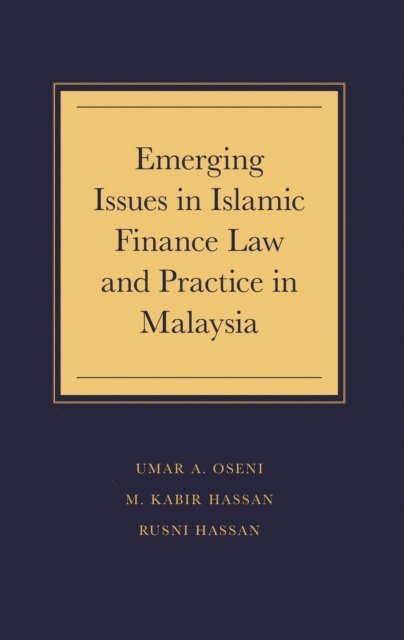
Law and regulation are becoming increasingly important in any discourse involving the Islamic financial services industry. This important aspect comprises both the legal and Sharīʿah aspects from the pre-contract stage up to the post-execution phase, and even post-contract termination phase. Emerging Issues in Islamic Finance Law and Practice in Malaysia focuses on emerging legal, Sharī‘ah and regulatory issues in the Islamic finance industry in Malaysia. Through the lens of the Malaysian legal framework, financial experts Umar A. Oseni, M. Kabir Hassan, and Rusni Hassan and their expert contributors raise and discuss issues that cut across borders and, as such, can be transposed to other Islamic finance jurisdictions. With the different perspectives and approaches adopted by various chapters, Emerging Issues is specifically designed to meet the needs of academics and practitioners of Islamic finance law to provide general legal and Sharīʿah guidance on the emerging issues identified. In Emerging Issues, Oseni, Hassan and Hassan provide rigorous research for curious minds who seek to ascertain the position of Islamic law on certain new issues, such as the application of Fintech in Islamic finance and the regulation of digital currencies. Readers will also benefit from the case studies included, which are based on the Malaysian legal and Sharīʿah framework since Malaysia is generally considered a model for other Islamic finance jurisdictions.