Russell Hardin - Böcker
Visar alla böcker från författaren Russell Hardin. Handla med fri frakt och snabb leverans.
22 produkter
22 produkter
1 200 kr
Skickas inom 5-8 vardagar
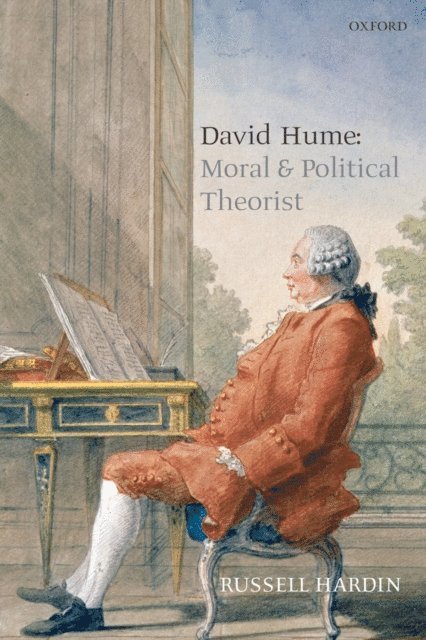
Russell Hardin presents a new explication of David Hume's moral and political theory. With Hume, he holds that our normative views can be scientifically explained but they cannot be justified as true. Hume argued for the psychological basis of such views. In particular, he argued for sympathy as the mirroring of the psychological sensations and emotions of others. By placing Hume in the developing tradition of social science, as a strong forerunner of his younger friend Adam Smith, Hardin demonstrates Hume's strong strategic sense, his nascent utilitarianism, his powerful theory of convention as a main source of social and political order, and his recognition of moral and political theory as a single enterprise.
658 kr
Skickas inom 7-10 vardagar
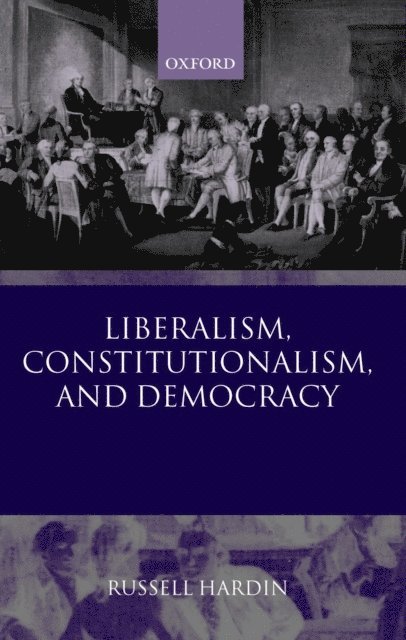
In his ground-breaking book, the leading political philosopher Russell Hardin develops a new theory of liberal constitutional democracy. Arguing against the standard consensus theories, the author shows how social co-ordination on limited, sociological mutual advantage lies at the heart of liberal constitutionalism when it works to produce stable government.The book argues that liberalism, constitutionalism, and democracy are co-ordination theories. They work only in societies in which co-ordination of the important power groups for mutual advantage is feasible. It then goes on to examine and interpret the US constitution as motivated centrally by the concern with creating a government to enable commerce. In addition, the book addresses the nature of the problems that the newly democratic, newly market-oriented states face. The analysis of constitutionalism is based on its workability, not on its intrinsic, normative, or universal appeals. Hardin argues, similarly, there are harsh limits on the possibilities of democracy. In general, democracy works only on the margins of great issues. Indeed, it is inherently a device for regulating marginal political conflicts.
739 kr
Skickas inom 7-10 vardagar
Russell Hardin presents a new explication of David Hume's moral and political theory. With Hume, he holds that our normative views can be scientifically explained but they cannot be justified as true. Hume argued for the psychological basis of such views. In particular, he argued for sympathy as the mirroring of the psychological sensations and emotions of others. By placing Hume in the developing tradition of social science, as a strong forerunner of his younger friend Adam Smith, Hardin demonstrates Hume's strong strategic sense, his nascent utilitarianism, his powerful theory of convention as a main source of social and political order, and his recognition of moral and political theory as a single enterprise.
392 kr
Skickas inom 7-10 vardagar
This provocative, lucidly written reconstruction of utilitarianism focuses on the practical constraints involved in ethical choice: information may be inadequate, and understanding of causes and effects may be limited. Good decision making may be especially constrained if other people are closely involved in determining an outcome. Hardin demonstrates that many of these structural issues can and should be distinguished from the thornier problems of utilitarian value theory, and he is able to show what kinds of moral conclusions we can reach within the limits of reason.
428 kr
Skickas inom 7-10 vardagar
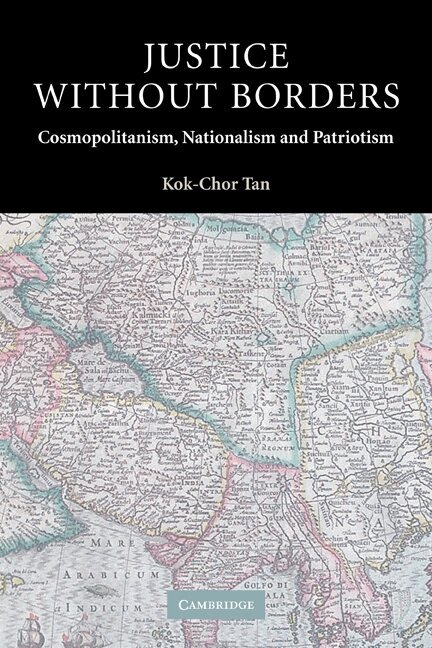
The cosmopolitan idea of justice is commonly accused of not taking seriously the special ties and commitments of nationality and patriotism. This is because the ideal of impartial egalitarianism, which is central to the cosmopolitan view, seems to be directly opposed to the moral partiality inherent to nationalism and patriotism. In this book, Kok-Chor Tan argues that cosmopolitan justice, properly understood, can accommodate and appreciate nationalist and patriotic commitments, setting limits for these commitments without denying their moral significance. This book offers a defense of cosmopolitan justice against the charge that it denies the values that ordinarily matter to people, and a defence of nationalism and patriotism against the charge that these morally partial ideals are fundamentally inconsistent with the obligations of global justice. Accessible and persuasive, this book will have broad appeal to political theorists and moral philosophers.
428 kr
Skickas inom 7-10 vardagar
Democracy has been a flawed hegemony since the fall of communism. Its flexibility, its commitment to equality of representation, and its recognition of the legitimacy of opposition politics are all positive features for political institutions. But democracy has many deficiencies: it is all too easily held hostage by powerful interests; it often fails to advance social justice; and it does not cope well with a number of features of the political landscape, such as political identities, boundary disputes, and environmental crises. Although democracy is valuable it fits uneasily with other political values and is in many respects less than equal to the demands it confronts. In this volume (and its companion Democracy's Edges) prominent political theorists and social scientists present original discussions of such central issues. Democracy's Values deals with the nature and value of democracy, particularly the tensions between it and such goods as justice, equality, efficiency, and freedom.
428 kr
Skickas inom 7-10 vardagar
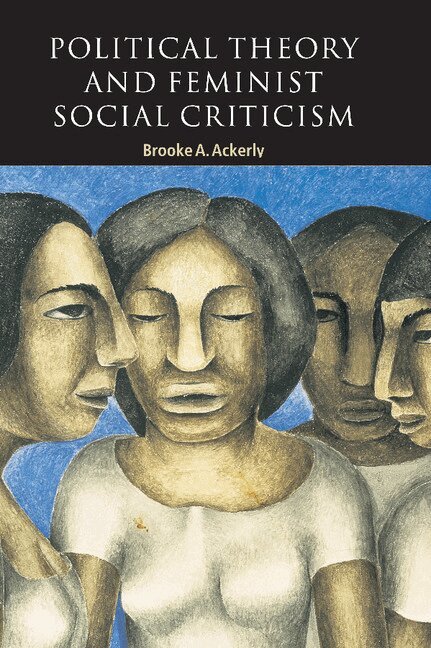
In Political Theory and Feminist Social Criticism Brooke Ackerly demonstrates the shortcomings of contemporary deliberative democratic theory, relativism and essentialism for guiding the practice of social criticism in the real, imperfect world. Drawing theoretical implications from the activism of Third World feminists who help bring to public audiences the voices of women silenced by coercion, Brooke Ackerly provides a practicable model of social criticism. She argues that feminist critics have managed to achieve in practice what other theorists do only incompletely in theory. Complemented by Third World feminist social criticism, deliberative democratic theory becomes critical theory - actionable, coherent, and self-reflective. While a complement to democratic theory, Third World feminist social criticism also addresses the problem in feminist theory associated with attempts to deal with identity politics. Third World feminist social criticism thus takes feminist theory beyond the critical impasse of the tension between anti-relativist and anti-essentialist feminist theory.
428 kr
Skickas inom 7-10 vardagar
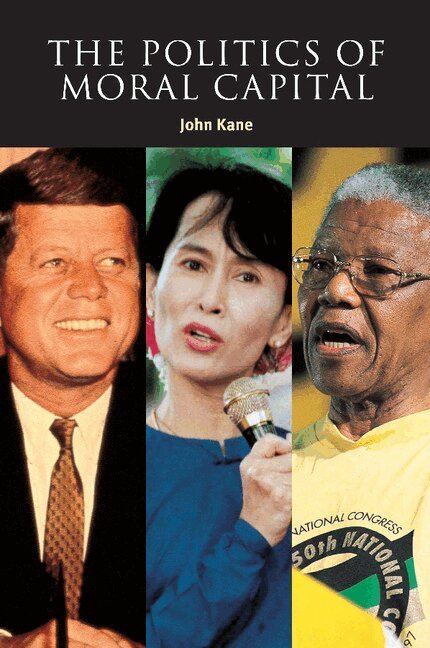
It is often said that politics is an amoral realm of power and interest in which moral judgment is irrelevant. In this book, by contrast, John Kane argues that people's positive moral judgments of political actors and institutions provide leaders with an important resource, which he christens 'moral capital'. Negative judgements cause a loss of moral capital which jeopardizes legitimacy and political survival. Studies of several historical and contemporary leaders - Lincoln, de Gaulle, Mandela, Aung San Suu Kyi - illustrate the significance of moral capital for political legitimation, mobilizing support, and the creation of strategic opportunities. In the book's final section, Kane applies his arguments to the American presidency from Kennedy to Clinton. He argues that a moral crisis has afflicted the nation at its mythical heart and has been refracted through and enacted within its central institutions, eroding the moral capital of government and people and undermining the nation's morale.
1 245 kr
Skickas inom 7-10 vardagar
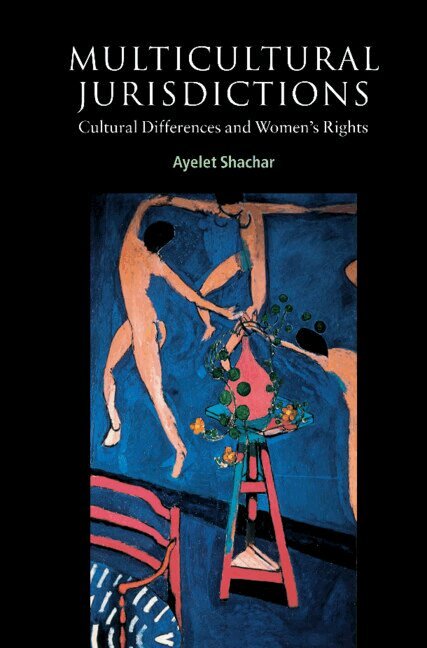
Is it possible for the state simultaneously to respect deep cultural differences and to protect the hard-won citizenship rights of vulnerable group members, particularly women? This 2001 book argues that it is not only theoretically needed, but also institutionally feasible. Rejecting prevalent normative and legal solutions to this 'paradox of multicultural vulnerability', Multicultural Jurisdictions develops a powerful argument for enhancement of the jurisdictional autonomy of religious and cultural minorities while at the same time providing viable legal-institutional solutions to the problem of sanctioned intra-group rights violation. This new 'joint governance' approach is guided by an innovative principle that strives for the reduction of injustice between minority groups and the wider society, together with the enhancement of justice within them. This book will interest students of political and social theory, law, religion, institutional design, as well as cultural and gender studies.
428 kr
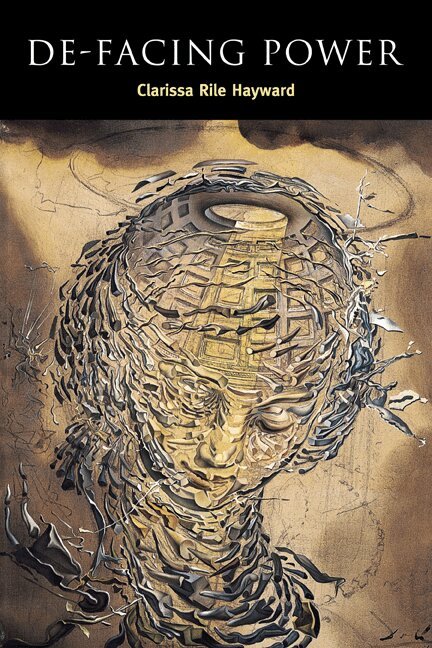
In this major contribution to the power debate, Clarissa Rile Hayward challenges the prevailing view which treats power as something powerful people have and use. Rather than seeing it as having a 'face', she considers power as a complex network of social boundaries - norms, identities, institutions - which define both the field of action and the individual's freedom within it, for the 'powerful' and 'powerless' alike. Hayward suggests that the critical analysis of power relations should focus on the ways these relationships affect people's capacities to help shape the institutions and practices which govern their lives. Using a detailed comparative analysis of the relationships within two ethnically diverse educational settings - one in a low-income, predominantly African-American, urban school, the other in an affluent, predominantly white, suburban school - this book develops a compelling account of the concept of power in terms of networks of practices and relations.
334 kr
Skickas inom 7-10 vardagar
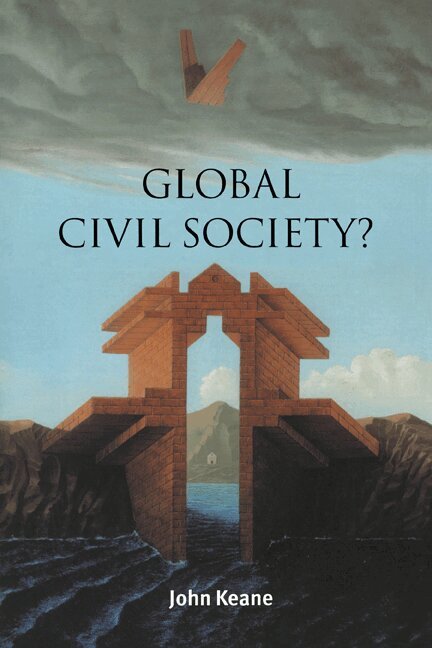
John Keane, a leading scholar of political theory, tracks the recent development of a big idea with fresh potency - global civil society. In this timely book, Keane explores the contradictory forces currently nurturing or threatening its growth, and he shows how talk of global civil society implies a political vision of a less violent world, founded on legally sanctioned power-sharing arrangements among different and intermingling forms of socio-economic life. Keane's reflections are pitted against the widespread feeling that the world is both too complex and too violent to deserve serious reflection. His account borrows from various scholarly disciplines, including political science and international relations, to challenge the silence and confusion within much of contemporary literature on globalisation and global governance. Against fears of terrorism, rising tides of xenophobia, and loose talk of 'anti-globalisation', the defence of global civil society mounted here implies the need for new democratic ways of living.
450 kr
Skickas inom 7-10 vardagar
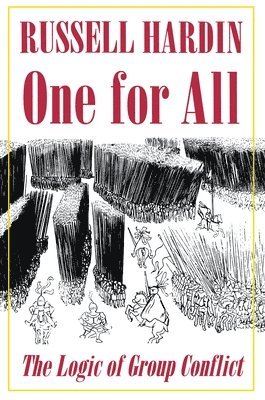
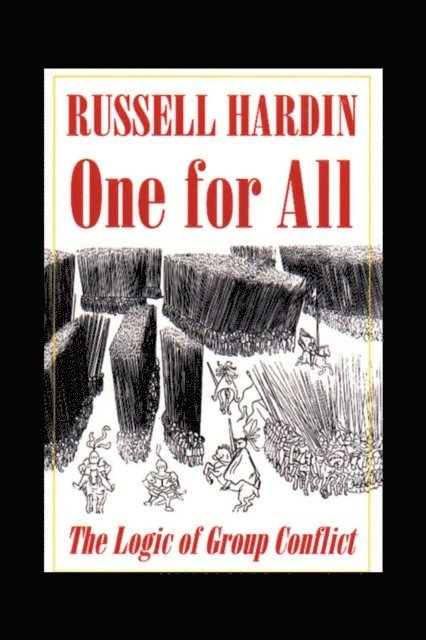
In a book that challenges the most widely held ideas of why individuals engage in collective conflict, Russell Hardin offers a timely, crucial explanation of group action in its most destructive forms. Contrary to those observers who attribute group violence to irrationality, primordial instinct, or complex psychology, Hardin uncovers a systematic exploitation of self-interest in the underpinnings of group identification and collective violence. Using examples from Mafia vendettas to ethnic violence in places such as Bosnia and Rwanda, he describes the social and economic circumstances that set this violence into motion. Hardin explains why hatred alone does not necessarily start wars but how leaders cultivate it to mobilize their people. He also reveals the thinking behind the preemptive strikes that contribute to much of the violence between groups, identifies the dangers of "particularist" communitarianism, and argues for government structures to prevent any ethnic or other group from having too much sway.Exploring conflict between groups such as Serbs and Croats, Hutu and Tutsi, Northern Irish Catholics and Protestants, Hardin vividly illustrates the danger that arises when individual and group interests merge. In these examples, groups of people have been governed by movements that managed to reflect their members' personal interests--mainly by striving for political and economic advances at the expense of other groups and by closing themselves off from society at large. The author concludes that we make a better and safer world if we design our social institutions to facilitate individual efforts to achieve personal goals than if we concentrate on the ethnic political makeup of our respective societies.
622 kr
Skickas inom 3-6 vardagar
In simple action theory, when people choose between courses of action, they know what the outcome will be. When an individual is making a choice "against nature," such as switching on a light, that assumption may hold true. But in strategic interaction outcomes, indeterminacy is pervasive and often intractable. Whether one is choosing for oneself or making a choice about a policy matter, it is usually possible only to make a guess about the outcome, one based on anticipating what other actors will do. In this book Russell Hardin asserts, in his characteristically clear and uncompromising prose, "Indeterminacy in contexts of strategic interaction ...Is an issue that is constantly swept under the rug because it is often disruptive to pristine social theory. But the theory is fake: the indeterminacy is real."In the course of the book, Hardin thus outlines the various ways in which theorists from Hobbes to Rawls have gone wrong in denying or ignoring indeterminacy, and suggests how social theories would be enhanced--and how certain problems could be resolved effectively or successfully--if they assumed from the beginning that indeterminacy was the normal state of affairs, not the exception. Representing a bold challenge to widely held theoretical assumptions and habits of thought, Indeterminacy and Society will be debated across a range of fields including politics, law, philosophy, economics, and business management.
541 kr
Skickas inom 7-10 vardagar
How do ordinary people come to know or believe what they do? We need an account of this process to help explain why people act as they do. You might think I am acting irrationally--against my interest or my purpose--until you realize that what you know and what I know differ significantly. My actions, given my knowledge, might make eminently good sense. Of course, this pushes our problem back one stage to assess why someone knows or believes what they do. That is the focus of this book. Russell Hardin supposes that people are not usually going to act knowingly against their interests or other purposes. To try to understand how they have come to their knowledge or beliefs is therefore to be charitable in assessing their rationality. Hardin insists on such a charitable stance in the effort to understand others and their sometimes objectively perverse actions. Hardin presents an essentially economic account of what an individual can come to know and then applies this account to many areas of ordinary life: political participation, religious beliefs, popular knowledge of science, liberalism, culture, extremism, moral beliefs, and institutional knowledge.All of these can be enlightened by the supposition that people are attempting reasonable actions under the severe constraints of acquiring better knowledge when they face demands that far outstretch their possibilities.
455 kr
Skickas inom 3-6 vardagar
How do ordinary people come to know or believe what they do? We need an account of this process to help explain why people act as they do. You might think I am acting irrationally--against my interest or my purpose--until you realize that what you know and what I know differ significantly. My actions, given my knowledge, might make eminently good sense. Of course, this pushes our problem back one stage to assess why someone knows or believes what they do. That is the focus of this book. Russell Hardin supposes that people are not usually going to act knowingly against their interests or other purposes. To try to understand how they have come to their knowledge or beliefs is therefore to be charitable in assessing their rationality. Hardin insists on such a charitable stance in the effort to understand others and their sometimes objectively perverse actions. Hardin presents an essentially economic account of what an individual can come to know and then applies this account to many areas of ordinary life: political participation, religious beliefs, popular knowledge of science, liberalism, culture, extremism, moral beliefs, and institutional knowledge.All of these can be enlightened by the supposition that people are attempting reasonable actions under the severe constraints of acquiring better knowledge when they face demands that far outstretch their possibilities.
867 kr
Skickas inom 5-8 vardagar
Can we trust our elected representatives or is public life so corrupted that we can no longer rely on governments to protect our interests or even our civil liberties? Is the current mood of public distrust justified or do we need to re-evaluate our understanding of trust in the global age? In this wide-ranging book, Russell Hardin sets out to dispel the myths surrounding the concept of trust in contemporary society and politics. He examines the growing literature on trust to analyze public concerns about declining levels of trust, both in our fellow citizens and in our governments and their officials.Hardin explores the various manifestations of trust and distrust in public life – from terrorism to the internet, social capital to representative democracy. He shows that while today’s politicians may well be experiencing a decline in public confidence, this is nothing new; distrust in government characterized the work of leading liberal thinkers such as David Hume and James Madison. Their views, he contends, are as relevant today as they were in the eighteenth and nineteenth centuries and we should not, therefore, be distressed at the apparent distrust of twenty-first century government. On a personal level, Hardin contends that the world in which we live is much more diverse and interconnected than that of our forebears and this will logically result in higher levels of personal trust and distrust between individuals.Written by one of the world's leading authorities on trust, this book will be a valuable resource for students of government and politics, sociology and philosophy.
259 kr
Skickas inom 5-8 vardagar
Can we trust our elected representatives or is public life so corrupted that we can no longer rely on governments to protect our interests or even our civil liberties? Is the current mood of public distrust justified or do we need to re-evaluate our understanding of trust in the global age? In this wide-ranging book, Russell Hardin sets out to dispel the myths surrounding the concept of trust in contemporary society and politics. He examines the growing literature on trust to analyze public concerns about declining levels of trust, both in our fellow citizens and in our governments and their officials.Hardin explores the various manifestations of trust and distrust in public life – from terrorism to the internet, social capital to representative democracy. He shows that while today’s politicians may well be experiencing a decline in public confidence, this is nothing new; distrust in government characterized the work of leading liberal thinkers such as David Hume and James Madison. Their views, he contends, are as relevant today as they were in the eighteenth and nineteenth centuries and we should not, therefore, be distressed at the apparent distrust of twenty-first century government. On a personal level, Hardin contends that the world in which we live is much more diverse and interconnected than that of our forebears and this will logically result in higher levels of personal trust and distrust between individuals.Written by one of the world's leading authorities on trust, this book will be a valuable resource for students of government and politics, sociology and philosophy.
547 kr
Skickas inom 10-15 vardagar
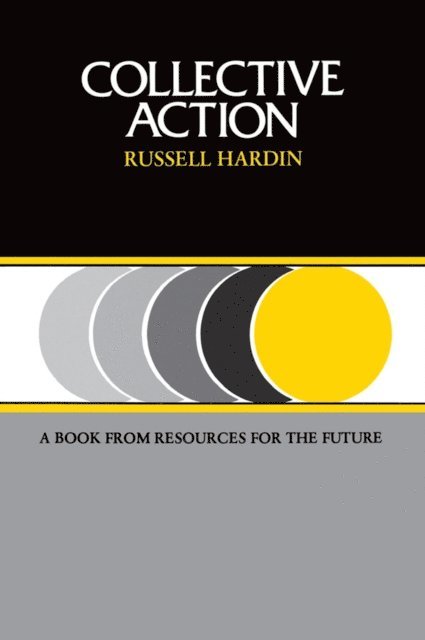
Public choice, an important subdiscipline in the field of political theory, seeks to understand how people and societies make decisions affecting their collective lives. Relying heavily on theoretical models of decision making, public choice postulates that people act in their individual interests in making collective decisions. As it happens, however, reality does not mirror theory, and people often act contrary to what the principal public choice models suggest. In this book, Russell Hardin looks beyond the models to find out why people choose to act together in situations that the models find quite hopeless. He uses three constructs of modern political economy--public goods, the Prisoner's Dilemma, and game theory--to test public choice theories against real world examples of collective action. These include movements important in American society in the past few decades--civil rights, the Vietnam War, women's rights, and environmental concerns. This classic work on public choice will be of interest to theoreticians and graduate students in the fields of public choice, political economy, or political theory--and to those in other disciplines who are concerned with the problem of collective action in social contexts.
898 kr
Skickas inom 7-10 vardagar
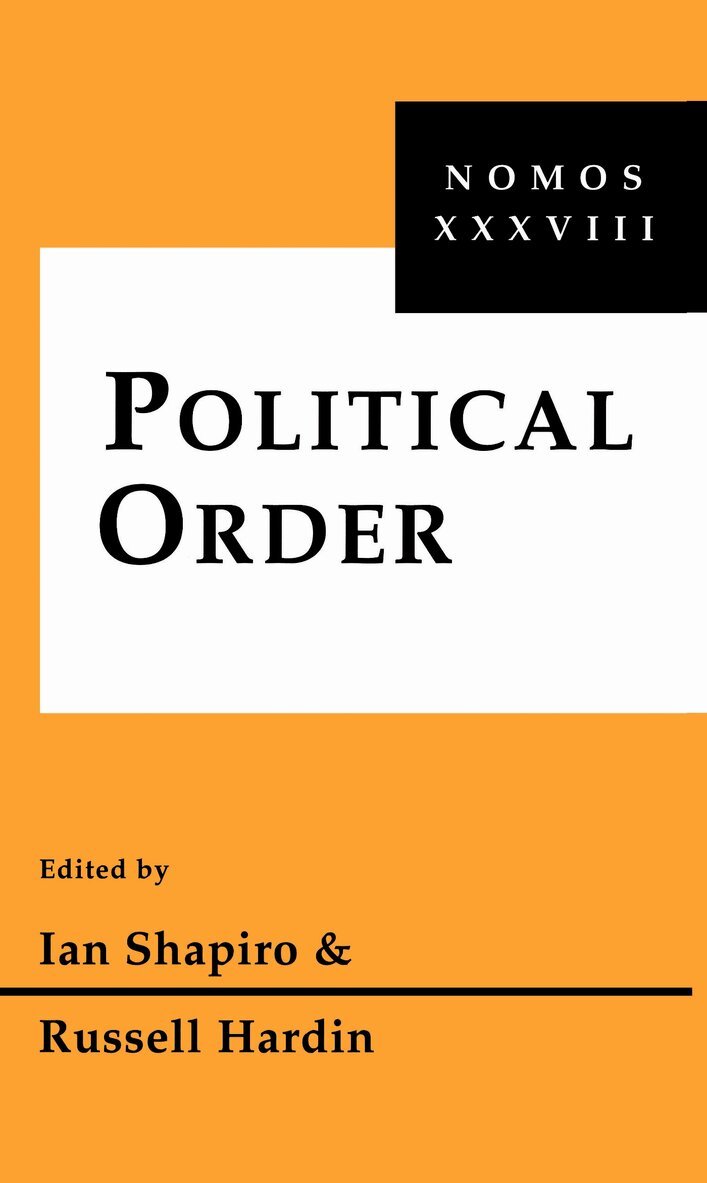
The collapse of the Soviet empire stands as a dramatic reminder that political institutions are human creations that can be designed more or less well. The question of what constitutes a viable political order is as old as it is profound, and is a central part of the works of such thinkers as Plato, Aristotle, Machiavelli, Hobbes, Locke, Montesquieu, and the American Founders.In eighteen original essays, Political Order presents the work of major scholars such as Robert Dahl, John Gray, Jennifer Nedelsky, Pasquale Pasquino, James Scott, Karen Orren, Steven Skowronek, Walter Dean Burnham, Morris Fiorina, and Norman Schofield who address some of the most pressing questions about political order. Under what conditions do we get political order rather than political chaos? How is political order sustained once it has been created? Do constitutions and electoral systems matter, and if so how much? Is there one best type of political order, and, if not, what is the range of viable possibilities and how should they be evaluated?
361 kr
Skickas inom 7-10 vardagar
The collapse of the Soviet empire stands as a dramatic reminder that political institutions are human creations that can be designed more or less well. The question of what constitutes a viable political order is as old as it is profound, and is a central part of the works of such thinkers as Plato, Aristotle, Machiavelli, Hobbes, Locke, Montesquieu, and the American Founders.In eighteen original essays, Political Order presents the work of major scholars such as Robert Dahl, John Gray, Jennifer Nedelsky, Pasquale Pasquino, James Scott, Karen Orren, Steven Skowronek, Walter Dean Burnham, Morris Fiorina, and Norman Schofield who address some of the most pressing questions about political order. Under what conditions do we get political order rather than political chaos? How is political order sustained once it has been created? Do constitutions and electoral systems matter, and if so how much? Is there one best type of political order, and, if not, what is the range of viable possibilities and how should they be evaluated?
494 kr
Tillfälligt slut
1 807 kr
Skickas inom 10-15 vardagar
Public choice, an important subdiscipline in the field of political theory, seeks to understand how people and societies make decisions affecting their collective lives. Relying heavily on theoretical models of decision making, public choice postulates that people act in their individual interests in making collective decisions. As it happens, however, reality does not mirror theory, and people often act contrary to what the principal public choice models suggest. In this book, Russell Hardin looks beyond the models to find out why people choose to act together in situations that the models find quite hopeless. He uses three constructs of modern political economy--public goods, the Prisoner's Dilemma, and game theory--to test public choice theories against real world examples of collective action. These include movements important in American society in the past few decades--civil rights, the Vietnam War, women's rights, and environmental concerns. This classic work on public choice will be of interest to theoreticians and graduate students in the fields of public choice, political economy, or political theory--and to those in other disciplines who are concerned with the problem of collective action in social contexts.