Russell J. Donnelly - Böcker
Visar alla böcker från författaren Russell J. Donnelly. Handla med fri frakt och snabb leverans.
4 produkter
4 produkter
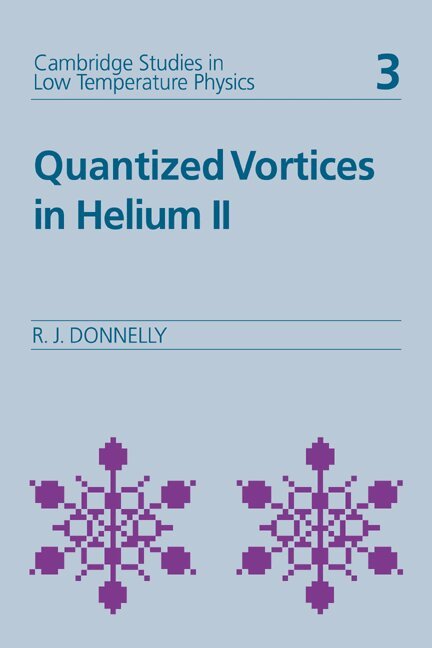
Del 3 - Cambridge Studies in Low Temperature Physics
Quantized Vortices in Helium II
Häftad, Engelska, 2005
837 kr
Skickas inom 7-10 vardagar
This book discusses the properties of quantized vortex lines in superfluid helium-4 in the light of research on vortices in modern fluid mechanics, and gives the first comprehensive treatment of the problem. The author begins with a review of the knowledge of classical fluid dynamics which is relevant to the main topics of the book. This is followed by a presentation of basic material on helium II and quantized vortices. The following chapters deal with various different aspects of the subject, and the book concludes with substantial introductions to two currently active topics, namely superfluid turbulence and the nucleation of quantized vortices. Both quantum tunnelling and thermal activation nucleation processes are also discussed, including the Kosterlitz-Thouless transition in thin films. The author's comprehensive approach will make this book invaluable for students taking advanced undergraduate or graduate courses, and for all those involved in research on classical and quantum vortices.
Del 3 - Cambridge Studies in Low Temperature Physics
Quantized Vortices in Helium II
Inbunden, Engelska, 1991
1 771 kr
Skickas inom 7-10 vardagar
This book discusses the properties of quantized vortex lines in superfluid helium-4 in the light of research on vortices in modern fluid mechanics, and gives the first comprehensive treatment of the problem. The author begins with a review of the knowledge of classical fluid dynamics which is relevant to the main topics of the book. This is followed by a presentation of basic material on helium II and quantized vortices. The following chapters deal with various different aspects of the subject, and the book concludes with substantial introductions to two currently active topics, namely superfluid turbulence and the nucleation of quantized vortices. Both quantum tunnelling and thermal activation nucleation processes are also discussed, including the Kosterlitz-Thouless transition in thin films. The author's comprehensive approach will make this book invaluable for students taking advanced undergraduate or graduate courses, and for all those involved in research on classical and quantum vortices.
1 062 kr
Skickas inom 10-15 vardagar
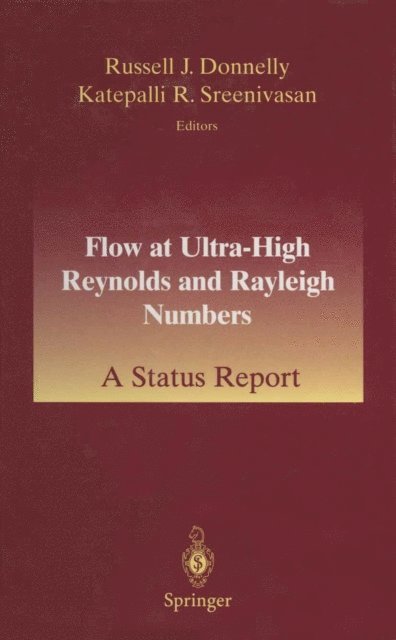
Because of their extremely low viscosity, liquid helium and ultra-cold helium gas provide ideal media for fundamental studies of fluid flow and turbulence at extremely high Reynolds numbers. Such flows occur in aerospace applications (satellite reentry) and other extreme conditions, where they are difficult to study. A cryogenic-helium wind tunnel would allow one to model these flows in a laboratory at much more benign conditions. Such studies have not been feasible because, using these fluids in a wind tunnel requires more liquid helium than has readily been available. However, the capacity of the refrigerators installed at several physics laboratories that supply liquid helium for particle accelerators (such as the one intended for the SSC in Texas or the one at Brookhaven National Laboratory) is so great that some of the liquid helium or the ultra-cold helium gas may also be used for fluid dynamics studies. The chapters in this book survey the challenges and prospects for research on fluid flows at high Reynolds and Rayleigh numbers using cryogenic helium. They cover a wide range of topics: from refrigeration and instrumentation to theories of superfluid turbulence. The chapters are largely based on contributions to a workshop held at Brookhaven, but these have all been brought up to the state of the art in late 1997; in addition, several chapters contain entirely new material. This book will be of interest to physicist interested in fluid dynamics, mechanical engineers interested in turbulent flows and transport, and naval and aerospace engineers.
1 062 kr
Skickas inom 10-15 vardagar
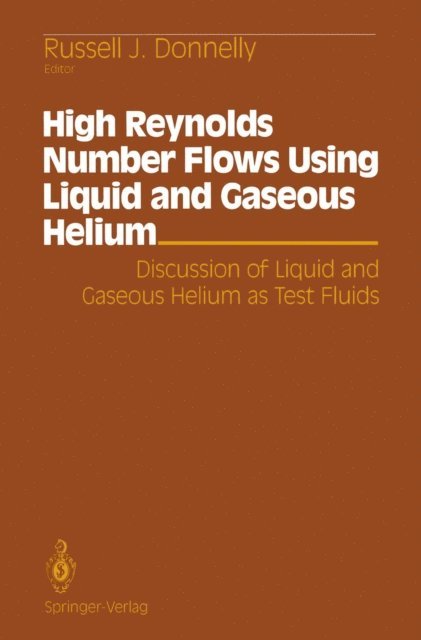
Liquid helium has been studied for its intrinsic interest through much of the 20th century. In the past decade, much has been learned about heat transfer in liquid helium because of the need to cool superconducting magnets and other devices. The topic of the Seventh Oregon Conference on Low Temperature Physics was an applied one, namely the use of liquid and gaseous helium to generate high Reynolds number flows. The low kinematic viscosity of liquid helium automatically makes high Reynolds numbers accessible and the question addressed in this conference was to explore various possibilities to see what practical devices might be built using liquid or gaseous helium. There are a number of possibilities: construction of a wind tunnel using critical helium gas, free surface testing, low speed flow facilities using helium I and helium ll. At the time of the conference, most consideration had been given to the last possibility because it seemed both possible and useful to build a flow facility which could reach unprecedented Reynolds numbers. Such a device could be useful in pure research for studying turbulence, and in applied research for testing models much as is done in a water tunnel. In order to examine these possibilities in detail, we invited a wide range of experts to Eugene in October 1989 to present papers on their own specialties and to listen to presentations on the liquid helium proposals.