Ruth Berins Collier - Böcker
Visar alla böcker från författaren Ruth Berins Collier. Handla med fri frakt och snabb leverans.
7 produkter
7 produkter
567 kr
Skickas inom 10-15 vardagar
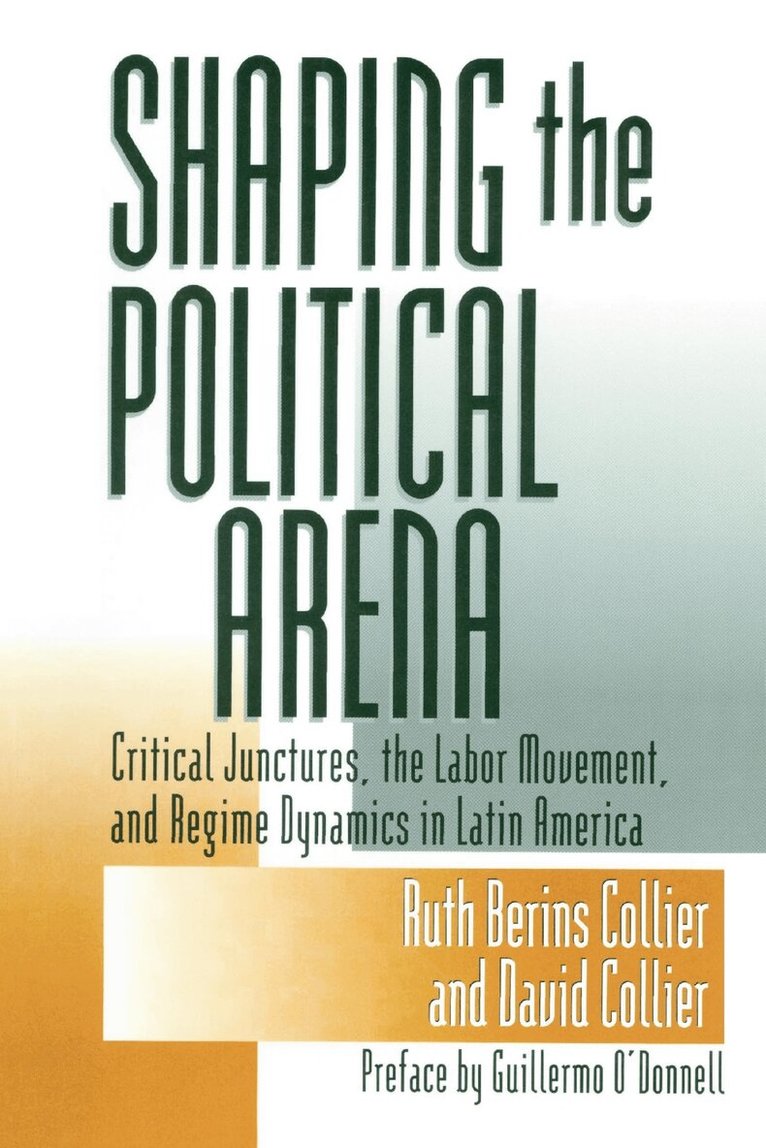
Ruth Berins Collier and David Collier are political scientists who use comparative historical research to discover and evaluate patterns and sources of political change. Their work is an overall analysis of Chile, Brazil, Uruguay, Colombia, Argentina, Peru, Venezuela, and Mexico, plus case studies of four distinct pairs in that group: Chile/Brazil, Uruguay/Colombia, Argentina/Peru, and Venezuela/Mexico. In addition, the Colliers meticulously describe and discuss their methods for the study including the limitations of their approach. The authors specifically focus on why and how organized labor movements in the first half of the twentieth century were incorporated into the political process in the eight Latin American countries they study. They analyze the role played by political parties, central government control, worker mobilization, and conflict between radical vs. centrist political philosophies and activities.
Reorganizing Popular Politics
Participation and the New Interest Regime in Latin America
Inbunden, Engelska, 2010
834 kr
Skickas inom 7-10 vardagar
A historic shift has occurred in the organizational structures through which the lower classes in Latin America express voice and find political representation. With the political and economic reforms of the 1980s and 1990s, networks of community-based associations and nongovernmental organizations replaced party-affiliated labor unions as the predominant organizations to which the lower classes turned. This volume examines the new “interest regime” in Argentina, Chile, Peru, and Venezuela through two extensive surveys—one of individuals and one of associations—undertaken in those nations’ capital cities. Contrary to common perceptions, the new interest regime is neither a vibrant, autonomous civil society nor a set of weak, atomized organizations. Participation in associations is generally high, compared to “direct action” as a strategy for pursuing collective interests, and associations more frequently coordinate and engage the state than has sometimes been assumed. However, various forms of interaction with the state pose a classic trade-off between representation and state control, and the new interest regime is marked by representational distortion, in that the lower classes are less likely to use the new structures than the middle classes. Within these general patterns, distinct national models are emerging. This volume represents the most ambitious and systematic effort to date to examine individual participation and associational life in Latin America and to carry out a cross-national analysis of new forms of political representation.
Reorganizing Popular Politics
Participation and the New Interest Regime in Latin America
Häftad, Engelska, 2009
502 kr
Skickas inom 5-8 vardagar
A historic shift has occurred in the organizational structures through which the lower classes in Latin America express voice and find political representation. With the political and economic reforms of the 1980s and 1990s, networks of community-based associations and nongovernmental organizations replaced party-affiliated labor unions as the predominant organizations to which the lower classes turned. This volume examines the new “interest regime” in Argentina, Chile, Peru, and Venezuela through two extensive surveys—one of individuals and one of associations—undertaken in those nations’ capital cities. Contrary to common perceptions, the new interest regime is neither a vibrant, autonomous civil society nor a set of weak, atomized organizations. Participation in associations is generally high, compared to “direct action” as a strategy for pursuing collective interests, and associations more frequently coordinate and engage the state than has sometimes been assumed. However, various forms of interaction with the state pose a classic trade-off between representation and state control, and the new interest regime is marked by representational distortion, in that the lower classes are less likely to use the new structures than the middle classes. Within these general patterns, distinct national models are emerging. This volume represents the most ambitious and systematic effort to date to examine individual participation and associational life in Latin America and to carry out a cross-national analysis of new forms of political representation.
665 kr
Skickas inom 3-6 vardagar
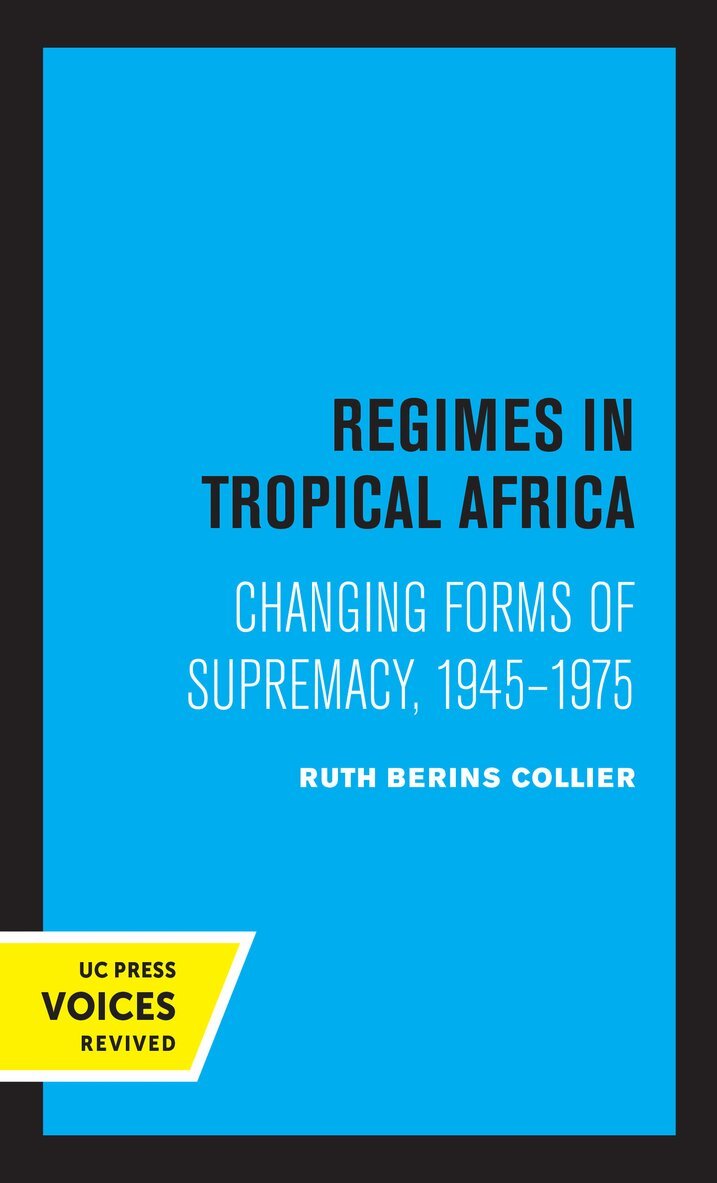
Regimes in Tropical Africa: Changing Forms of Supremacy, 1945–1975 offers a comparative study of political transformation across twenty-six African countries in the critical decades from decolonization through the mid-1970s. Beginning with the postwar introduction of mass suffrage, competitive parties, and parliamentary institutions, the book shows how colonial rulers attempted to graft European democratic structures onto African societies. These institutions created opportunities for emerging elites to mobilize popular support but also generated risks of elite fragmentation and destabilizing demands. With independence, the mismatch between electoral democracy and the imperatives of elite consolidation led quickly to the dismantling of competitive institutions and the construction of new authoritarian orders.Through careful analysis of colonial legacies, electoral systems, and the cohesion of nationalist elites, the study explains why some countries gravitated toward relatively unified one-party regimes while others fractured into unstable coalitions or succumbed to military rule. Elections, far from being abandoned altogether, often reappeared in controlled forms, serving to legitimate authority, manage pluralism, and reinforce supremacy. By situating African trajectories within broader debates on state, regime, and class formation, the book highlights how authoritarianism became a mechanism of elite consolidation in postcolonial contexts. The enduring takeaway is that regime change in Africa cannot be understood solely as the collapse of transplanted democratic institutions, but rather as the contested process by which new political classes fashioned durable, if limited, structures of rule.This title is part of UC Press's Voices Revived program, which commemorates University of California Press’s mission to seek out and cultivate the brightest minds and give them voice, reach, and impact. Drawing on a backlist dating to 1893, Voices Revived makes high-quality, peer-reviewed scholarship accessible once again using print-on-demand technology. This title was originally published in 1982.
1 469 kr
Skickas inom 3-6 vardagar
Regimes in Tropical Africa: Changing Forms of Supremacy, 1945–1975 offers a comparative study of political transformation across twenty-six African countries in the critical decades from decolonization through the mid-1970s. Beginning with the postwar introduction of mass suffrage, competitive parties, and parliamentary institutions, the book shows how colonial rulers attempted to graft European democratic structures onto African societies. These institutions created opportunities for emerging elites to mobilize popular support but also generated risks of elite fragmentation and destabilizing demands. With independence, the mismatch between electoral democracy and the imperatives of elite consolidation led quickly to the dismantling of competitive institutions and the construction of new authoritarian orders.Through careful analysis of colonial legacies, electoral systems, and the cohesion of nationalist elites, the study explains why some countries gravitated toward relatively unified one-party regimes while others fractured into unstable coalitions or succumbed to military rule. Elections, far from being abandoned altogether, often reappeared in controlled forms, serving to legitimate authority, manage pluralism, and reinforce supremacy. By situating African trajectories within broader debates on state, regime, and class formation, the book highlights how authoritarianism became a mechanism of elite consolidation in postcolonial contexts. The enduring takeaway is that regime change in Africa cannot be understood solely as the collapse of transplanted democratic institutions, but rather as the contested process by which new political classes fashioned durable, if limited, structures of rule.This title is part of UC Press's Voices Revived program, which commemorates University of California Press’s mission to seek out and cultivate the brightest minds and give them voice, reach, and impact. Drawing on a backlist dating to 1893, Voices Revived makes high-quality, peer-reviewed scholarship accessible once again using print-on-demand technology. This title was originally published in 1982.
Paths toward Democracy
The Working Class and Elites in Western Europe and South America
Inbunden, Engelska, 1999
1 034 kr
Skickas inom 7-10 vardagar
The question of whether democratization is an elite-led process from above or a popular triumph from below continues to be an area of contention among political scientists. Examining the experiences of countries which have provided the main empirical base for recent theorizing, namely, Western Europe and South America in the 19th and early 20th centuries and again in the 1970s and 1980s, this book delineates a more complex and varied set of patterns. The volume explores the politics of democratization through a comparative analysis that examines the role of labor in relation to elite strategies in both contemporary and historical perspectives. In her detailed analysis, Professor Collier also describes multiple patterns within each historical period, challenges conventional understandings of these events, and recaptures a role for unions and labor-based parties in contemporary processes of democratization.
Paths toward Democracy
The Working Class and Elites in Western Europe and South America
Häftad, Engelska, 1999
334 kr
Skickas inom 7-10 vardagar
The question of whether democratization is an elite-led process from above or a popular triumph from below continues to be an area of contention among political scientists. Examining the experiences of countries which have provided the main empirical base for recent theorizing, namely, Western Europe and South America in the 19th and early 20th centuries and again in the 1970s and 1980s, this book delineates a more complex and varied set of patterns. The volume explores the politics of democratization through a comparative analysis that examines the role of labor in relation to elite strategies in both contemporary and historical perspectives. In her detailed analysis, Professor Collier also describes multiple patterns within each historical period, challenges conventional understandings of these events, and recaptures a role for unions and labor-based parties in contemporary processes of democratization.