Sabrina Karim - Böcker
Visar alla böcker från författaren Sabrina Karim. Handla med fri frakt och snabb leverans.
4 produkter
4 produkter
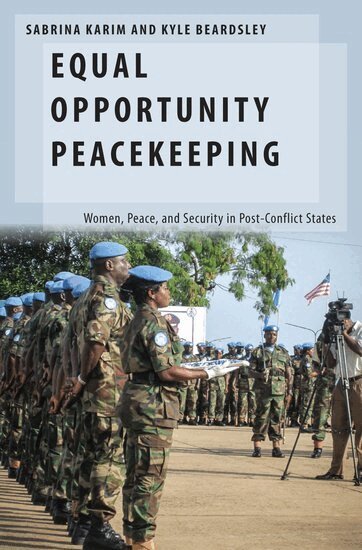
Equal Opportunity Peacekeeping
Women, Peace, and Security in Post-Conflict States
Häftad, Engelska, 2019
363 kr
Skickas inom 5-8 vardagar
Recent developments such as Sweden's Feminist Foreign Policy, the "Hillary Doctrine," and the integration of women into combat roles in the U.S. have propelled gender equality to the forefront of international politics. The UN Department of Peacekeeping Operations, however, has been integrating gender equality into peacekeeping missions for nearly two decades as part of the women, peace, and security agenda that has been most clearly articulated in UNSC Resolution 1325. To what extent have peacekeeping operations achieved gender equality in peacekeeping operations and been vehicles for promoting gender equality in post-conflict states?While there have been major improvements related to women's participation and protection, there is still much left to be desired. Sabrina Karim and Kyle Beardsley argue that gender power imbalances between the sexes and among genders place restrictions on the participation of women in peacekeeping missions. Specifically, discrimination, a relegation of women to safe spaces, and sexual exploitation, abuse, harassment, and violence (SEAHV) continue to threaten progress on gender equality. Using unique cross-national data on sex-disaggregated participation of peacekeepers and on the allegations of SEAHV, as well as original data from the UN Mission in Liberia, the authors examine the origins and consequences of these challenges. Karim and Beardsley also identify and examine how increasing the representation of women in peacekeeping forces, and even more importantly through enhancing a more holistic value for "equal opportunity," can enable peacekeeping operations to overcome the challenges posed by power imbalances and be more of an example of and vehicle for gender equality globally.
Equal Opportunity Peacekeeping
Women, Peace, and Security in Post-Conflict States
Inbunden, Engelska, 2017
1 217 kr
Skickas inom 5-8 vardagar
Recent developments such as Sweden's' Feminist Foreign Policy, the "Hillary Doctrine," and the integration of women into combat roles in the U.S. have propelled gender equality to the forefront of international politics. The UN Department of Peacekeeping Operations, however, has been integrating gender equality into peacekeeping missions for nearly two decades as part of the women, peace and security agenda that has been most clearly articulated in UNSC Resolution 1325. To what extent have peacekeeping operations achieved gender equality in peacekeeping operations and been vehicles for promoting gender equality in post-conflict states?While there have been major improvements related to women's participation and protection, there is still much left to be desired. Sabrina Karim and Kyle Beardsley argue that gender power imbalances between the sexes and among genders place restrictions on the participation of women in peacekeeping missions. Specifically, discrimination, a relegation of women to safe spaces, and sexual exploitation, abuse, harassment, and violence (SEAHV) continue to threaten progress on gender equality. Using unique cross-national data on sex-disaggregated participation of peacekeepers and on the allegations of SEAHV, as well as original data from the UN Mission in Liberia, the authors examine the origins and consequences of these challenges. Karim and Beardsley also identify and examine how increasing the representation of women in peacekeeping forces, and even more importantly through enhancing a more holistic value for "equal opportunity," can enable peacekeeping operations to overcome the challenges posed by power imbalances and be more of an example of and vehicle for gender equality globally.
Positioning Women in Conflict Studies
How Women's Status Affects Political Violence
Inbunden, Engelska, 2024
969 kr
Skickas inom 7-10 vardagar
For decades, scholars have asserted that gender matters when it comes to domestic and international politics and that gender equality means more than the rights and inclusion of women in the political sphere. Yet the existing research on gender equality and violent political conflict tends to equate and conflate gender equality with observable indicators related to women's inclusion in formal politics. Consequently, this conceptual problem has impeded efforts to theorize and empirically examine the connection between gender equality, women's status, and political violence.In Positioning Women in Conflict Studies, Sabrina Karim and Daniel W. Hill, Jr., develop an original framework to study the condition of women in peace and conflict that avoids conflating gender equality with other terms. Karim and Hill re-evaluate the literature on gender, international politics, and conflict to reveal that the term "gender equality" is often used to refer to four distinct concepts: women's inclusion, women's rights, harm to women, and beliefs about women's roles. They develop original measures for each of these concepts and examine their impact on inter-state war onset, intra-state conflict onset, state repression/human rights violations, and terrorism. The results suggest that the relationships between women's status and political violence are not uniform and vary across different aspects of women's status as well as different types of political violence. Overall, Positioning Women in Conflict Studies demonstrates how the conceptualization and measurement of gender equality and women's status is critical in understanding how to reduce political violence globally.
Positioning Women in Conflict Studies
How Women's Status Affects Political Violence
Häftad, Engelska, 2024
268 kr
Skickas inom 5-8 vardagar
For decades, scholars have asserted that gender matters when it comes to domestic and international politics and that gender equality means more than the rights and inclusion of women in the political sphere. Yet the existing research on gender equality and violent political conflict tends to equate and conflate gender equality with observable indicators related to women's inclusion in formal politics. Consequently, this conceptual problem has impeded efforts to theorize and empirically examine the connection between gender equality, women's status, and political violence.In Positioning Women in Conflict Studies, Sabrina Karim and Daniel W. Hill, Jr., develop an original framework to study the condition of women in peace and conflict that avoids conflating gender equality with other terms. Karim and Hill re-evaluate the literature on gender, international politics, and conflict to reveal that the term "gender equality" is often used to refer to four distinct concepts: women's inclusion, women's rights, harm to women, and beliefs about women's roles. They develop original measures for each of these concepts and examine their impact on inter-state war onset, intra-state conflict onset, state repression/human rights violations, and terrorism. The results suggest that the relationships between women's status and political violence are not uniform and vary across different aspects of women's status as well as different types of political violence. Overall, Positioning Women in Conflict Studies demonstrates how the conceptualization and measurement of gender equality and women's status is critical in understanding how to reduce political violence globally.