• Fri frakt över 249 kr
  • •
  • Snabba leveranser
  • •
  • Billiga böcker
Kundservice

Du är på sajten för privatpersoner.

Företag, bibliotek eller offentlig verksamhet?

Du handlar på classic.bokus.com, där alla dina funktioner finns intakta.
Till classic.bokus.com
Bokus logotyp. Gå till startsidan.
  • Erbjudanden
  • Nyheter
  • Student
  • Topplistor
  • Barn & ungdom
  • Bokus Play
  • E-böcker
  • Pocketböcker
  • Spel & pussel

10% rabatt på allt med kod: NYSTART10 →

Sidfot

Mina sidor

    Hjälp

    • Kundservice
    • Vanliga frågor och svar
    • Frakt och leverans
    • Retur vid ångerrätt
    • Reklamera vara
    • Betalning
    • Köpvillkor
    • Allmänna villkor
    • Information om webbplatsens tillgänglighet

    Om Bokus

    • Om oss
    • Pressrum
    • För studenter
    • För företag
    • För bibliotek och offentlig verksamhet
    • För leverantörer
    • Hållbarhet

    Populärt

    • Aktuella erbjudanden
    • Presentkort
    • Studentlitteratur
    • Nya böcker
    • Topplistor
    • Signerade böcker
    • Engelska böcker

    Inspiration

    • Boktips
    • BookTok
    • Populära bokserier
    • Barnbokskaraktärer
    • Populära författare
    Logotyp för Bokus
    Följ oss på Facebook (extern länk)Följ oss på Instagram (extern länk)Följ oss på YouTube (extern länk)Följ oss på TikTok (extern länk)
    bokus @ CookiesAnpassa cookiesIntegritetspolicyKöpvillkor
    Till Citymail hemsida (extern länk)Till Budbee hemsida (extern länk)Till Postnord hemsida (extern länk)Till Schenker hemsida (extern länk)Till Early Bird hemsida (extern länk)Till Walleys hemsida (extern länk)
    1. Samhälle och politik
    2. Samhälle och kultur
    3. Sociala grupper och identitet
    4. Genusvetenskap

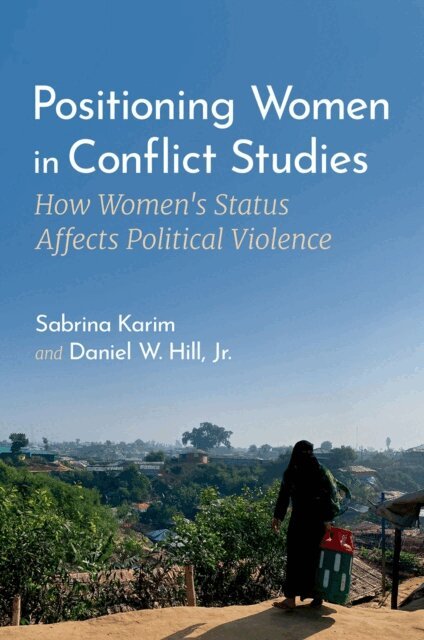
    Positioning Women in Conflict Studies

    How Women's Status Affects Political Violence

    AvSabrina Karim,Daniel W. Hill, Jr.

    Häftad, Engelska, 2024

    273 kr

    Beställningsvara. Skickas inom 5-8 vardagar. Fri frakt över 249 kr.

    Fler format och utgåvor

    Inbunden

    1 043 kr

    Beskrivning

    For decades, scholars have asserted that gender matters when it comes to domestic and international politics and that gender equality means more than the rights and inclusion of women in the political sphere. Yet the existing research on gender equality and violent political conflict tends to equate and conflate gender equality with observable indicators related to women's inclusion in formal politics. Consequently, this conceptual problem has impeded efforts to theorize and empirically examine the connection between gender equality, women's status, and political violence.In Positioning Women in Conflict Studies, Sabrina Karim and Daniel W. Hill, Jr., develop an original framework to study the condition of women in peace and conflict that avoids conflating gender equality with other terms. Karim and Hill re-evaluate the literature on gender, international politics, and conflict to reveal that the term "gender equality" is often used to refer to four distinct concepts: women's inclusion, women's rights, harm to women, and beliefs about women's roles. They develop original measures for each of these concepts and examine their impact on inter-state war onset, intra-state conflict onset, state repression/human rights violations, and terrorism. The results suggest that the relationships between women's status and political violence are not uniform and vary across different aspects of women's status as well as different types of political violence. Overall, Positioning Women in Conflict Studies demonstrates how the conceptualization and measurement of gender equality and women's status is critical in understanding how to reduce political violence globally.
    Produktinformation

    • Utgivningsdatum:2024-12-19
    • Mått:150 x 226 x 22 mm
    • Vikt:454 g
    • Format:Häftad
    • Språk:Engelska
    • Antal sidor:328
    • Förlag:OUP USA
    • ISBN:9780197757949

    Utforska kategorier

    • Genusvetenskap inom Samhälle och politik
    • Krig och försvar inom Samhälle och politik
    • Internationella relationer inom Samhälle och politik

    Mer om författaren

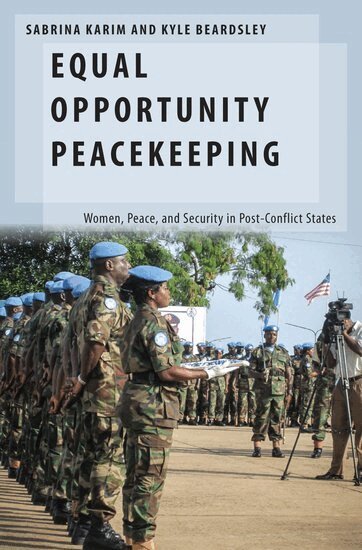
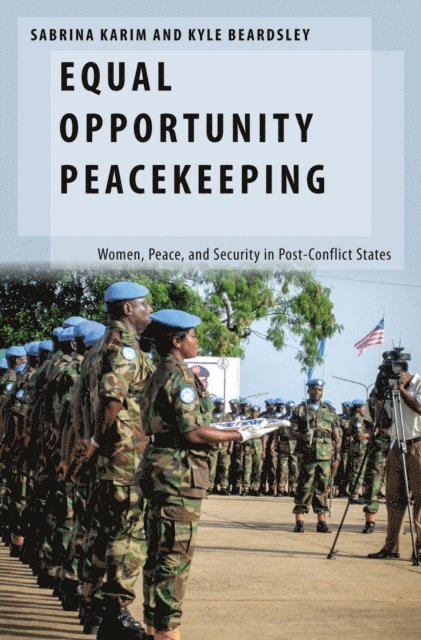
    Sabrina Karim is the Hardis Family Assistant Professor in Government at Cornell University. She directs the Gender and Security Sector Lab funded by Global Affairs Canada and is a recipient of a National Science Foundation Faculty Early CAREER Development Award. Her research focuses on international involvement in security assistance to post-conflict states, gender reforms in peacekeeping and domestic security sectors, and the relationship between gender and violence. She is the co-author of Equal Opportunity Peacekeeping: Women, Peace, and Security in Post-Conflict States. Daniel W. Hill, Jr., is an Associate Professor of International Affairs at the University of Georgia. His research focuses on violent political conflict, human rights, and international organizations and law. He has published on a variety of topics, including international human rights law and NGOs, state repression, police violence, terrorism, and quantitative methodology.

    Recensioner i media

    Karim and Hill's book presents a provocative argument about conceptualizing and measuring women's status in political violence research. By providing cogent critiques coupled with practical solutions, their arguments have important implications for both scholars and policymakers. The result is an analysis that offers conceptual and definitional clarity, rigorous empirical tests, and new directions for future research on a critical topic.

    Innehållsförteckning

    • Introduction Part I: From "Gender (In)equality" to the Status of Women Chapter 1: From "Gender (In)equality" to the Status of Women Solving the Concept Stretching Problem Chapter 2: From "Gender (In)equality" to the Status of Women Solving the Measurement Invalidity Problem Part II: The Status of Women and Political Violence Chapter 3: Women's Inclusion and Political Violence Chapter 4: Women's Rights and Political Violence Chapter 5: Harm to Women and Political Violence Chapter 6: Beliefs about Women's Gender Roles and Political Violence Conclusion Notes References Index