Kyle Beardsley - Böcker
Visar alla böcker från författaren Kyle Beardsley. Handla med fri frakt och snabb leverans.
11 produkter
11 produkter
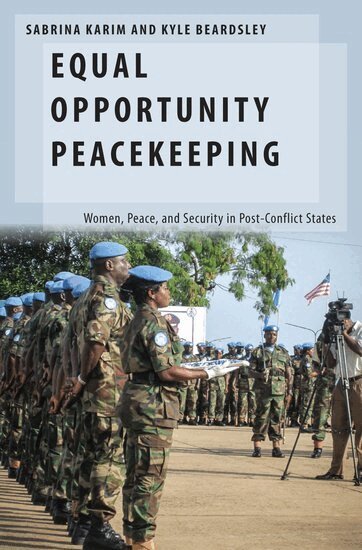
Equal Opportunity Peacekeeping
Women, Peace, and Security in Post-Conflict States
Häftad, Engelska, 2019
363 kr
Skickas inom 5-8 vardagar
Recent developments such as Sweden's Feminist Foreign Policy, the "Hillary Doctrine," and the integration of women into combat roles in the U.S. have propelled gender equality to the forefront of international politics. The UN Department of Peacekeeping Operations, however, has been integrating gender equality into peacekeeping missions for nearly two decades as part of the women, peace, and security agenda that has been most clearly articulated in UNSC Resolution 1325. To what extent have peacekeeping operations achieved gender equality in peacekeeping operations and been vehicles for promoting gender equality in post-conflict states?While there have been major improvements related to women's participation and protection, there is still much left to be desired. Sabrina Karim and Kyle Beardsley argue that gender power imbalances between the sexes and among genders place restrictions on the participation of women in peacekeeping missions. Specifically, discrimination, a relegation of women to safe spaces, and sexual exploitation, abuse, harassment, and violence (SEAHV) continue to threaten progress on gender equality. Using unique cross-national data on sex-disaggregated participation of peacekeepers and on the allegations of SEAHV, as well as original data from the UN Mission in Liberia, the authors examine the origins and consequences of these challenges. Karim and Beardsley also identify and examine how increasing the representation of women in peacekeeping forces, and even more importantly through enhancing a more holistic value for "equal opportunity," can enable peacekeeping operations to overcome the challenges posed by power imbalances and be more of an example of and vehicle for gender equality globally.
Equal Opportunity Peacekeeping
Women, Peace, and Security in Post-Conflict States
Inbunden, Engelska, 2017
1 217 kr
Skickas inom 5-8 vardagar
Recent developments such as Sweden's' Feminist Foreign Policy, the "Hillary Doctrine," and the integration of women into combat roles in the U.S. have propelled gender equality to the forefront of international politics. The UN Department of Peacekeeping Operations, however, has been integrating gender equality into peacekeeping missions for nearly two decades as part of the women, peace and security agenda that has been most clearly articulated in UNSC Resolution 1325. To what extent have peacekeeping operations achieved gender equality in peacekeeping operations and been vehicles for promoting gender equality in post-conflict states?While there have been major improvements related to women's participation and protection, there is still much left to be desired. Sabrina Karim and Kyle Beardsley argue that gender power imbalances between the sexes and among genders place restrictions on the participation of women in peacekeeping missions. Specifically, discrimination, a relegation of women to safe spaces, and sexual exploitation, abuse, harassment, and violence (SEAHV) continue to threaten progress on gender equality. Using unique cross-national data on sex-disaggregated participation of peacekeepers and on the allegations of SEAHV, as well as original data from the UN Mission in Liberia, the authors examine the origins and consequences of these challenges. Karim and Beardsley also identify and examine how increasing the representation of women in peacekeeping forces, and even more importantly through enhancing a more holistic value for "equal opportunity," can enable peacekeeping operations to overcome the challenges posed by power imbalances and be more of an example of and vehicle for gender equality globally.
884 kr
Kommande
Perhaps more than ever, we need to invest in the study of the causes and consequences of crises. Since its founding in 1975, the International Crisis Behavior (ICB) Project has aimed to better equip academics, policymakers, and the next generation of engaged citizens to make sense of why crises arise and how they can be more effectively managed and prevented. The ICB Project’s data holdings consist of full-length qualitative case studies, along with an expanding range of quantitative datasets that include information regarding the characteristics of the states in crisis, crisis behavior, attempts at third-party crisis management, the role of nonstate actors, and the system-level context.A Century of International Crisis Behavior summarizes the evolving patterns of international crisis behavior in the more than 500 cases cataloged since 1918, provides an accounting of the state of the scholarship to make sense of the patterns, and presents new findings that advance our understanding. Chapters are grouped according to their level of analysis: studies of systems, dyads, and states. The authors highlight what we have learned and what we have yet to learn regarding the prevention, escalation, and de-escalation of international crises.
2 493 kr
Kommande
Perhaps more than ever, we need to invest in the study of the causes and consequences of crises. Since its founding in 1975, the International Crisis Behavior (ICB) Project has aimed to better equip academics, policymakers, and the next generation of engaged citizens to make sense of why crises arise and how they can be more effectively managed and prevented. The ICB Project’s data holdings consist of full-length qualitative case studies, along with an expanding range of quantitative datasets that include information regarding the characteristics of the states in crisis, crisis behavior, attempts at third-party crisis management, the role of nonstate actors, and the system-level context.A Century of International Crisis Behavior summarizes the evolving patterns of international crisis behavior in the more than 500 cases cataloged since 1918, provides an accounting of the state of the scholarship to make sense of the patterns, and presents new findings that advance our understanding. Chapters are grouped according to their level of analysis: studies of systems, dyads, and states. The authors highlight what we have learned and what we have yet to learn regarding the prevention, escalation, and de-escalation of international crises.
585 kr
Skickas inom 10-15 vardagar
Mediation has become a common technique for terminating violent conflicts both within and between states; while mediation has a strong record in reducing hostilities, it is not without its own problems. In The Mediation Dilemma, Kyle Beardsley highlights its long-term limitations. The result of this oft-superficial approach to peacemaking, immediate and reassuring as it may be, is often a fragile peace. With the intervention of a third-party mediator, warring parties may formally agree to concessions that are insupportable in the long term and soon enough find themselves at odds again. Beardsley examines his argument empirically using two data sets and traces it through several historical cases: Henry Kissinger's and Jimmy Carter's initiatives in the Middle East, 1973–1979; Theodore Roosevelt's 1905 mediation in the Russo-Japanese War; and Carter's attempt to mediate in the 1994 North Korean nuclear crisis. He also draws upon the lessons of the 1993 Arusha Accords, the 1993 Oslo Accords, Haiti in 1994, the 2002 Ceasefire Agreement in Sri Lanka, and the 2005 Memorandum of Understanding in Aceh. Beardsley concludes that a reliance on mediation risks a greater chance of conflict relapse in the future, whereas the rejection of mediation risks ongoing bloodshed as war continues. The trade-off between mediation's short-term and long-term effects is stark when the third-party mediator adopts heavy-handed forms of leverage, and, Beardsley finds, multiple mediators and intergovernmental organizations also do relatively poorly in securing long-term peace. He finds that mediation has the greatest opportunity to foster both short-term and long-term peace when a single third party mediates among belligerents that can afford to wait for a self-enforcing arrangement to be reached.
331 kr
Kommande
Who your friends are shapes who your enemies are and vice versa. Starting with this premise, Mixed Blessings takes up two related research questions: how does a state's relational web of security assistance (amity) influence its relationships of threat (enmity), and how does a state's relational web of enmity influence its relationships of amity? Drawing on theories of alliance politics and deterrence theory, Kyle Beardsley uncovers the causes and consequences of security assistance through quantitative examination of the networked and relational nature of international politics. Qualitative assessments of the end of the Cold War-with particular attention to the proxy wars in Central America and Southern Africa-and recent developments in the Indo-Pacific further illustrate the mechanisms in play while also seeding the ground for ongoing inquiry. The lessons learned from the analyses directly bear on questions of American statecraft and the collapsing liberal international order.
928 kr
Kommande
Who your friends are shapes who your enemies are and vice versa. Starting with this premise, Mixed Blessings takes up two related research questions: how does a state's relational web of security assistance (amity) influence its relationships of threat (enmity), and how does a state's relational web of enmity influence its relationships of amity? Drawing on theories of alliance politics and deterrence theory, Kyle Beardsley uncovers the causes and consequences of security assistance through quantitative examination of the networked and relational nature of international politics. Qualitative assessments of the end of the Cold War-with particular attention to the proxy wars in Central America and Southern Africa-and recent developments in the Indo-Pacific further illustrate the mechanisms in play while also seeding the ground for ongoing inquiry. The lessons learned from the analyses directly bear on questions of American statecraft and the collapsing liberal international order.
Understanding Near Crises and Escalation in World Politics
A Mixed Methods Approach
Häftad, Engelska, 2025
649 kr
Skickas inom 10-15 vardagar
This book introduces the near crisis phase of conflict and escalation.These time-sensitive disputes between states, and even with violent non-state actors, do not involve significant risk of military escalation, at least in the moment. Investigating how and why some near crises escalate, while others do not, requires an explanation of the different dynamics of international disputes and the policy tools that states and international institutions can employ. We ask an expanded set of questions about specific cases and general patterns of conflict behavior, such as: why did Israeli leaders respond to Hezbollah’s 2006 cross-border raid with escalation, resulting in the Second Lebanon War, while in previous instances the Israelis limited their retaliation? Why didn’t the 2015 Iranian Ballistic Missile Test or the 1995 Norwegian Black Brant Missile Launch escalate, while the 2009 North Korea Missile Movement and the 1995 Taiwan Straits dispute tipped into a full-blown crisis, and why did the 2008 Russia-Georgia conflict escalate from near crisis to war? We use primary sources and newly created data on near crises to answer these questions and others. The overall conclusion is that an ounce of prevention at the near crisis phase is worth a pound of cure in averting a full-blown crisis or war.This book will be of great interest to students of security studies, conflict studies, foreign policy, and international relations.
Understanding Near Crises and Escalation in World Politics
A Mixed Methods Approach
Inbunden, Engelska, 2025
2 103 kr
Skickas inom 10-15 vardagar
This book introduces the near crisis phase of conflict and escalation.These time-sensitive disputes between states, and even with violent non-state actors, do not involve significant risk of military escalation, at least in the moment. Investigating how and why some near crises escalate, while others do not, requires an explanation of the different dynamics of international disputes and the policy tools that states and international institutions can employ. We ask an expanded set of questions about specific cases and general patterns of conflict behavior, such as: why did Israeli leaders respond to Hezbollah’s 2006 cross-border raid with escalation, resulting in the Second Lebanon War, while in previous instances the Israelis limited their retaliation? Why didn’t the 2015 Iranian Ballistic Missile Test or the 1995 Norwegian Black Brant Missile Launch escalate, while the 2009 North Korea Missile Movement and the 1995 Taiwan Straits dispute tipped into a full-blown crisis, and why did the 2008 Russia-Georgia conflict escalate from near crisis to war? We use primary sources and newly created data on near crises to answer these questions and others. The overall conclusion is that an ounce of prevention at the near crisis phase is worth a pound of cure in averting a full-blown crisis or war.This book will be of great interest to students of security studies, conflict studies, foreign policy, and international relations.
3 669 kr
Skickas inom 7-10 vardagar
Current conceptions of mediation can often fail to capture the complexity and intricacy of modern conflicts. This Research Handbook addresses this problem by presenting the leading expert opinions on international mediation, examining how international mediation practices, mechanisms and institutions should adapt to the changing characteristics of contemporary international crises.Chapters consider the challenges facing the international community when aiming to achieve lasting resolutions in intrastate and interstate conflicts during acute periods of crisis and potential or actual violence escalation. The authors also provide much-needed context for 'gray zone conflict', the actions of non-state actors, gender dynamics and biases that hinder mediation. The ever-expanding role of mediation means authors also cover human security, climate diplomacy and cyber disputes. Using extensive analysis of salient cases as well as quantitative studies of aggregate trends, this Research Handbook is the vital reference work for mediation in contemporary international politics. The concluding chapter explores the overarching themes and key policy recommendations from the leading voices in mediation.An essential reference for postgraduate researchers of international politics, this Research Handbook provides both quantitative and qualitative analysis to further case knowledge for research. In addition, the case studies and concluding chapter will be a much-needed resource for policymakers and practitioners in defence policy and peace advocacy due to their emphasis on lessons learned and best practice.Contributors include: P. Aall, Z. Bakaki, J.A. Bangerter, M. Barrett, K. Beardsley, D. Belo, T. Böhmelt, A. Boutellis, M. Brecher, D. Carment, A.B. Çelik, K. Christie, C.A. Crocker, D.E. Cunningham, K. DeRouen Jr., P.F. Diehl, Y. Duman, S.S. Gartner, M. Gelfand, S. Gent, Z. Goncz, J.M. Greig, F.O. Hampson, E. Hoffman, P.T. Hopmann, L. Hultman, L. Kemp, R.C. Maness, M.M. Melin, E.J. Menninga, M. Nikolko, P. Olander, A.P. Owsiak, D. Quinn, L. Reid, M. Sarver, N. Schreffler, J.A. Stevenson, I. Svensson, B. Valeriano, S. Vukovic, P.B. White, J. Wilkenfeld, M.-J. Zahar, I.W. Zartman
805 kr
Skickas inom 7-10 vardagar
Current conceptions of mediation can often fail to capture the complexity and intricacy of modern conflicts. This Research Handbook addresses this problem by presenting the leading expert opinions on international mediation, examining how international mediation practices, mechanisms and institutions should adapt to the changing characteristics of contemporary international crises.Chapters consider the challenges facing the international community when aiming to achieve lasting resolutions in intrastate and interstate conflicts during acute periods of crisis and potential or actual violence escalation. The authors also provide much-needed context for 'gray zone conflict', the actions of non-state actors, gender dynamics and biases that hinder mediation. The ever-expanding role of mediation means authors also cover human security, climate diplomacy and cyber disputes. Using extensive analysis of salient cases as well as quantitative studies of aggregate trends, this Research Handbook is the vital reference work for mediation in contemporary international politics. The concluding chapter explores the overarching themes and key policy recommendations from the leading voices in mediation.An essential reference for postgraduate researchers of international politics, this Research Handbook provides both quantitative and qualitative analysis to further case knowledge for research. In addition, the case studies and concluding chapter will be a much-needed resource for policymakers and practitioners in defence policy and peace advocacy due to their emphasis on lessons learned and best practice.Contributors include: P. Aall, Z. Bakaki, J.A. Bangerter, M. Barrett, K. Beardsley, D. Belo, T. Böhmelt, A. Boutellis, M. Brecher, D. Carment, A.B. Çelik, K. Christie, C.A. Crocker, D.E. Cunningham, K. DeRouen Jr., P.F. Diehl, Y. Duman, S.S. Gartner, M. Gelfand, S. Gent, Z. Goncz, J.M. Greig, F.O. Hampson, E. Hoffman, P.T. Hopmann, L. Hultman, L. Kemp, R.C. Maness, M.M. Melin, E.J. Menninga, M. Nikolko, P. Olander, A.P. Owsiak, D. Quinn, L. Reid, M. Sarver, N. Schreffler, J.A. Stevenson, I. Svensson, B. Valeriano, S. Vukovic, P.B. White, J. Wilkenfeld, M.-J. Zahar, I.W. Zartman