Sandra Braman - Böcker
Visar alla böcker från författaren Sandra Braman. Handla med fri frakt och snabb leverans.
6 produkter
6 produkter
293 kr
Skickas inom 7-10 vardagar
Though subjected to years of criticism, Four Theories of the Press remains a core text in communications. Its influence on the field, impact on generations of journalists, and ability to spark debate on why the press acts as it does continue to make it an oft-quoted source and classroom staple. In Last Rights, eight communications scholars critique and expand on the classic text. The authors argue that Four Theories spoke to and for a world beset by a cold war ended long ago. At the same time, they praise the book for offering an alternative view of the press and society and as a useful tool for helping scholars and citizens alike grapple with contradictions in classical liberalism. They also raise important questions about the Internet and other major changes in communications systems and society since the original publication of Four Theories. Contributors: William E. Berry, Sandra Braman, Clifford Christians, Thomas G. Guback, Steven J. Helle, Louis W. Liebovich, John C. Nerone, and Kim B. Rotzoll
444 kr
Skickas inom 5-8 vardagar
290 kr
Tillfälligt slut
456 kr
Skickas inom 10-15 vardagar
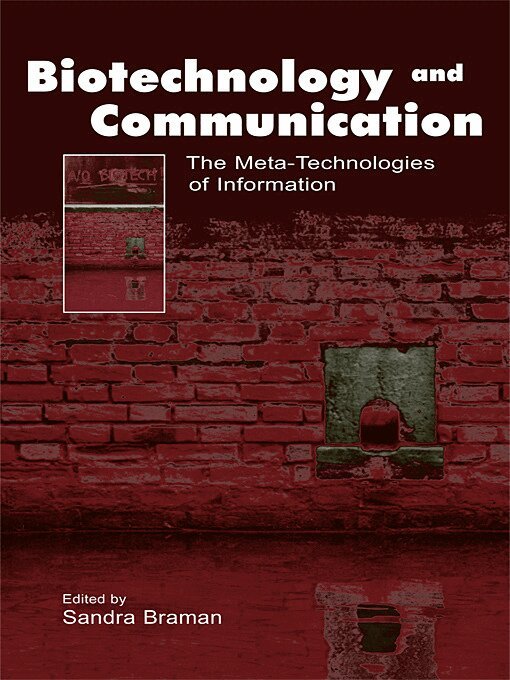
This volume examines the convergence of biotechnology and communication systems and explores how this convergence directly influences our understanding of the nature of communication. Editor Sandra Braman brings together scholars to examine this convergence in three areas: genetic information and "facticity"; social issues and implications; and the economic and legal issues raised by the production and ownership of information. The work highlights the sophisticated processes taking place as biotechnology and information technology systems continue to evolve. The chapters in this book approach the complex history of this topic and the issues it raises from a number of directions. It begins by examining the shared features and spaces of biotechnology and digital information technologies as meta-technologies--qualitatively distinct from both the tools first used in the premodern era and the industrial technologies that characterized modernity. Next, the book explores what is and is not useful in treating the types of information processed by the two meta-technologies through a shared conceptual lens and looks at issues raised by the ownership of genetic and digital information. The final chapters are concerned with relationships between information and power. Defining a future research agenda for communication scholarship, this work is beneficial to scholars and students in science communication, cultural studies, information technologies, and sociology.
1 301 kr
Skickas inom 10-15 vardagar
This volume examines the convergence of biotechnology and communication systems and explores how this convergence directly influences our understanding of the nature of communication. Editor Sandra Braman brings together scholars to examine this convergence in three areas: genetic information and "facticity"; social issues and implications; and the economic and legal issues raised by the production and ownership of information. The work highlights the sophisticated processes taking place as biotechnology and information technology systems continue to evolve. The chapters in this book approach the complex history of this topic and the issues it raises from a number of directions. It begins by examining the shared features and spaces of biotechnology and digital information technologies as meta-technologies--qualitatively distinct from both the tools first used in the premodern era and the industrial technologies that characterized modernity. Next, the book explores what is and is not useful in treating the types of information processed by the two meta-technologies through a shared conceptual lens and looks at issues raised by the ownership of genetic and digital information. The final chapters are concerned with relationships between information and power. Defining a future research agenda for communication scholarship, this work is beneficial to scholars and students in science communication, cultural studies, information technologies, and sociology.
284 kr
Skickas inom 10-15 vardagar
Contemporary theorising about globalisation processes has only recently come to acknowledge the crucial role of media systems, a theme long familiar to researchers within communications. Thus this volume situates media forms and processes as central foci of globalisation processes and gives communications researchers a chance to respond to the theories often devised by those without any intimate involvement in communications theory or practice. The responses are loud and varied. The first half of the book clusters theoretical critiques and embellishments of globalisation theory as well as offers some alternative theoretical models for examining current communications and cultural practices in the unfolding new world system. Considerable attention is paid to unpacking notions of a ""transnational public sphere"", ""global civil society"", and ""solidarity"", and examining the role that media play in structuring both potentially hegemonic practices as well as alternative practices. The second half clusters a variety of case studies exploring different facets of the dynamics of globalisation. Three chapters focus on specific media forms such as the examination of music, language, and news. A last chapter explores the notion of solidarity in a different way: how international organisations such as Amnesty can try to influence the news agenda to mobilise transnational public sympathy for an oppressed group, specifically street children in Brazil. The introduction and conclusion, each written by one of the editors, provide contextualisation and development of the debates, and focus on further issues for theoretical development and empirical research.