Sara Chatfield - Böcker
Visar alla böcker från författaren Sara Chatfield. Handla med fri frakt och snabb leverans.
5 produkter
5 produkter
985 kr
Skickas inom 7-10 vardagar
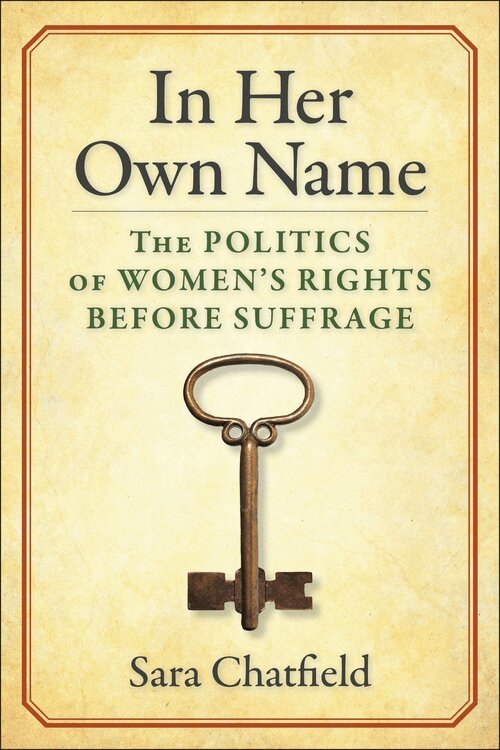
Co-Winner, 2024 V.O. Key Award, Southern Political Science AssociationLong before American women had the right to vote, states dramatically transformed their status as economic citizens. In the early nineteenth century, a married woman had hardly any legal existence apart from her husband. By the twentieth, state-level statutes, constitutional provisions, and court rulings had granted married women a host of protections relating to ownership and control of property. Why did powerful men extend these rights during a period when women had so little political sway?In Her Own Name explores the origins and consequences of laws guaranteeing married women’s property rights, focusing on the people and institutions that shaped them. Sara Chatfield demonstrates that the motives of male elites included personal interests, benefits to the larger economy, and bolstering state power. She shows that married women’s property rights could serve varied political goals across regions and eras, from temperance to debt relief to settlement of the West. State legislatures, constitutional conventions, and courts expanded these rights incrementally, and laws spread across the country without national-level coordination.Chatfield emphasizes that the reform of married women’s economic rights rested on exclusionary foundations, including protecting slavery and encouraging settler colonialism. Although some women benefited from property reforms, many others saw their rights stripped away by the same processes. Drawing on a mix of qualitative and quantitative evidence, In Her Own Name sheds new light on the place of women in the fitful democratization of the United States.
252 kr
Skickas inom 7-10 vardagar
Co-Winner, 2024 V.O. Key Award, Southern Political Science AssociationLong before American women had the right to vote, states dramatically transformed their status as economic citizens. In the early nineteenth century, a married woman had hardly any legal existence apart from her husband. By the twentieth, state-level statutes, constitutional provisions, and court rulings had granted married women a host of protections relating to ownership and control of property. Why did powerful men extend these rights during a period when women had so little political sway?In Her Own Name explores the origins and consequences of laws guaranteeing married women’s property rights, focusing on the people and institutions that shaped them. Sara Chatfield demonstrates that the motives of male elites included personal interests, benefits to the larger economy, and bolstering state power. She shows that married women’s property rights could serve varied political goals across regions and eras, from temperance to debt relief to settlement of the West. State legislatures, constitutional conventions, and courts expanded these rights incrementally, and laws spread across the country without national-level coordination.Chatfield emphasizes that the reform of married women’s economic rights rested on exclusionary foundations, including protecting slavery and encouraging settler colonialism. Although some women benefited from property reforms, many others saw their rights stripped away by the same processes. Drawing on a mix of qualitative and quantitative evidence, In Her Own Name sheds new light on the place of women in the fitful democratization of the United States.
234 kr
Skickas inom 7-10 vardagar
The past twenty years have seen an explosion of state laws focused on bathroom access, including laws that both restrict and expand the ability of people to access basic needs in public. Through an analysis of several distinct state-level policies that regulate bathrooms along the dimensions of gender and gender roles, gender identity, and disability, the author argues that bathroom access is an important aspect of citizenship, signaling both physical and symbolic exclusion and inclusion. Social citizenship requires that individuals and groups be able to fully take part in the public sphere, yet denying toilet access means that individuals can only exist in public for as long as they can 'hold it.' Thus, ensuring equal access to bathrooms – or denying it to targeted groups – becomes a powerful way for society to define who is a full citizen and to indicate who belongs and who doesn't in public spaces.
753 kr
Skickas inom 7-10 vardagar
The past twenty years have seen an explosion of state laws focused on bathroom access, including laws that both restrict and expand the ability of people to access basic needs in public. Through an analysis of several distinct state-level policies that regulate bathrooms along the dimensions of gender and gender roles, gender identity, and disability, the author argues that bathroom access is an important aspect of citizenship, signaling both physical and symbolic exclusion and inclusion. Social citizenship requires that individuals and groups be able to fully take part in the public sphere, yet denying toilet access means that individuals can only exist in public for as long as they can 'hold it.' Thus, ensuring equal access to bathrooms – or denying it to targeted groups – becomes a powerful way for society to define who is a full citizen and to indicate who belongs and who doesn't in public spaces.
Target Estimation and Adjustment Weighting for Survey Nonresponse and Sampling Bias
Häftad, Engelska, 2020
234 kr
Skickas inom 7-10 vardagar
We elaborate a general workflow of weighting-based survey inference, decomposing it into two main tasks. The first is the estimation of population targets from one or more sources of auxiliary information. The second is the construction of weights that calibrate the survey sample to the population targets. We emphasize that these tasks are predicated on models of the measurement, sampling, and nonresponse process whose assumptions cannot be fully tested. After describing this workflow in abstract terms, we then describe in detail how it can be applied to the analysis of historical and contemporary opinion polls. We also discuss extensions of the basic workflow, particularly inference for causal quantities and multilevel regression and poststratification.