Sarah Paterson – författare
Visar alla böcker från författaren Sarah Paterson. Handla med fri frakt och snabb leverans.
5 produkter
5 produkter
4 388 kr
Skickas inom 5-8 vardagar
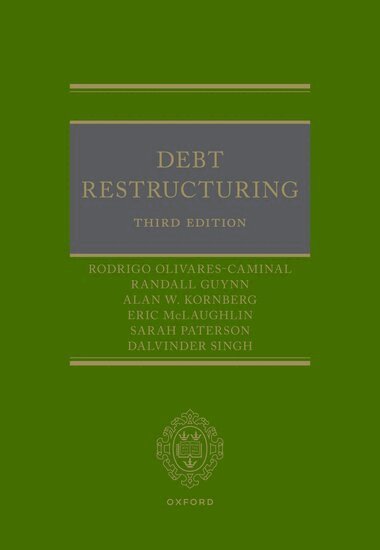
The new third edition of Debt Restructuring offers detailed legal analysis of international corporate, banking, and sovereign debt restructuring, from the perspective of creditors and debtors. It provides practical guidance to help practitioners, policy-makers, and academics in the UK and US to understand current developments in debt restructuring, and provides solutions for creditors holding distressed debt and debtor options in a distressed scenario.The Corporate Debt section includes significant changes to highlight the impact of COVID-19 on restructurings, including: potential grounds for investors/lenders to modify or terminate commitments to fund or support restructurings by invoking material adverse effect or force majeure clauses; unprecedented relief granted by insolvency courts to aid ailing retailers; and challenges facing insolvency courts in making necessary confirmation findings regarding the feasibility of reorganization plans due to market instability. This section also includes the recent adoption of the Part 26A Restructuring Plans and the EU Restructuring Directive. Amendments to the Bank Resolution section reflect decisions by the Single Resolution Board, and national authority resolution decisions notified to the European Banking Authority. A new sub-section on domestic bank insolvency and liquidation covers the developments under the Deposit Guarantee Schemes Directive, and a new chapter on insolvency law relating to Insurance Firms addresses the international debate on a special resolution regime for insurance firms. Other updates include the 2017 code of practice, the 'third country' branch model after Brexit, non-equivalence regarding depositor protection arrangements, and the Resolvability Assessment Framework.In the Sovereign Debt section, there is detailed coverage of US and UK developments, examining the increased role of sanctions and the possibility of piercing the corporate veil in SoEs (Chrystallex), as well as the increased push for domestic laws to be used to curtail litigation. It also covers developments in re-designation and the emergence of the 'pac-man technique' in the context of collective action clauses, as a result of the recent restructurings of Argentina and Ecuador. The impact of COVID-19 on the adoption of the Debt Service Suspension Initiative and the Common Framework are also analysed.
6 775 kr
Skickas inom 7-10 vardagar
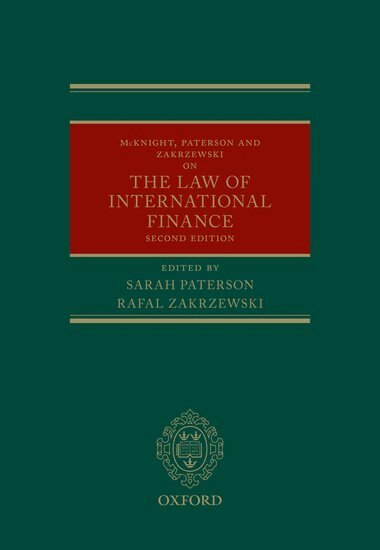
This acclaimed and comprehensive work analyses the legal issues involved in international finance transactions operating under English law. The second edition thoroughly updates the book to take account of major developments in regulation, practice, and case law since the first edition published in 2008. The most notable development in the intervening period has been the global financial crisis of 2008-9, whose effects have profoundly changed the nature of international finance, and the new edition has been updated by a team of expert editors and contributors to reflect the post-crisis legal framework of international transactions.The new edition covers the many significant changes to Bank Regulation which have occurred since 2008. Major developments in conflicts of laws and cross-border insolvency are addressed, including the consequences of the decision in Rubin v Eurofinance. This edition also takes account of major litigation in the sovereign debt field, significant developments in the loan markets, and recent challenges with the provision of legal opinions, including the increasing need to provide opinions in cross-border transactions. Developments in financing structures in the aftermath of the financial crisis are examined. Significant litigation in the derivatives field (partly as a response to the collapse of Lehman Brothers Holdings Inc.) and amendments proposed by the International Swaps and Derivatives Association are also addressed. There is also coverage of further work on secured transactions following the Law Commission's and the City of London Law Society's Working Party's proposals. Providing detailed transaction-led analysis of all aspects of international finance practice, this work is a must-have reference source for all practitioners and academics working in the field.
1 378 kr
Skickas inom 5-8 vardagar
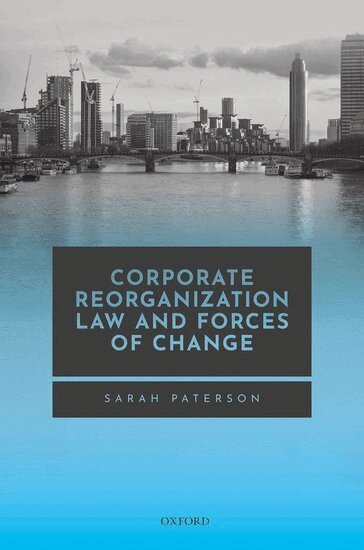
Corporate Reorganization Law and Forces of Change argues that significant shifts in logics, practices, and identities in the finance and non-financial corporate fields can change the nature of the problem which corporate reorganization law is required to solve, so that corporate reorganization law is mobilized and adapted by the participants in the process in new and diverse ways. This book argues that, whichever theoretical or policy approach is engaged, these adaptations cannot all be evaluated using a single universal or fixed conceptual framework. Adopting a comparative US/UK approach, the book undertakes a detailed analysis of six forces of change which developed in the finance and non-financial corporate fields from the 1980s. It analyses the ways in which these forces of change affected the nature of the corporate reorganization case, and the new ways in which participants in the corporate reorganization process mobilized and adapted corporate reorganization law in response. It argues that it is crucial to analyse the specific adaptations of corporate reorganization law which emerged from this process of change. This demands that corporate reorganization law theorists or policy makers do not start their analysis using a conceptual framework developed in response to historical adaptations of corporate reorganization law. It is necessary, instead, to identify how dominant theoretical or policy concerns manifest themselves in the specific adaptation of corporate reorganization law which is under review and to adapt conceptual frameworks accordingly. This is a timely analysis. Just as the book is going to press, governments around the world have been forced to enact shut down measures to contain the Covid-19 threat. The book draws a distinction between adaptations of corporate reorganization law to reorganize complex, leveraged capital structures and other adaptations to reorganize a mixture of financial and other liabilities. It unpacks why it is necessary to adapt conceptual frameworks in different ways for these different types of case. This provides a way for scholars, practitioners, judges, and the legislature to think about corporate reorganization law when it is mobilized and adapted to meet the specific challenges posed for business by the Covid-19 shutdown.
177 kr
Skickas inom 5-8 vardagar
204 kr
Skickas
When Allied troops fell into enemy hands, one secret and ingenious branch of military intelligence was tasked with their rescue. M.I.9 created and supported a network of escape and evasion lines across war-torn Europe to ensure the safe return of Allied fighters. These escape lines were essential in the Total War against Nazi Germany. Every individual was vital to the fight, and failure wasn't an option.Published for the first time since its creation in 1942, this 'most secret' facsimile reveals the many marvellous escape aids created by M.I.9 to help Allied personnel both evade capture and escape from prisoner of war camps. From silk maps designed for concealment in garments to tiny radio receivers hidden in cigar boxes, these gadgets and inventions were the brainchild of Christopher Clayton Hutton – the eccentric M.I.9 inventor who inspired many of Q's creations in James Bond. Most Secret offers a rare look at the most highly classified and clandestine tools of British intelligence.An accompanying introduction uncovers the history of this secret volume and traces the origin and use of escape aids from theiremergence in the First World War to their development and wider use in the Second World War.