Shadreck Chirikure - Böcker
Visar alla böcker från författaren Shadreck Chirikure. Handla med fri frakt och snabb leverans.
12 produkter
12 produkter
4 274 kr
Skickas inom 5-8 vardagar
The Oxford Encyclopedia of African Archaeology brings together contributions from a global community of leading scholars to present a comprehensive overview of the current state of the field. The Encyclopedia covers the breadth of topics and leading questions in the practice and study of archaeology across the continent, from the emergence of human ancestors and the earliest manifestation of human culture to the role of cultural heritage in the present day. African archaeology is a field where discoveries are continuously being made and disciplinary specializations are constantly emerging. As a result, capturing an accurate snapshot of the current body of research is a challenge. Neither is it always possible to produce a volume that synthesizes local and regional histories, both recent and ancient, into a cohesive understading of the continent. This volume is a major landmark in that it achieves those goals. The Encyclopedia engages with topical themes such as the changing nature of social organization, innovations in livelihoods and subsistence strategies, changing technology and materials, and human resilience across regions and time periods. This compilation is a must-have companion for anyone interested in the full range of African archaeology in terms of specialization, geographical coverage, gender representation, and sound scholarship. The Oxford Encyclopedia of African Archaeolgy is a resource for transforming understanding and practice in African archaeology, and an essential resource for those from other regions interested in learning about the deep and recent African peoples and pasts.
2 166 kr
Skickas inom 10-15 vardagar
Conditioned by local ways of knowing and doing, Great Zimbabwe develops a new interpretation of the famous World Heritage site of Great Zimbabwe. It combines archaeological knowledge, including recent material from the author’s excavations, with native concepts and philosophies. Working from a large data set has made it possible, for the first time, to develop an archaeology of Great Zimbabwe that is informed by finds and observations from the entire site and wider landscape. In so doing, the book strongly contributes towards decolonising African and world archaeology. Written in an accessible manner, the book is aimed at undergraduate students, graduate students, and practicing archaeologists both in Africa and across the globe. The book will also make contributions to the broader field such as African Studies, African History, and World Archaeology through its emphasis on developing synergies between local ways of knowing and the archaeology.
3 386 kr
Skickas inom 10-15 vardagar
This handbook is a foundational reference point for critical heritage research about Africa and its diaspora.Foregrounding the diversity of knowledge systems needed to examine heritage issues in such a diverse continent, the contributors to this volume:argue for an understanding heritage that is at once both natural and cultural, tangible and intangible, political and dissonant, going beyond the physical and objective to include subjective narratives, performances, rituals, memories and emotionsexamine the pre-coloniality, coloniality, post-coloniality, and decoloniality of current African heritage discourses and their consequencesanalyse how heritage legislation derived from colonial law is compatible or otherwise with how heritage is perceived, identified and remembered in African communitiesdiscuss questions of repatriation, restitution and reparations in relation to the return of artefacts from Western countriesilluminate the importance of ‘difficult heritage’ within Africa and its diasporaconsider the role of heritage for development in AfricaMaking a crucial contribution to our understanding of African conceptions and practices of heritage, this book is an important read for scholars of African Studies, heritage and museum studies, archaeology, anthropology and history.
682 kr
Skickas inom 10-15 vardagar
Conditioned by local ways of knowing and doing, Great Zimbabwe develops a new interpretation of the famous World Heritage site of Great Zimbabwe. It combines archaeological knowledge, including recent material from the author’s excavations, with native concepts and philosophies. Working from a large data set has made it possible, for the first time, to develop an archaeology of Great Zimbabwe that is informed by finds and observations from the entire site and wider landscape. In so doing, the book strongly contributes towards decolonising African and world archaeology. Written in an accessible manner, the book is aimed at undergraduate students, graduate students, and practicing archaeologists both in Africa and across the globe. The book will also make contributions to the broader field such as African Studies, African History, and World Archaeology through its emphasis on developing synergies between local ways of knowing and the archaeology.
738 kr
Skickas inom 10-15 vardagar
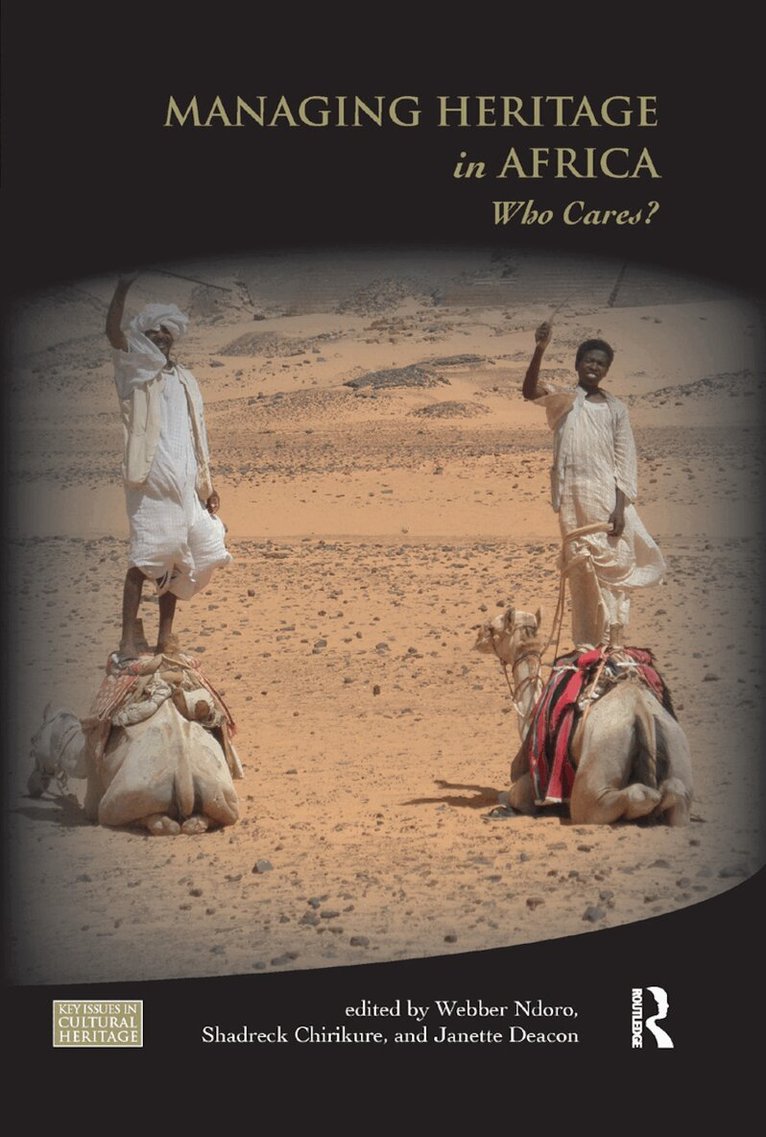
Managing Heritage in Africa provides a wide-ranging, up-to-date synthesis of heritage management practice in Africa, covering a broad spectrum of heritage issues such as archaeology, living traditions, sacred sites, heritage of pain (slavery), international conventions cultural landscapes, heritage in conflict areas and heritage versus development. Dealing with both intangible and tangible heritage, Managing Heritage in Africa gives an informative insight into some of the major issues and approaches to contemporary heritage management in Africa and situates the challenges facing heritage practitioners.
1 877 kr
Kommande
Ancient Civilizations provides a vivid and accessible account of early states and empires in Eurasia, Africa and the Americas. This textbook covers not only the traditional early states that formed in Egypt and Mesopotamia, in the Indus valley and China, in highland and lowland Mesoamerica and Andean South America, but it also follows the development of later states and empires including classical Greece and Rome, Han China and Angkor, and the kingdoms of sub-Saharan Africa. It provides a description of each, highlighting their key features and the kinds of evidence available for their study. Ancient Civilizations sees the development of states as a phenomenon recurring throughout past millennia, in different regions of the world, as part of a widespread process of social development and demographic growth. Particular attention is paid to the circumstances that allowed early states to develop and survive, the crucial role of agriculture and irrigation in supporting larger populations, the impact of warfare and expansionism, and the centrality of élites, ritual practices and monumentality in these early societies. Introductory chapters explain the history of research on early state societies, with due attention to the role of non-western scholars and examples in their study and interpretation. That broader postcolonial perspective is strengthened by the coverage of more recent state societies of sub-Saharan Africa and southeast Asia alongside those cultures that have so frequently dominated texts on ‘first civilizations’, and Ancient Civilizations offers greater insight into the whole range of societies that fall under this heading. Thus, Angkor in Cambodia and Great Zimbabwe in southern Africa are covered alongside Egypt, the Maya, and classical Greece and Rome. The result is a book unique in its scope and compelling in its diversity, written by three active scholars with considerable experience in their respective fields. Including features to support student learning: a wealth of images, feature boxes which expand on key sites, finds and written sources, and an extensive guide to further reading, Ancient Civilizations provides a unique introduction to pre-industrial civilizations.
2 968 kr
Kommande
Ancient Civilizations provides a vivid and accessible account of early states and empires in Eurasia, Africa and the Americas. This textbook covers not only the traditional early states that formed in Egypt and Mesopotamia, in the Indus valley and China, in highland and lowland Mesoamerica and Andean South America, but it also follows the development of later states and empires including classical Greece and Rome, Han China and Angkor, and the kingdoms of sub-Saharan Africa. It provides a description of each, highlighting their key features and the kinds of evidence available for their study. Ancient Civilizations sees the development of states as a phenomenon recurring throughout past millennia, in different regions of the world, as part of a widespread process of social development and demographic growth. Particular attention is paid to the circumstances that allowed early states to develop and survive, the crucial role of agriculture and irrigation in supporting larger populations, the impact of warfare and expansionism, and the centrality of élites, ritual practices and monumentality in these early societies. Introductory chapters explain the history of research on early state societies, with due attention to the role of non-western scholars and examples in their study and interpretation. That broader postcolonial perspective is strengthened by the coverage of more recent state societies of sub-Saharan Africa and southeast Asia alongside those cultures that have so frequently dominated texts on ‘first civilizations’, and Ancient Civilizations offers greater insight into the whole range of societies that fall under this heading. Thus, Angkor in Cambodia and Great Zimbabwe in southern Africa are covered alongside Egypt, the Maya, and classical Greece and Rome. The result is a book unique in its scope and compelling in its diversity, written by three active scholars with considerable experience in their respective fields. Including features to support student learning: a wealth of images, feature boxes which expand on key sites, finds and written sources, and an extensive guide to further reading, Ancient Civilizations provides a unique introduction to pre-industrial civilizations.
770 kr
Kommande
This handbook is a foundational reference point for critical heritage research about Africa and its diaspora.Foregrounding the diversity of knowledge systems needed to examine heritage issues in such a diverse continent, the contributors to this volume:argue for an understanding heritage that is at once both natural and cultural, tangible and intangible, political and dissonant, going beyond the physical and objective to include subjective narratives, performances, rituals, memories and emotionsexamine the pre-coloniality, coloniality, post-coloniality, and decoloniality of current African heritage discourses and their consequencesanalyse how heritage legislation derived from colonial law is compatible or otherwise with how heritage is perceived, identified and remembered in African communitiesdiscuss questions of repatriation, restitution and reparations in relation to the return of artefacts from Western countriesilluminate the importance of ‘difficult heritage’ within Africa and its diasporaconsider the role of heritage for development in AfricaMaking a crucial contribution to our understanding of African conceptions and practices of heritage, this book is an important read for scholars of African Studies, heritage and museum studies, archaeology, anthropology and history.
2 374 kr
Skickas inom 10-15 vardagar
Managing Heritage in Africa provides a wide-ranging, up-to-date synthesis of heritage management practice in Africa, covering a broad spectrum of heritage issues such as archaeology, living traditions, sacred sites, heritage of pain (slavery), international conventions cultural landscapes, heritage in conflict areas and heritage versus development. Dealing with both intangible and tangible heritage, Managing Heritage in Africa gives an informative insight into some of the major issues and approaches to contemporary heritage management in Africa and situates the challenges facing heritage practitioners.
375 kr
Skickas inom 7-10 vardagar
In the age of the African Renaissance, southern Africa has needed to reinterpret the past in fresh and more appropriate ways. The last 500 years represent a strikingly unexplored and misrepresented period which remains disfigured by colonial/apartheid assumptions, most notably in the way that African societies are depicted as fixed, passive, isolated, un-enterprising and unenlightened. This period is one the most formative in relation to southern Africa's past while remaining, in many ways, the least known. Key cultural contours of the sub-continent took shape, while in a jagged and uneven fashion some of the features of modern identities emerged. Enormous internal economic innovation and political experimentation was taking place at the same time as expanding European mercantile forces started to press upon southern African shores and its hinterlands. This suggests that interaction, flux and mixing were a strong feature of the period, rather than the homogeneity and fixity proposed in standard historical and archaeological writings. Five Hundred Years Rediscovered represents the first step, taken by a group of archaeologists and historians, to collectively reframe, revitalise and re-examine the last 500 years. By integrating research and developing trans-frontier research networks, the group hopes to challenge thinking about the region's expanding internal and colonial frontiers, and to broaden current perceptions about southern Africa's colonial past.
662 kr
Skickas inom 10-15 vardagar
This book seeks to communicate to both a global and local audience, the key attributes of pre-industrial African metallurgy such as technological variation across space and time, methods of mining and extractive metallurgy and the fabrication of metal objects.
Archives, Objects, Places and Landscapes
Multidisciplinary approaches to Decolonised Zimbabwean Pasts
Häftad, Engelska, 2017
692 kr
Skickas inom 5-8 vardagar