• Fri frakt över 249 kr
  • •
  • Snabba leveranser
  • •
  • Billiga böcker
Kundservice

Du är på sajten för privatpersoner.

Företag, bibliotek eller offentlig verksamhet?

Du handlar på classic.bokus.com, där alla dina funktioner finns intakta.
Till classic.bokus.com
Bokus logotyp. Gå till startsidan.
  • Erbjudanden
  • Nyheter
  • Student
  • Topplistor
  • Barn & ungdom
  • Bokus Play
  • E-böcker
  • Pocketböcker
  • Spel & pussel

10% rabatt på allt med kod NYSTART10 →

Sidfot

Mina sidor

    Hjälp

    • Kundservice
    • Vanliga frågor och svar
    • Frakt och leverans
    • Retur vid ångerrätt
    • Reklamera vara
    • Betalning
    • Köpvillkor
    • Allmänna villkor
    • Information om webbplatsens tillgänglighet

    Om Bokus

    • Om oss
    • Pressrum
    • För studenter
    • För företag
    • För bibliotek och offentlig verksamhet
    • För leverantörer
    • Hållbarhet

    Populärt

    • Aktuella erbjudanden
    • Presentkort
    • Studentlitteratur
    • Nya böcker
    • Topplistor
    • Signerade böcker
    • Engelska böcker

    Inspiration

    • Boktips
    • BookTok
    • Populära bokserier
    • Barnbokskaraktärer
    • Populära författare
    Logotyp för Bokus
    Följ oss på Facebook (extern länk)Följ oss på Instagram (extern länk)Följ oss på YouTube (extern länk)Följ oss på TikTok (extern länk)
    bokus @ CookiesAnpassa cookiesIntegritetspolicyKöpvillkor
    Till Citymail hemsida (extern länk)Till Budbee hemsida (extern länk)Till Postnord hemsida (extern länk)Till Schenker hemsida (extern länk)Till Early Bird hemsida (extern länk)Till Walleys hemsida (extern länk)
    1. Samhälle och politik
    2. Sociologi och antropologi
    3. Antropologi

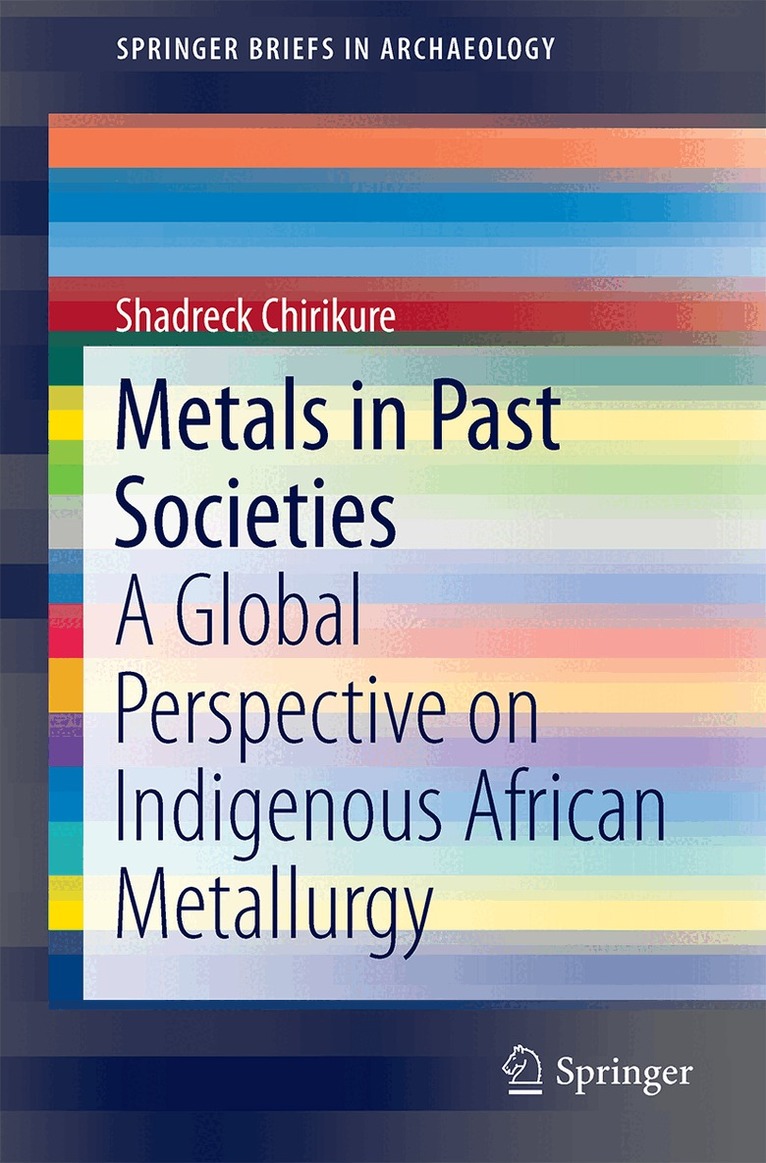
    Metals in Past Societies

    A Global Perspective on Indigenous African Metallurgy

    AvShadreck Chirikure

    Häftad, Engelska, 2015

    Del i serien SpringerBriefs in Archaeology

    674 kr

    Beställningsvara. Skickas inom 10-15 vardagar. Fri frakt över 249 kr.

    Fler format och utgåvor

    E-bok

    894 kr

    Beskrivning

    This book seeks to communicate to both a global and local audience, the key attributes of pre-industrial African metallurgy such as technological variation across space and time, methods of mining and extractive metallurgy and the fabrication of metal objects.  These processes were transformative in a physical and metaphoric sense, which made them total social facts. Because the production and use of metals was an accretion of various categories of practice, a chaine operatoire conceptual and theoretical framework that simultaneously considers the embedded technological and anthropological factors was used. The book focuses on Africa’s different regions as roughly defined by cultural geography. On the one hand there is North Africa, Egypt, the Egyptian Sudan, and the Horn of Africa which share cultural inheritances with the Middle East and on the other is Africa south of the Sahara and the Sudan which despite interacting with the former is remarkably different in terms of technological practice. For example, not only is the timing of metallurgy different but so is the infrastructure for working metals and the associated symbolic and sociological factors. The cultural valuation of metals and the social positions of metal workers were different too although there is evidence of some values transfer and multi-directional technological cross borrowing. The multitude of permutations associated with metals production and use amply demonstrates that metals participated in the production and reproduction of society.  Despite huge temporal and spatial differences there are so many common factors between African metallurgy and that of other regions of the world. For example, the role of magic and ritual in metal working is almost universal be it in Bolivia, Nepal, Malawi, Timna, Togo or Zimbabwe. Similarly, techniques of mining were constrained by the underlying geology but this should not in any way suggest that Africa’s metallurgy was derivative or that thecontinent had no initiative. Rather it demonstrates that when confronted with similar challenges, humanity in different regions of the world responded to identical challenges in predictable ways mediated as mediated by the prevailing cultural context. The success of the use of historical and ethnographic data in understanding variation and improvisation in African metallurgical practices flags the potential utility of these sources in Asia, Latin America and Europe. Some nuance is however needed because it is simply naïve to assume that everything depicted in the history or ethnography has a parallel in the past and vice versa. Rather, the confluence of archaeology, history and ethnography becomes a pedestal for dialogue between different sources, subjects and ideas that is important for broadening our knowledge of global categories of metallurgical practice.

    Produktinformation

    • Utgivningsdatum:2015-03-31
    • Mått:155 x 235 x 11 mm
    • Vikt:295 g
    • Format:Häftad
    • Språk:Engelska
    • Serie:SpringerBriefs in Archaeology
    • Antal sidor:166
    • Förlag:Springer International Publishing AG
    • ISBN:9783319116402

    Utforska kategorier

    • Antropologi inom Samhälle och politik
    • Arkeologiska perioder och områden inom Historia och arkeologi
    • Tillverkningsteknik inom Naturvetenskap och teknik

    Mer om författaren

    Shadreck Chirikure graduated with a Masters of Arts in Artefact Studies Degree and a PhD in Archaeology from the Institute of Archaeology, University College London. Chirikure was born into one of the most senior houses of the Gutu-Rufura people in rural Zimbabwe. During his childhood years, Chirikure’s grandmother was a potter and a number of men were forging scrap iron in his village. Therefore, negotiating through rituals and taboos embedded in pottery making and other categories of practice were part of Chirikure’s experience growing up.  Unknown to him, these would be part of his academic routine when he later became an archaeologist. Because of this village experience, Chirikure always attempts to gestate archaeological reconstructions that are tempered with local realities where nothing was fixed in space and time. His main research marries techniques from earth and engineering sciences with those from more humanistic disciplines to study high temperature technologiessuch as metallurgy and pottery making to enlighten their contribution to societal development. Currently, Chirikure’s work on the metallurgy of the World Heritage Sites of Great Zimbabwe and Khami in southern Africa is throwing new light on the contribution of metals to culture contact, interaction, and social differentiation. The work shows that metals, like cattle were a pivot on which society achieved growth and renewal. Shadreck has published extensively on the subject including a book, multiple journal articles, book chapters and contributions prestigious encyclopaedias. In the process, he won several national and international awards for his contributions to African Iron Age research.

    Recensioner i media

    "This compact but comprehensive book on African metallurgy is the first of a Springer series that aims to boost the visibility of African archaeology and emphasise its relevance to broader archaeological debates. ... This book seems to be a very positive step towards ensuring that this occurs by eloquently presenting the numerous ways in which African archaeometallurgy has influenced archaeological theory to date and highlighting those arenas upon which it can make an impact in the future." (Louise Iles, Azania, Archaeological Research in Africa, Vol. 51 (2), 2016) "This slim book shines a spotlight on pre-industrial African metallurgy, its global connections, and anthropological implications. ... The sources of information are adequately cited, and the long list of references at the end of each chapter will be a boon to researchers in this field. ... This volume is well written and illustrated with photos, micrographs, colorful maps, and drawings that enliven this challenging topic." (Ram Devanathan, MRS Bulletin, Vol. 40, October, 2015)

    Innehållsförteckning

    • ​Chapter 1: Metals and the production and reproduction of society.- Chapter 2: Origins and development of Africa’s pre-industrial mining and metallurgy.- Chapter 3: Mother earth provides: mining and crossing the boundary between nature and culture.- Chapter 4: Domesticating nature.- Chapter 5: Socializing metals.- Chapter 6: The social role of metals.- Chapter 7: Bridging conceptual boundaries, a global perspective.