Stanley Wolpert - Böcker
Visar alla böcker från författaren Stanley Wolpert. Handla med fri frakt och snabb leverans.
10 produkter
10 produkter
781 kr
Skickas inom 5-8 vardagar
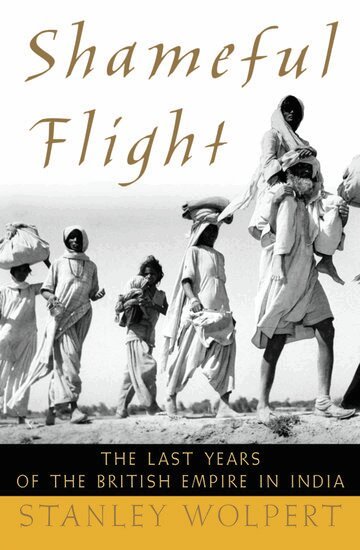
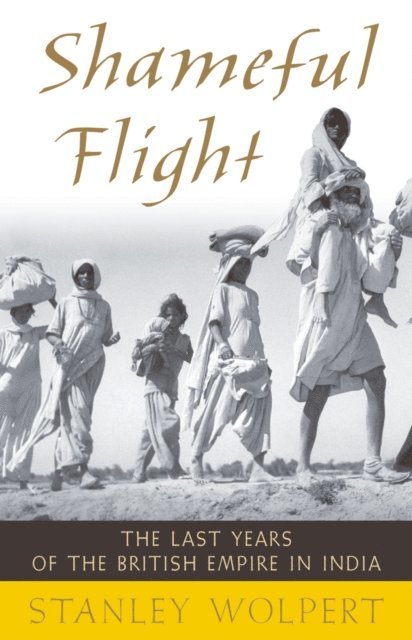
Britain's precipitous and ill-planned disengagement from India in 1947--condemned as a "shameful flight" by Winston Churchill--had a truly catastrophic effect on South Asia, leaving hundreds of thousands of people dead in its wake and creating a legacy of chaos, hatred, and war that has lasted over half a century.Ranging from the fall of Singapore in 1942 to the assassination of Mahatma Gandhi in 1948, Shameful Flight provides a vivid behind-the-scenes look at Britain's decision to divest itself from the crown jewel of its empire. Stanley Wolpert, a leading authority on Indian history, paints memorable portraits of all the key participants, including Gandhi, Churchill, Attlee, Nehru, and Jinnah, with special focus on British viceroy, Lord Louis Mountbatten. Wolpert places the blame for the catastrophe largely on Mountbatten, the flamboyant cousin of the king, who rushed the process of nationhood along at an absurd pace. The viceroy's worst blunder was the impetuous drawing of new border lines through the middle of Punjab and Bengal. Virtually everyone involved advised Mountbatten that to partition those provinces was a calamitous mistake that would unleash uncontrollable violence. Indeed, as Wolpert shows, civil unrest among Muslims, Hindus, and Sikhs escalated as Independence Day approached, and when the new boundary lines were announced, arson, murder, and mayhem erupted. Partition uprooted over ten million people, 500,000 to a million of whom died in the ensuing inferno. Here then is the dramatic story of a truly pivotal moment in the history of India, Pakistan, and Britain, an event that ignited fires of continuing political unrest that still burn in South Asia.
1 542 kr
Skickas inom 7-10 vardagar
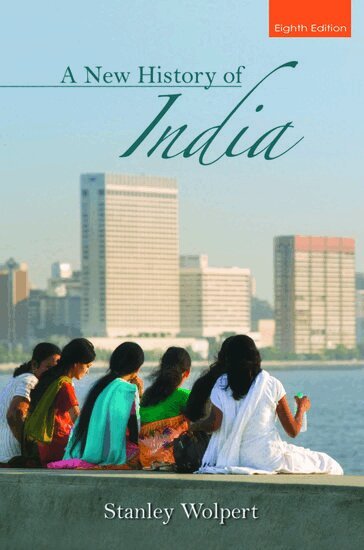
After more than twenty-five years in print, A New History of India continues to be the most readable and popular one-volume history of India available. Now in its eighth edition, this acclaimed text features updated scholarship and bibliographic material throughout and integrates new research on such incisive topics as the Indian diaspora, the economy, and the nuclear issue.In lively, accessible language, Stanley Wolpert condenses more than 4,000 years of India's history into a graceful and engaging narrative. He discusses modern India's rapidly growing population, industry, and economy, and also considers the prospects for India's future. From a carefully balanced perspective, Wolpert presents a fair and truthful record of India's history--he offers both a triumphant portrayal of the brightest achievements of Indian civilization as well as a sobering examination of its persistent social inequities and economic and political corruption.Enhanced with striking new images and a full-color map of India and the surrounding area, A New History of India, Eighth Edition, remains the authoritative text on the compelling--and often controversial--history of this fascinating country.
223 kr
Skickas inom 5-8 vardagar
Britain's precipitous and ill-planned disengagement from India in 1947--condemned as a "shameful flight" by Winston Churchill--had a truly catastrophic effect on South Asia, leaving hundreds of thousands of people dead in its wake and creating a legacy of chaos, hatred, and war that has lasted over half a century.Ranging from the fall of Singapore in 1942 to the assassination of Mahatma Gandhi in 1948, Shameful Flight provides a vivid behind-the-scenes look at Britain's decision to divest itself from the crown jewel of its empire. Stanley Wolpert, a leading authority on Indian history, paints memorable portraits of all the key participants, including Gandhi, Churchill, Attlee, Nehru, and Jinnah, with special focus on British viceroy, Lord Louis Mountbatten. Wolpert places the blame for the catastrophe largely on Mountbatten, the flamboyant cousin of the king, who rushed the process of nationhood along at an absurd pace. The viceroy's worst blunder was the impetuous drawing of new border lines through the middle of Punjab and Bengal. Virtually everyone involved advised Mountbatten that to partition those provinces was a calamitous mistake that would unleash uncontrollable violence. Indeed, as Wolpert shows, civil unrest among Muslims, Hindus, and Sikhs escalated as Independence Day approached, and when the new boundary lines were announced, arson, murder, and mayhem erupted. Partition uprooted over ten million people, 500,000 to a million of whom died in the ensuing inferno. Here then is the dramatic story of a truly pivotal moment in the history of India, Pakistan, and Britain, an event that ignited fires of continuing political unrest that still burn in South Asia. "In this engrossing, but very controversial, book, Wolpert considers the responsibility of the leaders, both British and Indian, for the immediate consequences of the partition in 1947 of British India into India and Pakistan when hundreds of thousands were killed in riots and millions became homeless refugees. Shameful Flight is sobering reading for anyone interested in the rise and fall of Western imperialism." --Ainslee Embree, Columbia University "Wolpert's book is a delightful read and will shine for its stellar quality of scholarship among the growing body of partition literature that has surfaced in the last two decades. It will be of great interest to anyone curious about whatever happened to the great British Empire and those who often wonder why Indians and Pakistanis endlessly fight with each other."--Dilip Basu, University of California, Santa Cruz
292 kr
Skickas inom 7-10 vardagar
This new edition brings Stanley Wolpert's brilliantly succinct and accessible introduction to India completely up to date for a new generation of readers, travelers, and students. In crisp detail, Wolpert gives a panoramic overview of the continent on which the world's most fascinating ancient civilization gave birth to one of its most complex modern democratic nations. "India" now includes new sections on the country's current global economic development, the recent national elections, and on its international relations, including those with Pakistan, China, Sri Lanka, and the United States, India's new strategic global partner.
487 kr
Skickas inom 7-10 vardagar
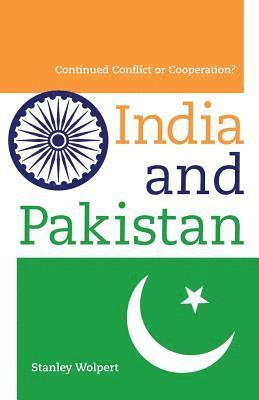
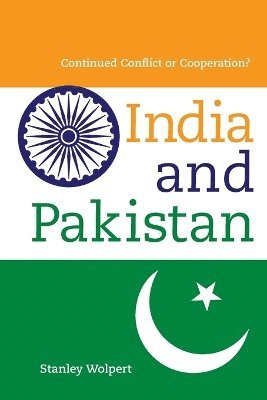
Beginning in 1947, when 'India and Pakistan were born to conflict', renowned India scholar Stanley Wolpert provides an authoritative, accessible primer on what is potentially the world's most dangerous crisis. He concisely distills sixty-three years of complex history, tracing the roots of the relationship between these two antagonists, explaining the many attempts to resolve their disputes, and assessing the dominant political leaders. While the tragic Partition left many urgent problems, none has been more difficult than the problem over Kashmir, claimed by both India and Pakistan. This intensely divisive issue has triggered two conventional wars, killed some 100,000 Kashmiris, and almost ignited two nuclear wars since 1998, when both India and Pakistan openly emerged as nuclear-weapon states. In addition to providing a comprehensive perspective on the origin and nature of this urgent conflict, Wolpert examines all the proposed solutions and concludes with a road map for a brighter future for South Asia.
428 kr
Skickas inom 3-6 vardagar
Beginning in 1947, when 'India and Pakistan were born to conflict,' renowned India scholar Stanley Wolpert provides an authoritative, accessible primer on what is potentially the world's most dangerous crisis. He concisely distills sixty-three years of complex history, tracing the roots of the relationship between these two antagonists, explaining the many attempts to resolve their disputes, and assessing the dominant political leaders. While the tragic Partition left many urgent problems, none has been more difficult than the problem over Kashmir, claimed by both India and Pakistan. This intensely divisive issue has triggered two conventional wars, killed some 100,000 Kashmiris, and almost ignited two nuclear wars since 1998, when both India and Pakistan openly emerged as nuclear-weapon states. In addition to providing a comprehensive perspective on the origin and nature of this urgent conflict, Wolpert examines all the proposed solutions and concludes with a road map for a brighter future for South Asia.
811 kr
Skickas inom 3-6 vardagar
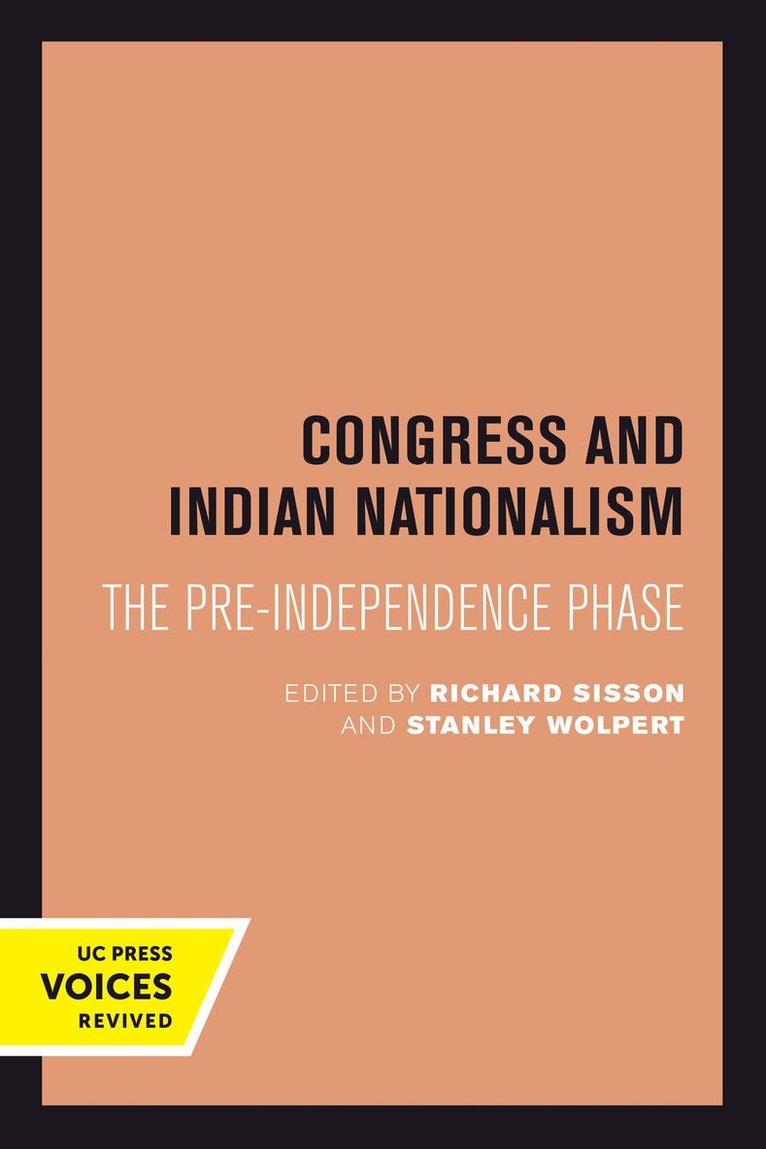
Seventeen distinguished historians and political scientists discuss the phenomenon of Indian Nationalism, one hundred years after the founding of the Congress party. They offer important new interpretations of Nationalism's evolution during more than six decades of crucial change and rapid growth. As India's foremost political institution, the National Congress with its changing fortunes mirrored Indian aspirations, ideals, dreams, and failures during the country's struggle for nationhood. Many difficulties face by the pre-independence Indian National Congress are critically examined for the first time in this volume. Major times of crisis and transition are considered, as well as the tension between mass action and political control and the problem of creating and maintaining unity in the face of divisive social and economic interests and between deeply hostile religious communities. A composite portrait of the Congress Party emerges. We see a coalition of often conflicting communities and interests much like India itself, struggling to stay together, tenuously united by little more at times than a common "enemy," the imperial British Raj. But linked together in precarious, seemingly haphazard fashion, shifting networks of elite political entrepreneurs manage to keep India's National Congress alive long enough to convince the British that it would be easier to "Quit India" than to try to hang on to it by force. With the abrupt transfer of power form the British to the independent Dominions of India and Pakistan in 1947, Congress provided institutional sinews for the administration of what had been British India and over five hundred Princely States. By contributing to a deeper understanding of India's nationalist experience, this volume may illuminate the experience of other Third World states. Essays by:S. BhattacharyaJudith M. BrownMushirul HansanZoya HasanD.A. LowClaude MarkovitsJohn R. McLaneW.H. Morris-JonesGyanendra PandeyBimal PrasadRajat Kanta RayBarbara N. RamusackPeter D. ReevesHitesranjan SanyalRichard SissonStanley WolpertEleanor Zelliot This title is part of UC Press's Voices Revived program, which commemorates University of California Press’s mission to seek out and cultivate the brightest minds and give them voice, reach, and impact. Drawing on a backlist dating to 1893, Voices Revived makes high-quality, peer-reviewed scholarship accessible once again using print-on-demand technology. This title was originally published in 1988.
835 kr
Skickas inom 3-6 vardagar
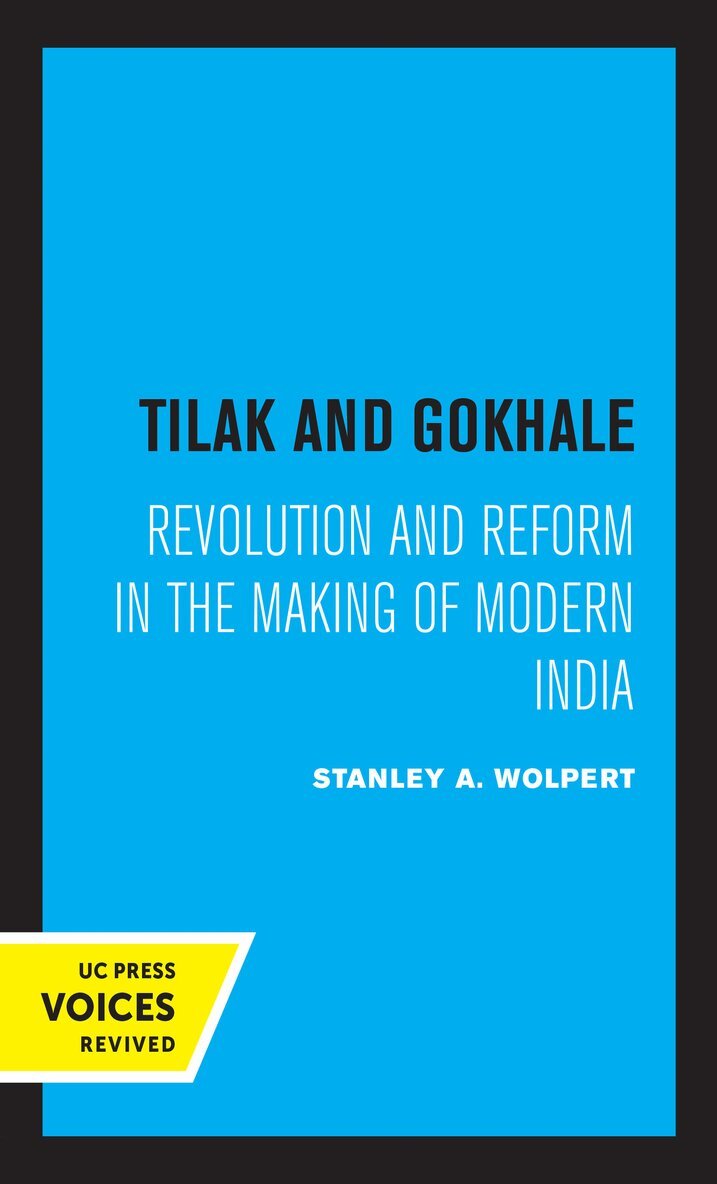
Stanley Wolpert’s study reframes India’s independence as the culmination of a long gestation rather than a sudden post-1947 birth, arguing that the intellectual and organizational groundwork for nationalism was laid well before Gandhi and Nehru. Centering on Bal Gangadhar Tilak and Gopal Krishna Gokhale—Gandhi’s most consequential predecessors—Wolpert tracks how their contrasting strategies and moral frames shaped methods of agitation, political education, and mass mobilization by the end of World War I. Tilak’s fiery populism and constitutional militancy (“Father of Indian Unrest” to detractors, national hero to admirers) drew on newspapers, street politics, and cultural revival; Gokhale’s ethical gradualism relied on legislative craft, institution building, and tutelary reform. The book contends that Gandhi’s later success synthesized Tilak’s mobilizing technique with Gokhale’s moral method, translating an inherited repertoire into a program capable of compelling British retreat without civil collapse.Wolpert also maps the source terrain and historiography. Tilak has attracted abundant, often hagiographic biographies (notably Kelkar’s Marathi trilogy, Karandikar, Tahmankar), grounded in the rich Kesari–Mahratta archives; British assessments like Chirol’s Indian Unrest supply a hostile counterpoint. Gokhale, by contrast, is underrepresented—his moderation, closeness to British officials, and early death yielding fewer, more memoiristic accounts (Paranjpe, Sastri, Gandhi’s tribute) and a handful of fuller biographies (Shahani, Hoyland). Rather than reprise single-figure lives, Wolpert stages a comparative analysis to show how each leader’s moves refracted and provoked the other’s, how both rode—and redirected—main currents of Indian political tradition, and how their competing impulses—revolution and reform—coalesced in the making of modern India. Rejecting “great man” determinism while foregrounding agency, he reads their interaction against institutional and cultural constraints, arguing that understanding their dialogue clarifies the lineage, limits, and continuity of Indian nationalism.This title is part of UC Press's Voices Revived program, which commemorates University of California Press’s mission to seek out and cultivate the brightest minds and give them voice, reach, and impact. Drawing on a backlist dating to 1893, Voices Revived makes high-quality, peer-reviewed scholarship accessible once again using print-on-demand technology. This title was originally published in 1961.
781 kr
Skickas inom 7-10 vardagar
Stanley Wolpert’s study reframes India’s independence as the culmination of a long gestation rather than a sudden post-1947 birth, arguing that the intellectual and organizational groundwork for nationalism was laid well before Gandhi and Nehru. Centering on Bal Gangadhar Tilak and Gopal Krishna Gokhale—Gandhi’s most consequential predecessors—Wolpert tracks how their contrasting strategies and moral frames shaped methods of agitation, political education, and mass mobilization by the end of World War I. Tilak’s fiery populism and constitutional militancy (“Father of Indian Unrest” to detractors, national hero to admirers) drew on newspapers, street politics, and cultural revival; Gokhale’s ethical gradualism relied on legislative craft, institution building, and tutelary reform. The book contends that Gandhi’s later success synthesized Tilak’s mobilizing technique with Gokhale’s moral method, translating an inherited repertoire into a program capable of compelling British retreat without civil collapse.Wolpert also maps the source terrain and historiography. Tilak has attracted abundant, often hagiographic biographies (notably Kelkar’s Marathi trilogy, Karandikar, Tahmankar), grounded in the rich Kesari–Mahratta archives; British assessments like Chirol’s Indian Unrest supply a hostile counterpoint. Gokhale, by contrast, is underrepresented—his moderation, closeness to British officials, and early death yielding fewer, more memoiristic accounts (Paranjpe, Sastri, Gandhi’s tribute) and a handful of fuller biographies (Shahani, Hoyland). Rather than reprise single-figure lives, Wolpert stages a comparative analysis to show how each leader’s moves refracted and provoked the other’s, how both rode—and redirected—main currents of Indian political tradition, and how their competing impulses—revolution and reform—coalesced in the making of modern India. Rejecting “great man” determinism while foregrounding agency, he reads their interaction against institutional and cultural constraints, arguing that understanding their dialogue clarifies the lineage, limits, and continuity of Indian nationalism.This title is part of UC Press's Voices Revived program, which commemorates University of California Press’s mission to seek out and cultivate the brightest minds and give them voice, reach, and impact. Drawing on a backlist dating to 1893, Voices Revived makes high-quality, peer-reviewed scholarship accessible once again using print-on-demand technology. This title was originally published in 1961.
1 469 kr
Skickas inom 3-6 vardagar
Seventeen distinguished historians and political scientists discuss the phenomenon of Indian Nationalism, one hundred years after the founding of the Congress party. They offer important new interpretations of Nationalism's evolution during more than six decades of crucial change and rapid growth. As India's foremost political institution, the National Congress with its changing fortunes mirrored Indian aspirations, ideals, dreams, and failures during the country's struggle for nationhood. Many difficulties face by the pre-independence Indian National Congress are critically examined for the first time in this volume. Major times of crisis and transition are considered, as well as the tension between mass action and political control and the problem of creating and maintaining unity in the face of divisive social and economic interests and between deeply hostile religious communities. A composite portrait of the Congress Party emerges. We see a coalition of often conflicting communities and interests much like India itself, struggling to stay together, tenuously united by little more at times than a common "enemy," the imperial British Raj. But linked together in precarious, seemingly haphazard fashion, shifting networks of elite political entrepreneurs manage to keep India's National Congress alive long enough to convince the British that it would be easier to "Quit India" than to try to hang on to it by force. With the abrupt transfer of power form the British to the independent Dominions of India and Pakistan in 1947, Congress provided institutional sinews for the administration of what had been British India and over five hundred Princely States. By contributing to a deeper understanding of India's nationalist experience, this volume may illuminate the experience of other Third World states. Essays by:S. BhattacharyaJudith M. BrownMushirul HansanZoya HasanD.A. LowClaude MarkovitsJohn R. McLaneW.H. Morris-JonesGyanendra PandeyBimal PrasadRajat Kanta RayBarbara N. RamusackPeter D. ReevesHitesranjan SanyalRichard SissonStanley WolpertEleanor Zelliot This title is part of UC Press's Voices Revived program, which commemorates University of California Press’s mission to seek out and cultivate the brightest minds and give them voice, reach, and impact. Drawing on a backlist dating to 1893, Voices Revived makes high-quality, peer-reviewed scholarship accessible once again using print-on-demand technology. This title was originally published in 1988.