
Stefanie Duguay – författare
Visar alla böcker från författaren Stefanie Duguay. Handla med fri frakt och snabb leverans.
4 produkter
4 produkter
Inbunden, Engelska, 2022
1 088 kr
Skickas inom 5-8 vardagar
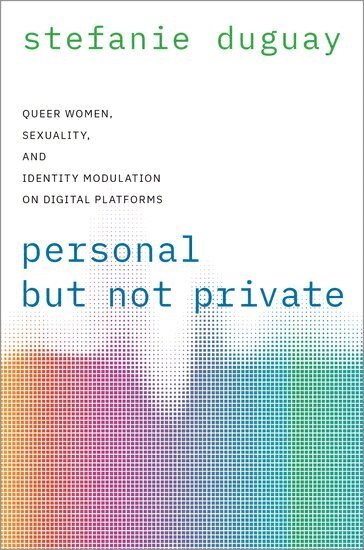
Privacy has become a pressing concern for many users of digital platforms who fear legal or social liability for sharing personal details online. Yet for queer women and others, an emphasis on privacy fails to reflect the creativity and struggles of everyday people seeking to represent themselves and form meaningful connections through social media.Personal but Not Private explores how queer women share and maintain their identities through digital technologies despite overlapping technological, social, economic, and political concerns. Focusing on representations of sexual identity through Tinder, Instagram, and Vine, this volume uncovers how queer women are continuously engaging in identity modulation, or the process through which people and platforms adjust or modify personal information, to form relationships, increase their social and economic participation, and counter intersecting forms of oppression. While queer women's representations of sexual identity give rise to publics and counterpublics through intimate and collective self-representation, platform-specific elements like design and governance place limitations on queer women's agency and often make them targets of censorship, harassment, and discrimination. This book also considers how identity modulation can be applied to a range of people negotiating digital contexts and promotes tangible changes to digital platforms and their broader social, economic, and political structures to empower individuals and their personal sharing on social media.Bringing together personal interviews and empirical research, Personal but Not Private offers a new lens for examining digitally mediated identities and highlights how platforms act as complicated sites of transformation.
Häftad, Engelska, 2022
315 kr
Skickas inom 5-8 vardagar
Privacy has become a pressing concern for many users of digital platforms who fear legal or social liability for sharing personal details online. Yet for queer women and others, an emphasis on privacy fails to reflect the creativity and struggles of everyday people seeking to represent themselves and form meaningful connections through social media.Personal but Not Private explores how queer women share and maintain their identities through digital technologies despite overlapping technological, social, economic, and political concerns. Focusing on representations of sexual identity through Tinder, Instagram, and Vine, this volume uncovers how queer women are continuously engaging in identity modulation, or the process through which people and platforms adjust or modify personal information, to form relationships, increase their social and economic participation, and counter intersecting forms of oppression. While queer women's representations of sexual identity give rise to publics and counterpublics through intimate and collective self-representation, platform-specific elements like design and governance place limitations on queer women's agency and often make them targets of censorship, harassment, and discrimination. This book also considers how identity modulation can be applied to a range of people negotiating digital contexts and promotes tangible changes to digital platforms and their broader social, economic, and political structures to empower individuals and their personal sharing on social media.Bringing together personal interviews and empirical research, Personal but Not Private offers a new lens for examining digitally mediated identities and highlights how platforms act as complicated sites of transformation.

Inbunden, Engelska, 2026
656 kr
Kommande
Since Tinder's launch in 2012, the app and its iconic swipe have sparked controversy, shaped the matchmaking industry, and changed how people date.In the first book-length scholarly exploration of Tinder, Stefanie Duguay traces the app's debut, rise to popularity, and the complicated relationship that many people have with it. She examines shifting interpretations of Tinder's purpose – from hook-ups to finding true love – alongside changes in verifying users' authenticity, ensuring safety, and generating revenue. She argues that Tinder's prominence has set the stage for how intimacy operates online. While positive for some users, others experience hostility, which leaves them fielding malicious reporting, harassment, reduced algorithmic visibility, and other challenges in using a technology that has become focal to many people's partner-seeking. Duguay concludes that noticing how these conditions have formed on Tinder enables us to imagine new ways of dating digitally in the future.Arriving when some have heralded the end of dating apps, this book illuminates how Tinder's legacy will continue to influence dating in the long term. It is essential reading for students and scholars in media and communication studies, sociology, gender and sexuality studies, and anyone who has ever thought of swiping right.

Häftad, Engelska, 2026
215 kr
Kommande
Since Tinder's launch in 2012, the app and its iconic swipe have sparked controversy, shaped the matchmaking industry, and changed how people date.In the first book-length scholarly exploration of Tinder, Stefanie Duguay traces the app's debut, rise to popularity, and the complicated relationship that many people have with it. She examines shifting interpretations of Tinder's purpose – from hook-ups to finding true love – alongside changes in verifying users' authenticity, ensuring safety, and generating revenue. She argues that Tinder's prominence has set the stage for how intimacy operates online. While positive for some users, others experience hostility, which leaves them fielding malicious reporting, harassment, reduced algorithmic visibility, and other challenges in using a technology that has become focal to many people's partner-seeking. Duguay concludes that noticing how these conditions have formed on Tinder enables us to imagine new ways of dating digitally in the future.Arriving when some have heralded the end of dating apps, this book illuminates how Tinder's legacy will continue to influence dating in the long term. It is essential reading for students and scholars in media and communication studies, sociology, gender and sexuality studies, and anyone who has ever thought of swiping right.