Stephanie Saldana - Böcker
Visar alla böcker från författaren Stephanie Saldana. Handla med fri frakt och snabb leverans.
8 produkter
8 produkter
209 kr
Skickas inom 5-8 vardagar
97 kr
Skickas inom 5-8 vardagar
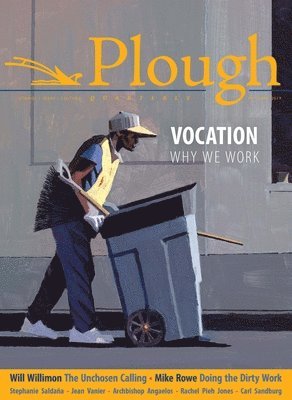
Your job is not your vocation.Everyone hungers for work that has meaning and purpose. But what gives work meaning? Vocation, or “calling,” is the answer Protestant Christianity offers: each person is called by God to serve the common good in a particular line of work. Your vocation, evidently, might be almost anything: as a nurse, a wilderness guide, a calligrapher, a missionary, an activist, a venture capitalist, a politician, an executioner… Yet, as Will Willimon writes in this issue, the New Testament knows only one form of vocation: discipleship. And discipleship is far more likely to mean leaving father and mother, houses and land, than it is to mean embracing one’s identity as a fisherman or tax collector.This issue of Plough focuses on people who lived their lives with that sense of vocation. Such a life demands self-sacrifice and a willingness to recognize one’s own supposed strengths as weaknesses, as it did for the Canadian philosopher Jean Vanier. It involves a lifelong commitment to a flesh-and-blood church, as Coptic Archbishop Angaelos describes. It may even require a readiness to give up one’s life, as it did for Annalena Tonelli, an Italian humanitarian who pioneered the treatment of tuberculosis in the Horn of Africa. But as these stories also testify, it brings a gladness deeper than any self-chosen path.Also in this issue: - Scott Beauchamp on mercenaries- Nathan Schneider on cryptocurrencies- Stephanie Saldaña on Syrian refugee art- Peter Biles on loneliness at college- Phil Christman on Bible translation- Michael Brendan Dougherty on fatherhood- Insights on vocation from C. S. Lewis, Thérèse of Lisieux, Mother Teresa, Eberhard Arnold, Dorothy Sayers, Jean Vanier, and Gerard Manley Hopkins- poetry by Devon Balwit and Carl Sandburg- reviews of books by Robert Alter, Edwidge Danticat, Matthew D. Hockenos, Amy Waldman, and Jeremy Courtney- art and photography by Pola Rader, Dean Mitchell, Mark Freear, Timothy Jones, Paweł Filipczak, Mary Pal, Harley Manifold, Sami Lalu Jahola, Marc Chagall, and Russell Bain.Plough Quarterly features stories, ideas, and culture for people eager to put their faith into action. Each issue brings you in-depth articles, interviews, poetry, book reviews, and art to help you put Jesus’ message into practice and find common cause with others.
100 kr
Skickas inom 5-8 vardagar
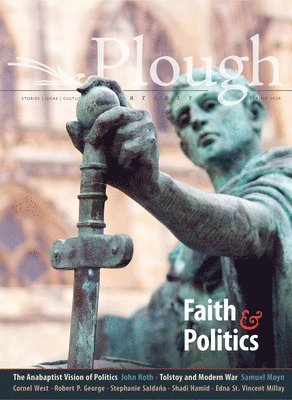
No matter who wins the next election, Caesar will remain Caesar, doing some good and some bad. But Christians report to a different king.This issue starts with a provocation. In his opening letter, editor Peter Mommsen suggests Christians are too excited about the wrong politics: “Questions of public justice should matter deeply to Christians. We dare not be indifferent about securing healthcare for all and ending interventionist wars; we must seek to reduce abortions and strengthen families. When an election comes, we should pray and then, perhaps, lend our support to a candidate we judge may, on balance, advance social righteousness. But if the early Christians and the Anabaptists are right, this isn’t the politics that matters most. And so, as a matter of faithfulness, we should question how much it deserves of our passion and time. Our allegiance belongs elsewhere.”In contrast to an election campaign, this politics may feel grittier and less glamorous. This issue of Plough Quarterly explores what this alternate vision of faithful Christian witness in the political sphere might look like.You’ll find articles on:What two leading political theorists of left and right agree onWhat persecution taught Anabaptists about politicsThe Bruderhof’s interactions with the stateTolstoy’s case against making war more humaneHow some Christians read Romans 13 under fascism
198 kr
Skickas
100 kr
Skickas inom 5-8 vardagar
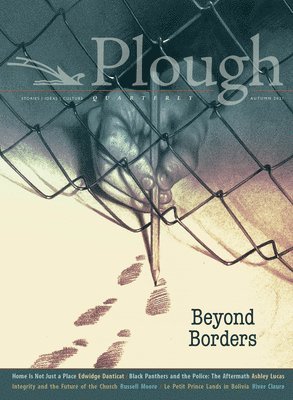
Canwe move beyond borders that divide us without losing our identity? Overthe past decade, theyearning for rootedness, for being part of a story bigger than oneself, hasflared up as a cultural force to be reckoned with. There’s much to affirm in thisdesire to belong to a people. That means pride in all that is admirable in thenation to which we belong – and repentance for its historic sins. Afocus on national identity, ofcourse, can lead to darker places. The new nationalists, who in Westerncountries often appeal to the memory of a Christian past, applaud whengovernments fortify borders to keep out people who are fleeing for their lives.(Needless to say, such actions are contrary to the Christian faith.) Is ouryearning for roots doomed to lead to a heartless politics of exclusion? Doesmaintaining group or national identity require borders guarded with lethalviolence? Theanswer isn’t artificial schemes for universal brotherhood, such as a universal language. Our differencesare what make a community human. Might the true ground for community lie deepereven than shared nationality or language? After all, the biblical vision ofhumankind’s ultimate future has “every tribe and language and people andnation” coming together – beyond all borders but still as themselves. In this issue: - Santiago Ramosdescribes a double homelessness immigrant children experience as outsiders inboth countries.- Ashley Lucasprofiles a Black Panther imprisoned for life and looks at the impact on hisfamily.- Simeon Wiehlerhelps a museum repatriate a thousand human skulls collected by a colonialist.- Yaniv Sageecalls Zionism back to its founding vision of a shared society withPalestinians.- StephanieSaldaña finds the lost legendary chocolates of Damascus being crafted in Texas.- EdwidgeDanticat says storytelling builds a home that no physical separation can takeaway.- Phographer RiverClaure reimagines Saint-Exupéry’s LePetit Prince as an Aymara fairy tale.- Ann Thomas tellsof liminal experiences while helping families choose a cemetery plot.- Russell Moorechallenges the church to reclaim its integrity and staunch an exodus. You’ll also find: - Prize-winning poemsby Mhairi Owens, Susan de Sola, and Forester McClatchey- A profile of Japanesepeacemaker Toyohiko Kagawa- Reviews ofFredrik deBoer’s The Cult of Smart,Anna Neima’s The Utopians, and AmorTowles’s The Lincoln Highway- Insights onfollowing Jesus from E. Stanley Jones, Barbara Brown Taylor, Teresa of Ávila,Oscar Romero, Martin Luther King Jr., Eberhard Arnold, Leonardo Boff, MeisterEckhart, C. S. Lewis, Hermas, and Dietrich Bonhoeffer Plough Quarterly features stories,ideas, and culturefor people eager to put their faith into action. Each issue brings you in-deptharticles, interviews, poetry, book reviews, and art to help you put Jesus’message into practice and find common cause with others.
117 kr
Skickas inom 5-8 vardagar
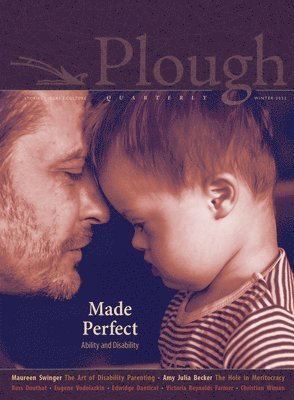
Whose lives count as fully human? The answer matters for everyone, disabled or not.The ancient Greek ideal linked physical wholeness to moral wholeness – the virtuous citizen was “beautiful and good.” It’s an ideal that has all too often turned deadly, casting those who do not measure up as less than human. In the pre-Christian era, infants with disabilities were left on the rocks; in modern times, they have been targeted by eugenics.Much has changed, thanks to the tenacious advocacy of the disability rights movement. Yesteryear’s hellish institutions have given way to customized educational programs and assisted living centers. Public spaces have been reconfigured to improve access. Therapies and medical technology have advanced rapidly in sophistication and effectiveness. Protections for people with disabilities have been enshrined in many countries’ antidiscrimination laws.But these victories, impressive as they are, mask other realities that collide awkwardly with society’s avowals of equality. Why are parents choosing to abort a baby likely to have a disability? Why does Belgian law allow for euthanasia in cases of disability, even absent a terminal diagnosis or physical pain? Why, when ventilators were in short supply during the first Covid wave, did some states list disability as a reason to deny care?On this theme: - Heonju Lee tells how his son with Down syndrome saved another child’s life.- Molly McCully Brown and Victoria Reynolds Farmer recount their personal experiences with disability.- Amy Julia Becker says meritocracies fail because they value the wrong things.- Maureen Swinger asks six mothers around the world about raising a child with disabilities.- Joe Keiderling documents the unfinished struggle for disability rights.- Isaac T. Soon wonders if Saint Paul’s “thorn in the flesh” was a disability.- Leah Libresco Sargeant reviews What Can a Body Do? and Making Disability Modern.- Sarah C. Williams says testing for fetal abnormalities is not a neutral practice.Also in the issue: - Ross Douthat is brought low by intractable Lyme disease.- Edwidge Danticat flees an active shooter in a packed mall.- Eugene Vodolazkin finds comic relief at funerals, including his own father’s.- Kelsey Osgood discovers that being an Orthodox Jew is strange, even in Brooklyn.- Christian Wiman pens three new poems.- Susannah Black profiles Flannery O’Conner.- Our writers review Eyal Press’s Dirty Work, Steve Coll’s Directorate S, and Millennial Nuns by the Daughters of Saint Paul.Plough Quarterly features stories, ideas, and culture for people eager to apply their faith to the challenges we face. Each issue includes in-depth articles, interviews, poetry, book reviews, and art.
112 kr
Skickas inom 11-20 vardagar
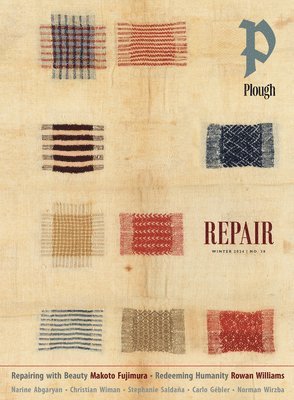
Our writers celebrate the work of repair – of objects, relationships, communities, and landscapes – and reckon with its limits.Consumers campaign for a “right to repair” in protest of products’ wasteful “planned obsolescence.” Repair cafés spring up, in which old-timers teach greenhorns to mend clothes and appliances. But much more than our possession stand in need of repair. For some, the Jewish phrase tikkun olam – to repair the world – may have become little more than a secular social justice mandate, not unlike the Christian cliché “God has no hands but ours.” Yet while we wait on God to repair the cosmos, there are indeed countless ways one can participate in this work, whether one is a mother, a handyman, a farmer, an artist, an teacher, or a pastor. The work may not be glamorous, but it calls forth our creativity and holds its own rewards.On this theme:- A handyman settles for humble work and doesn’t wish more for his children.- A mother mends her daughters’ clothes into extravagant works of arts.- A pastor in a declining denomination asks where to start repairing the church.- A farmer says a restored landscape will be more than it was before.- Yazidi, Rohingya, and Uyghur survivors of sexual violence find ways to reclaim their dignity.- Painter Makoto Fujimura says artists don’t fight culture wars, they make culture.- Prisoners and staff say prisons don’t rehabilitate, but education in prison just might.- A schoolteacher says education requires family, school, and community.- A church that prays in the language of Jesus, scattered by war, lives on in new places.Plough Quarterly features stories, ideas, and culture for people eager to apply their faith to the challenges we face. Each issue includes in-depth articles, interviews, poetry, book reviews, and art.
138 kr
Skickas