Stephen Doheny-Farina - Böcker
Visar alla böcker från författaren Stephen Doheny-Farina. Handla med fri frakt och snabb leverans.
4 produkter
4 produkter
657 kr
Tillfälligt slut
722 kr
Skickas inom 5-8 vardagar
428 kr
Skickas inom 5-8 vardagar
Are communication technologies ushering in a wondrous new age of computer networks that connect people into worldwide virtual communities of like-minded individuals? Or are global computer networks isolating us from real relationships and from our society, as we stare into a screen instead of interacting face to face? In this eloquent and thoughtful book, Stephen Doheny-Farina explores the nature of cyberspace and the increasing virtualization of everyday life. He occupies a middle ground between these two extreme views of the net, arguing that electronic neighborhoods should be less important than geophysical neighborhoods in all their integrity, and that we must use the new technologies not to escape from our troubled communities but to reinvigorate them.Doheny-Farina offers a critical perspective on virtual reality and its social impact, showing us how people meet and converse on the net, how they teach and learn, and how they establish workplaces that can accompany them wherever they go. Along the way he reveals the advantages and hazards of making the computer the center of our public and private lives. Doheny-Farina argues that once we begin to divorce ourselves from geographic place and start investing ourselves in virtual communities, we further the dissolution of our real, dying communities. He speaks out in favor of a movement called civic networking, which promotes the proliferation of networks that originate locally to organize community information and culture and to foster pride in and responsibility to our neighborhoods.
Grid and the Village
Losing Electricity, Finding Community, Surviving Disaster
Inbunden, Engelska, 2001
799 kr
Skickas inom 5-8 vardagar
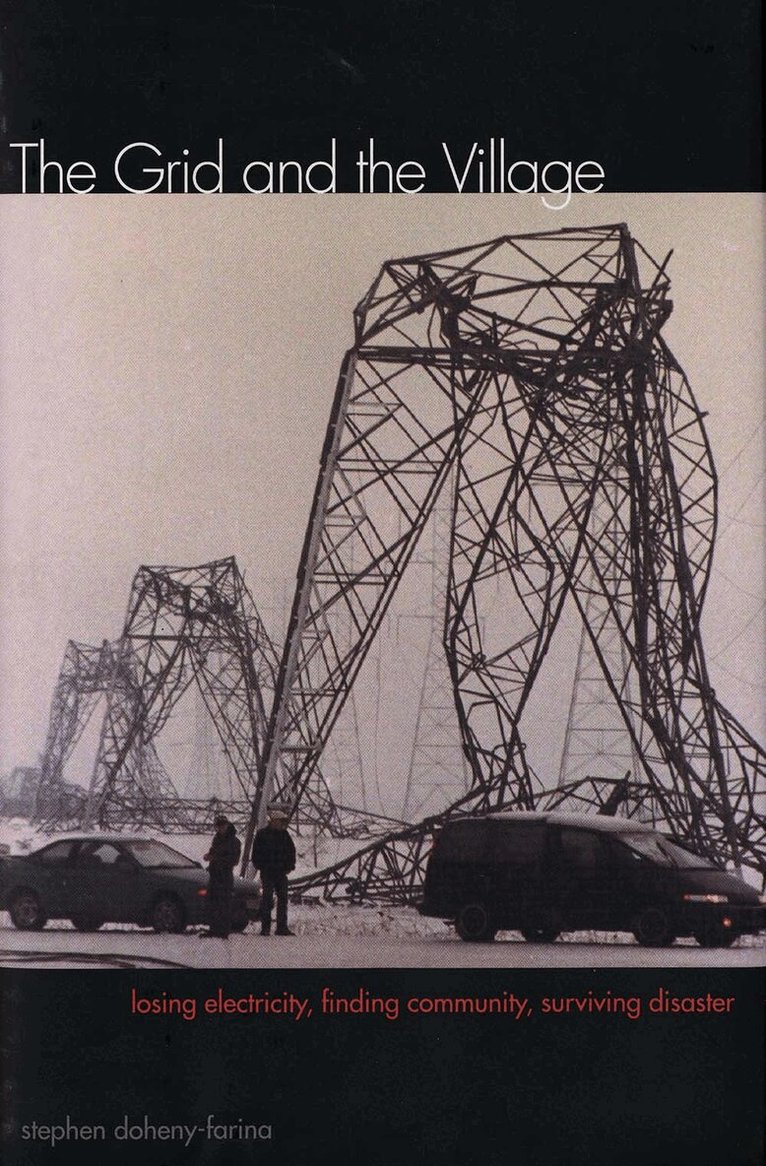
In January 1998 a massive ice storm descended on New York, New England, and eastern Canada. It crushed power grids from the Great Lakes to the North Atlantic, forcing thousands of people into public shelters and leaving millions of others in their homes without electricity. In this riveting book Stephen Doheny-Farina presents an insider’s account of these events, describing the destruction of the electric network in his own village and the emergence of the face-to-face interactions that took its place. His stories examine the impact of electronic communications on community, illuminating the relationship between electronic and human connections and between networks and neighborhoods, and exploring why and how media portrayals of disasters can distort authentic experience. Doheny-Farina begins by discussing the disaster and tracing the origins of the storm. He then goes back two hundred years to tell how this particular electric grid was built, showing us the sacrifices people made to create the grids that (usually) connect us to one another. Today’s power grid, says Doheny-Farina, has become more vulnerable than we realize, as demand begins to outstrip capacity in urban centers around the nation. His book reminds us what those grids mean—both positively and negatively—to our electronically saturated lives.