Stephen E. Spear – författare
1 575 kr
Skickas inom 5-8 vardagar
1 575 kr
Skickas inom 5-8 vardagar
1 575 kr
Skickas inom 5-8 vardagar
Endogenous Growth
Theory, Methods and Morphology
1 229 kr
Kommande
1 375 kr
Läs direkt efter köp
The 800 pound gorilla in the room of macroeconomics is the question of why the overlapping generations model didn’t become the central workhorse model for macroeconomics. Introduced in 1958 by Paul Samuelson, the model postulates an infinite number of finite-lived families. This is in stark contrast to the more dominant neoclassical growth model, which is based on the assumption that real economies are populated by a finite number of dynastic families. Despite the greater realism of the former model and the inherent implausibility of the assumptions underlying the growth model, the growth model has become dominant. The authors here explore the co-evolution of the two models to shed light on why this happened, spanning the entire post-WWII era.
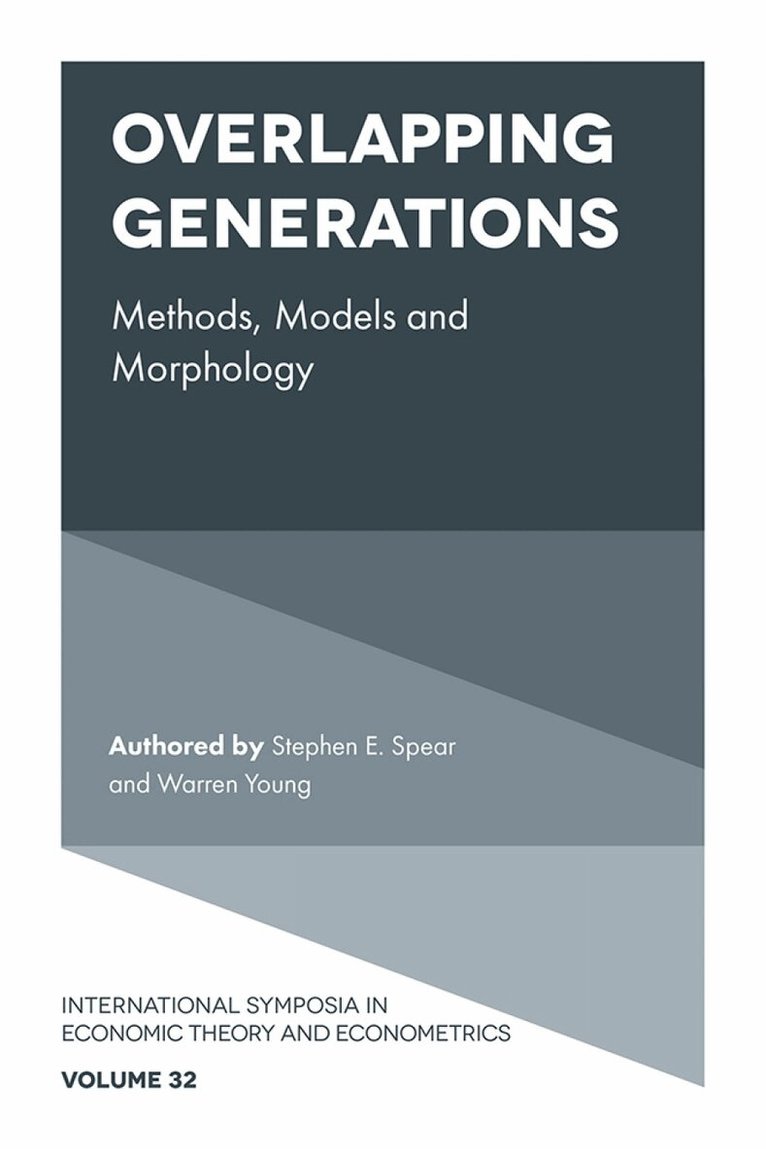
Overlapping Generations
Methods, Models and Morphology
1 278 kr
Skickas inom 5-8 vardagar
1 375 kr
Läs direkt efter köp
The 800 pound gorilla in the room of macroeconomics is the question of why the overlapping generations model didn’t become the central workhorse model for macroeconomics. Introduced in 1958 by Paul Samuelson, the model postulates an infinite number of finite-lived families. This is in stark contrast to the more dominant neoclassical growth model, which is based on the assumption that real economies are populated by a finite number of dynastic families. Despite the greater realism of the former model and the inherent implausibility of the assumptions underlying the growth model, the growth model has become dominant. The authors here explore the co-evolution of the two models to shed light on why this happened, spanning the entire post-WWII era.