Steven Totosy de Zepetnek – författare
Visar alla böcker från författaren Steven Totosy de Zepetnek. Handla med fri frakt och snabb leverans.
8 produkter
8 produkter
Häftad, Engelska, 2005
436 kr
Skickas inom 10-15 vardagar
The papers in this volume of the Purdue University Press series of Books in Comparative Cultural Studies represent recent scholarship about Booker Prize Winner Michael Ondaatje's oeuvre by scholars working in English-Canadian literature and culture. Contributors to the volume are Victoria Cook, Mariene Goldman, and Sandeep Sanghera with papers on Anil's Ghost, Beverley Curran, Stephanie M. Hilger, Hsuan Hsu, and Steven Totosy on The English Patient, Gien Lowry and Winfried Siemerling on In the Skin of a Lion, Jon Saklofske on Coming Through Slaughter, and Eluned Summers-Bremner on Ondaatje's poetry. The papers in the volume are followed by a selected bibliography of scholarship about Ondaatje's oeuvre (Steven Totosy), a list of Ondaatje's works, and the bio-profiles of the contributors to the volume. With the objective to render appreciation of both Ondaatje's writing and thought about his writing, the critical work presented in the volume will prove useful to general readers, critics, and scholars alike
Häftad, Engelska, 2005
436 kr
Skickas inom 10-15 vardagar
The volume fills a gap in scholarship about Imre Kertesz, whose work to date is largely unknown in the English-speaking world. The papers' authors are scholars from the US, Canada, the UK, Hungary, Germany, and New Zealand. In addition to the papers, the volume contains a bibliography of Kertesz's works including translations, and a bibliography of studies in several languages about his work.
Häftad, Engelska, 2009
407 kr
Skickas inom 11-20 vardagar
Comparative Central European Holocaust Studies contains select papers on various topics of culture and literature in Central and EastEurope from Canadian and U.S. conferences. Organized by the editor, Steven Tötösy de Zepetnek, the work presented in this volume is based on 1) the notion of the existence and the describability and analysis of a culture (including history, literature, society, and the arts) specific of/to the region designated as Central Europe, 2) the relevance of a field designated as Central European Holocaust studies, and 3) the relevance, in the study of culture, of the comparative and contextual approach designated as comparative cultural studies. Based on the (contested) notion of the existence of a specific culturalcontext of the region defined as "Central Europe," contributors tothe volume discuss the following topics: comparative cultural studies as a theoretical framework forthe study of Central and East European culture(s) (Steven Tötösy de Zepetnek),modernism in Central European literature (Andrea Fábry), Central EuropeanHolocaust poetry (Zsuzsanna Ozsváth), gender in Central European literature andfilm (Anikó Imre), Austroslovakism in the work of Slovak writer Anton Hykisch(Peter Petro), Kundera and the identity of Central Europe (Hana Pichova),public intellectuals in Central Europe after 1989 (Katherine Arens),contemporary Austrian and Hungarian cinema (Catherine Portuges), the notion ofperipherality in contemporary East European culture (Roumiana Deltcheva), andCentral European Jewish family history in the film Sunshine (Susan RubinSuleiman). The volume also includes a bibliography for the study of Central Europeanculture (Steven Tötösy de Zepetnek).
Häftad, Engelska, 2011
578 kr
Skickas inom 11-20 vardagar
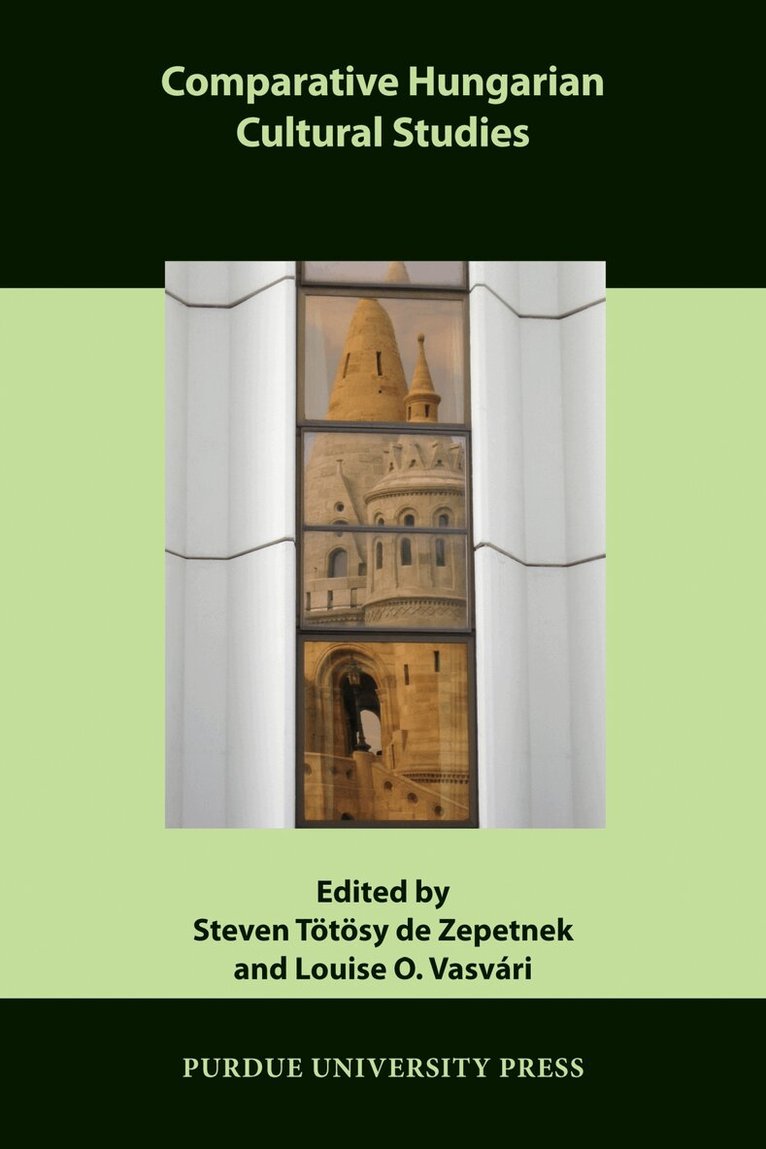
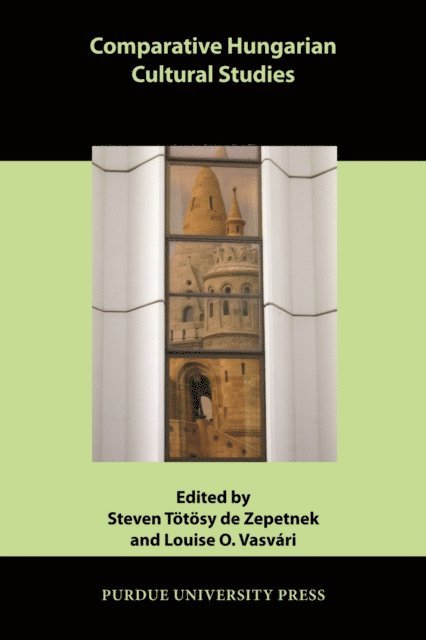
The studies presented in the collected volume Comparative Hungarian Cultural Studies -- edited by Steven Tötösy de Zepetnek and Louise O. Vasvári -- are intended as an addition to scholarship in (comparative) cultural studies. More specifically, the articles represent scholarship about Central and East European culture with special attention to Hungarian culture, literature, cinema, new media, and other areas of cultural expression. On the landscape of scholarship in Central and East Europe (including Hungary), cultural studies has acquired at best spotty interest and studies in the volume aim at forging interest in the field. The volume's articles are in five parts: part one, """"History Theory and Methodology of Comparative Hungarian Cultural Studies,"""" include studies on the prehistory of multicultural and multilingual Central Europe, where vernacular literatures were first institutionalized for developing a sense of national identity. Part two, """"Comparative Hungarian Cultural Studies and Literature and Culture"""" is about the re-evaluation of canonical works, as well as Jewish studies which has been explored inadequately in Central European scholarship. Part three, """"Comparative Hungarian Cultural Studies and Other Arts,"""" includes articles on race, jazz, operetta, and art, fin-de-siècle architecture, communist-era female fashion, and cinema. In part four, """"Comparative Hungarian Cultural Studies and Gender,"""" articles are about aspects of gender and sex(uality) with examples from fin-de-siècle transvestism, current media depictions of heterodox sexualities, and gendered language in the workplace. The volume's last section, part five, """"Comparative Hungarian Cultural Studies of Contemporary Hungary,"""" includes articles about post-1989 issues of race and ethnic relations, citizenship and public life, and new media.
E-bok
PDF, Engelska, 2011472 kr
Läs direkt efter köp
The studies presented in the collected volume Comparative Hungarian Cultural Studies— edited by Steven Totosy de Zepetnek and Louise O. Vasvari—are intended as an addition to scholarship in (comparative) cultural studies. More specifically, the articles represent scholarship about Central and East European culture with special attention to Hungarian culture, literature, cinema, new media, and other areas of cultural expression. On the landscape of scholarship in Central and East Europe (including Hungary), cultural studies has acquired at best spotty interest and studies in the volume aim at forging interest in the field. The volume''s articles are in five parts: part one, "History Theory and Methodology of Comparative Hungarian Cultural Studies," include studies on the prehistory of multicultural and multilingual Central Europe, where vernacular literatures were first institutionalized for developing a sense of national identity. Part two, "Comparative Hungarian Cultural Studies and Literature and Culture" is about the re-evaluation of canonical works, as well as Jewish studies which has been explored inadequately in Central European scholarship. Part three, "Comparative Hungarian Cultural Studies and Other Arts," includes articles on race, jazz, operetta, and art, fin-de-siecle architecture, communist-era female fashion, and cinema. In part four, "Comparative Hungarian Cultural Studies and Gender," articles are about aspects of gender and sex(uality) with examples from fin-de-siecle transvestism, current media depictions of heterodox sexualities, and gendered language in the workplace. The volume''s last section, part five, "Comparative Hungarian Cultural Studies of Contemporary Hungary," includes articles about post-1989 issues of race and ethnic relations, citizenship and public life, and new media.
E-bok
Engelska, 2011472 kr
Läs direkt efter köp
The studies presented in the collected volume Comparative Hungarian Cultural Studies— edited by Steven Totosy de Zepetnek and Louise O. Vasvari—are intended as an addition to scholarship in (comparative) cultural studies. More specifically, the articles represent scholarship about Central and East European culture with special attention to Hungarian culture, literature, cinema, new media, and other areas of cultural expression. On the landscape of scholarship in Central and East Europe (including Hungary), cultural studies has acquired at best spotty interest and studies in the volume aim at forging interest in the field. The volume''s articles are in five parts: part one, "History Theory and Methodology of Comparative Hungarian Cultural Studies," include studies on the prehistory of multicultural and multilingual Central Europe, where vernacular literatures were first institutionalized for developing a sense of national identity. Part two, "Comparative Hungarian Cultural Studies and Literature and Culture" is about the re-evaluation of canonical works, as well as Jewish studies which has been explored inadequately in Central European scholarship. Part three, "Comparative Hungarian Cultural Studies and Other Arts," includes articles on race, jazz, operetta, and art, fin-de-siecle architecture, communist-era female fashion, and cinema. In part four, "Comparative Hungarian Cultural Studies and Gender," articles are about aspects of gender and sex(uality) with examples from fin-de-siecle transvestism, current media depictions of heterodox sexualities, and gendered language in the workplace. The volume''s last section, part five, "Comparative Hungarian Cultural Studies of Contemporary Hungary," includes articles about post-1989 issues of race and ethnic relations, citizenship and public life, and new media.
E-bok
PDF, Engelska, 2013708 kr
Läs direkt efter köp
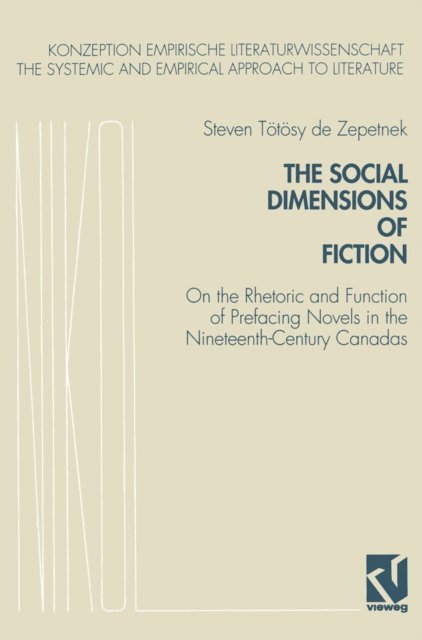
This work is a comparative study of nineteenth-century English-Canadian and French Canadian novel prefaces, a previously unexplored literary topic. As a study in Comparative Literature - with the application of a specific literary framework and methodology - the study conforms to theoretical and methodological postulates formulated in and prescribed by this framework when applied. This a priori postulate necessitates that the research on and the presentation of the Canadian novel preface be carried out in a specific manner, as follows. First, the study will establish the hypothesis that the preface to nineteenth-century English-Canadian and French-Canadian novels is a genre in its own right. This hypothesis will rest on the following: 1) a taxonomical survey of related terms meaning "preface"; 2) a survey of secondary Iiterature of works dealing with the preface; 3) a discussion of the theoretical framework and methodology of the Empirical Theory of Literature and its appropriateness for the study of the preface; and 4) a discussion of the process of the compilation of the corpus of nineteenth-century Canadian novel prefaces (Chapter one). In a second step, the theoretical postulate outlined in the hypothesis will be put into practice by the development and production of a preface typology (Chapter two). In a third step, further tenets of the Empirical Theory of Literature will be tested on the corpus of the prefaces (Chapter three). In a fourth step, the prefaces will be analysed following the tenets formulated in and prescribed by the systemic framework applied (Chapter four).
E-bok
PDF, Engelska, 20242 132 kr
Läs direkt efter köp
This book serves several purposes, all very much needed in today's embattled situation of the humanities and the study of literature. First, in Chapter One, the author proposes that the discipline of Comparative Literature is a most advantageous approach for the study of literature and culture as it is a priori a discipline of cross-disciplinarity and of international dimensions. After a Manifesto for a New Comparative Literature, he proceeds to offer several related theoretical frameworks as a composite method for the study of literature and culture he designates and explicates as the systemic and empirical approach. Following the introduction of the proposed New Comparative Literature, the author applies his method to a wide variety of literary and cultural areas of inquiry such as Literature and Cultural Participation where he discusses several aspects of reading and readership (Chapter Two), Comparative Literature as/and Interdisciplinarity (Chapter Three) where he deals with theory and application for film and literature and medicine and literature, Cultures, Peripheralities, and Comparative Literature (Chapter Four) where he proposes a theoretical designation he terms inbetween peripherality for the study of East Central European literatures and cultures as well as ethnic minority writing, Women's Literature and Men Writing about Women (Chapter Five) where he analyses texts written by women and texts about women written by men in the theoretical context of Ethical Constructivism, The Study of Translation and Comparative Literature (Chapter Six) where after a theoretical introduction he presents a new version of Anton Popovic's dictionary for literary translation as a taxonomy for the study of translation, and The Study of Literature and the Electronic Age (Chapter Seven), where he discusses the impact of new technologies on the study of literature and culture. The analyses in their various applications of the proposed New Comparative Literature involve modern and contemporary authors and their works such as Dorothy Richardson, Margit Kaffka, Mircea Cartarescu, Robert Musil, Alfred Doblin, Hermann Hesse, Peter Esterhazy, Dezso Kosztolanyi, Michael Ondaatje, Endre Kukorelly, Else Seel, and others.