Steven Ungar - Böcker
Visar alla böcker från författaren Steven Ungar. Handla med fri frakt och snabb leverans.
6 produkter
6 produkter
351 kr
Skickas inom 10-15 vardagar
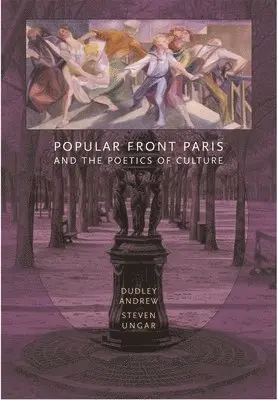
The story of Paris in the 1930s seems straightforward enough, with the Popular Front movement leading toward the inspiring 1936 election of a leftist coalition government. The socialist victory, which resulted in fundamental improvements in the lives of workers, was then derailed in a precipitous descent that culminated in France's capitulation before the Nazis in June 1940. Yet no matter how minutely recounted, this "straight story" clarifies only the political activity behind which turbulent cultural currents brought about far-reaching changes in everyday life and the way it is represented.In this book, Dudley Andrew and Steven Ungar apply an evocative "poetics of culture" to capture the complex atmospherics of Paris in the 1930s. They highlight the new symbolic forces put in play by technologies of the illustrated press and the sound film—technologies that converged with efforts among writers (Gide, Malraux, Céline), artists (Renoir, Dalí), and other intellectuals (Mounier, de Rougemont, Leiris) to respond to the decade's crises.Their analysis takes them to expositions and music halls, to upscale architecture and fashion sites, to traditional neighborhoods, and to overseas territories, the latter portrayed in metropolitan exhibits and colonial cinema. Rather than a straight story of the Popular Front, they have produced something closer to the format of an illustrated newspaper whose multiple columns represent the breadth of urban life during this critical decade at the end of the Third French Republic.
311 kr
Skickas inom 7-10 vardagar
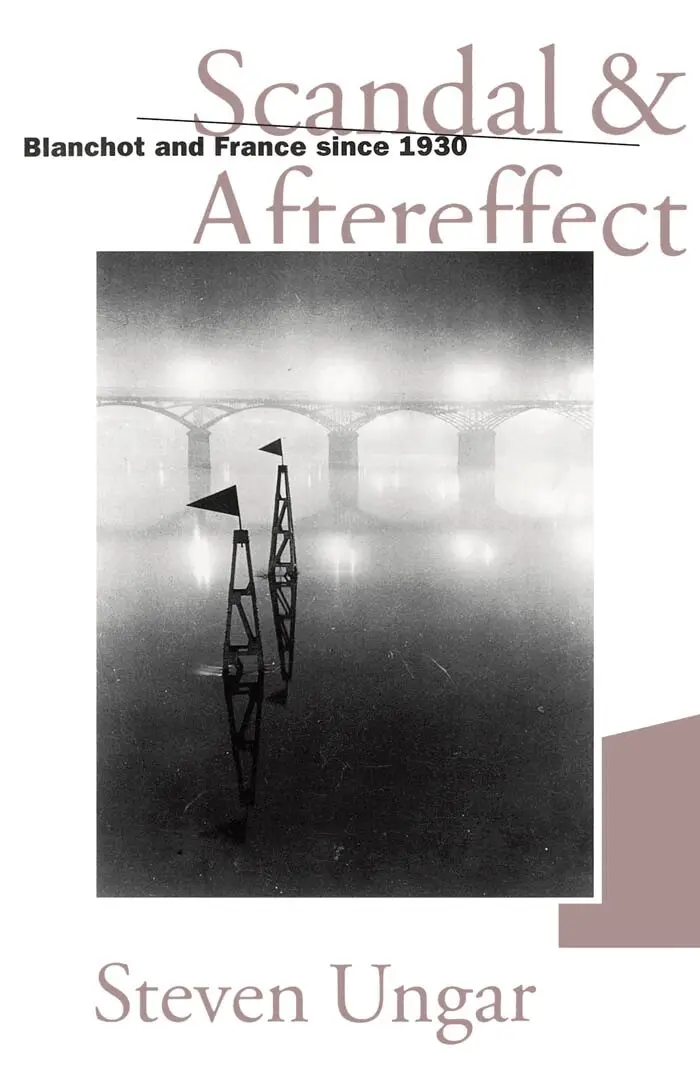
Maurice Blanchot emerged after World War II as a key figure in the literary world, though he was known by some of his contemporaries in France for his prior involvement in far-rightist politics. How did this happen? Why have literary critics, as in the cases of Martin Heidegger and Paul de Man, chosen to ignore or suppress Blanchot's right-wing interwar and wartime writings, focusing instead on his postwar production? Scandal and Aftereffect provides an enlightening and provocative examination of these questions, as Steven Ungar looks at 100 articles published under Blanchot's signature between 1932 and 1937 in such right-wing publications as Combat, Le Rempart, and l'InsurgÉ.Using the concept of the "aftereffect" (developed in psychoanalysis to link the shock of disclosure to problems of repression), Ungar expands his study of Blanchot's writings into a broader analyses of cultural, political, and historical amnesia in an attempt to resolve the following questions: How and when does critical understanding of the past develop when control over the memory of a specific period is contested among those who lived it and those whose access to it depends on the accounts of others? Why have historical accounts of the recent past become increasingly open to question and revision? How structural is this process, or is it purely peculiar to wartime periods and therefore tied to the nature of contemporary historical experiences?Addressing problems of method related to the convergence of interests among historians and literary scholars, Ungar includes an overview of current debates surrounding the contested memories of Vichy France and the Holocaust. Scandal and Aftereffect will make a crucial contribution to discussions about the function of memory in the relationship of history to cultural production and about the history of history itself.
640 kr
Skickas inom 10-15 vardagar
Identity Papers was first published in 1996. Minnesota Archive Editions uses digital technology to make long-unavailable books once again accessible, and are published unaltered from the original University of Minnesota Press editions.What does citizenship mean? What is the process of "naturalization" one goes through in becoming a citizen, and what is its connection to assimilation? How do the issues of identity raised by this process manifest themselves in culture? These questions, and the way they arise in contemporary France, are the focus of this diverse collection.The essays in this volume range in subject from fiction and essay to architecture and film. Among the topics discussed are the 1937 Exposition Universelle; films dealing with Vichy France; François Truffaut's Histoire d'Adèle H.; the war of Algerian independence; and nation building under François Mitterrand.Contributors: Anne Donadey, Elizabeth Ezra, Richard J. Golsan, Lynn A. Higgins, T. Jefferson Kline, Panivong Norindr, Shanny Peer, Rosemarie Scullion, David H. Slavin, Philip H. Solomon; Florianne Wild, .Steven Ungar is professor of cinema and comparative literature at the University of Iowa and author of Scandal and Aftereffect: Blanchot and France since 1930 (Minnesota, 1995). Tom Conley is professor of French at Harvard University.
301 kr
Skickas inom 7-10 vardagar
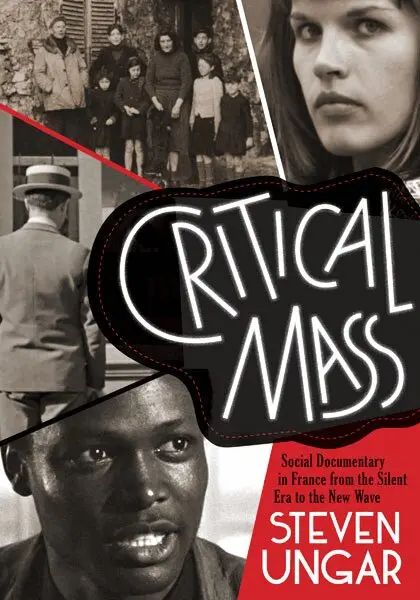
Thirty-five years of nonfiction films offer a unique lens on twentieth-century French social issuesCritical Mass is the first sustained study to trace the origins of social documentary filmmaking in France back to the late 1920s. Steven Ungar argues that socially engaged nonfiction cinema produced in France between 1945 and 1963 can be seen as a delayed response to what filmmaker Jean Vigo referred to in 1930 as a social cinema whose documented point of view would open the eyes of spectators to provocative subjects of the moment.Ungar identifies Vigo’s manifesto, his 1930 short À propos de Nice, and late silent-era films by Georges Lacombe, Boris Kaufman, AndrÉ Sauvage, and Marcel CarnÉ as antecedents of postwar documentaries by Eli Lotar, RenÉ Vautier, Alain Resnais, Chris Marker, and Jean Rouch, associated with critiques of colonialism and modernization in Fourth and early Fifth Republic France. Close readings of individual films alternate with transitions to address transnational practices as well as state- and industry-wide reforms between 1935 and 1960. Critical Mass is an indispensable complement to studies of nonfiction film in France, from Georges Lacombe’s La Zone (1928) to Chris Marker’s Le Joli Mai (1963).
246 kr
Skickas inom 7-10 vardagar
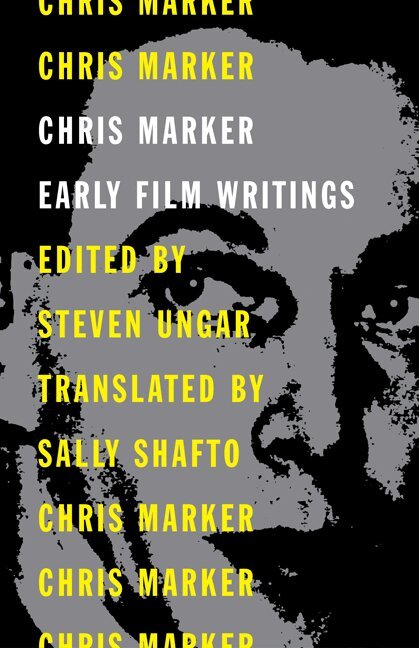
Formative writings by French avant-garde filmmaker Chris Marker It is hard to imagine French cinema without La JetÉe (1962), the time-travel short feature by the reclusive French filmmaker Christian FranÇois Bouche-Villeneuve, better known as Chris Marker. He not only influenced artists ranging from David Bowie to J. G. Ballard but also inspired the cult film 12 Monkeys. Marker’s influence expanded beyond his own films through his writings for the French monthly Esprit as well as anthologies and newly founded film publications. This first English translation of Marker’s early writings on film brings together reviews and essays, published between 1948 and 1955, that span the topics of film style, adaptation, and ideology, as well as animation and the debates surrounding 3-D and wide-screen technologies, ranging from late silent-era films to postwar Hollywood’s efforts to contend with the rise of television. Readers will find commentary on Laurence Olivier’s 1944 screen adaptation of Henry V, a scathing review of Robert Montgomery’s Lady in the Lake (1947), critiques of Walt Disney productions, a discussion of the pitfalls of prioritizing commercial success over aesthetic values, and more. An indispensable resource for cinephiles and scholars alike, these texts document the emergence of Marker’s critical voice and situate him alongside such contemporaries as AndrÉ Bazin and Eric Rohmer, as well as the future French New Wave figures Jean-Luc Godard and FranÇois Truffaut. They show how his remarks on individual films open onto his engagement with films as social and cultural phenomena.
189 kr
Skickas inom 7-10 vardagar
Cléo de 5 à 7 (Cléo from 5 to 7), Agnes Varda's classic 1962 work depicts, in near real-time, 90 minutes in the life of Cléo, a young woman in Paris awaiting the results of medical tests that she fears will confirm a fatal condition. The film, whose visual beauty matches its evocation of early-Fifth Republic Paris, was a major point of reference for the French New Wave despite the fact that Varda never considered herself a member of the core Cahiers du cinéma group of critics-turned- film-makers. Ungar provides a close reading of the film and situates it in its social, political and cinematic contexts, tracing Varda's early career as a student of art history and as a photographer, the history of post-war French film, and the lengthy Algerian war to which Cléo's health concerns and ambitions to become a pop singer make her more or less oblivious. His study is the first to set a reading of Cléo's formal and technical complexity alongside an analysis of its status as a visual document of its historical moment. Steven Ungar's foreword to this new edition looks back upon Varda's film-making career and considers her contributions as a female auteur and in the context of the French New Wave.