
Sukhendu Ray – författare
Visar alla böcker från författaren Sukhendu Ray. Handla med fri frakt och snabb leverans.
3 produkter
3 produkter
Häftad, Engelska, 2014
433 kr
Skickas inom 3-6 vardagar
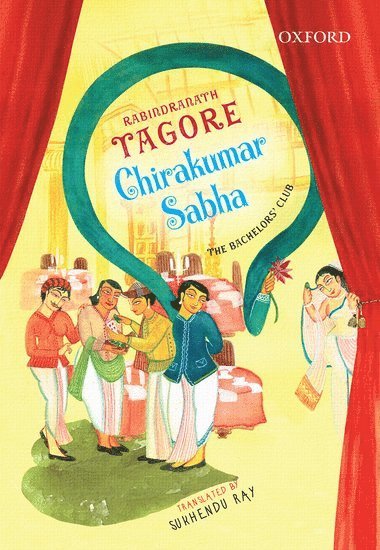
Set in Calcutta in the early-nineteenth century, the play Chirakumar Sabha (The Bachelors' Club), originally written by Rabindranath Tagore (1861-1941), is neatly aimed at matrimony, and against celibacy. Calcutta was the capital of British India then. Members of Chirakumar Sabha have vowed to remain unmarried throughout life. The Club is headed by Chandrababu, a professor, who lives with his niece, Nirmala and at whose house the meetings of Chirakumar Sabha are held. The coup de grace comes when the sole survivor, Purna, falls for Chandrababu's niece. A hilarious account of a group of bachelors eventually getting married in due course, this translation from the Bengali original by Sukhendu Ray captures the spirit of the original play while retaining its readability.
Häftad, Engelska, 2024
664 kr
Skickas inom 10-15 vardagar
This charming book The Many Worlds of Sarala Devi and The Tagores and Sartorial Styles, as the titles suggest, contain two separate but related writings on the Tagores. The Tagores were a pre-eminent family which became synonymous with the cultural regeneration of India, specifically of Bengal, in the nineteenth century. The first writing is a sensitive translation of Sarala Devis memoirs from the Bengali, Jeevaner Jharapata, by Sukhendu Ray. It is the first autobiography written by a nationalist woman leader of India. Sarala Devi was Rabindranath Tagores niece and had an unusual life. The translation unfolds, among other things, what it was like to grow up in a big affluent house Jorasanko, that had more than 116 inmates and a dozen cooks! The second writing by Malavika Karlekar is a photo essay, creatively conceived, visually reflecting the social and cultural trends of the times, through styles of dress, jewellery and accoutrements. The modern style of wearing a sari was introduced by Jnanadanandini Devi, a member of the Tagore family. The introduction by the well-known historian, Bharati Ray, very perceptively captures the larger context of family, marriage, womens education and politics of the time which touched Sarala Devis life. She points out that if memoirs are a kind of social history then womens diaries record social influences not found in official accounts and are therefore, a rich source of documentation.
Inbunden, Engelska, 2017
2 269 kr
Skickas inom 10-15 vardagar
This charming book The Many Worlds of Sarala Devi and The Tagores and Sartorial Styles, as the titles suggest, contain two separate but related writings on the Tagores. The Tagores were a pre-eminent family which became synonymous with the cultural regeneration of India, specifically of Bengal, in the nineteenth century. The first writing is a sensitive translation of Sarala Devis memoirs from the Bengali, Jeevaner Jharapata, by Sukhendu Ray. It is the first autobiography written by a nationalist woman leader of India. Sarala Devi was Rabindranath Tagores niece and had an unusual life. The translation unfolds, among other things, what it was like to grow up in a big affluent house Jorasanko, that had more than 116 inmates and a dozen cooks! The second writing by Malavika Karlekar is a photo essay, creatively conceived, visually reflecting the social and cultural trends of the times, through styles of dress, jewellery and accoutrements. The modern style of wearing a sari was introduced by Jnanadanandini Devi, a member of the Tagore family. The introduction by the well-known historian, Bharati Ray, very perceptively captures the larger context of family, marriage, womens education and politics of the time which touched Sarala Devis life. She points out that if memoirs are a kind of social history then womens diaries record social influences not found in official accounts and are therefore, a rich source of documentation.