Susan K. Sell - Böcker
Visar alla böcker från författaren Susan K. Sell. Handla med fri frakt och snabb leverans.
8 produkter
8 produkter
412 kr
Skickas inom 7-10 vardagar
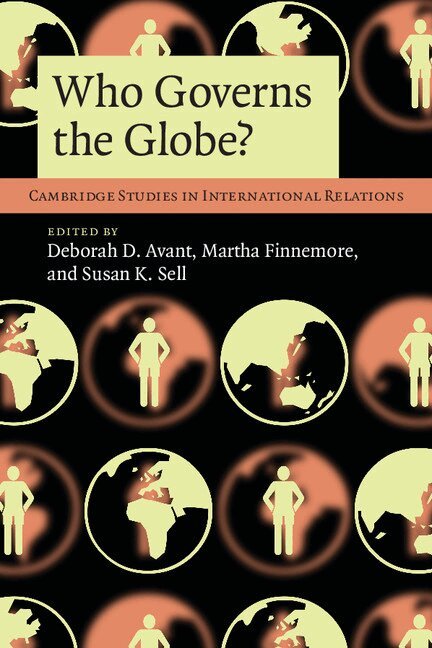
Academics and policymakers frequently discuss global governance but they treat governance as a structure or process, rarely considering who actually does the governing. This volume focuses on the agents of global governance: 'global governors'. The global policy arena is filled with a wide variety of actors such as international organizations, corporations, professional associations, and advocacy groups, all seeking to 'govern' activity surrounding their issues of concern. Who Governs the Globe? lays out a theoretical framework for understanding and investigating governors in world politics. It then applies this framework to various governors and policy arenas, including arms control, human rights, economic development, and global education. Edited by three of the world's leading international relations scholars, this is an important contribution that will be useful for courses, as well as for researchers in international studies and international organizations.
The Global Battle Over Intellectual Property
The Cat-and-Mouse Game of Protection and Enforcement
Inbunden, Engelska, 2025
1 339 kr
Skickas inom 3-6 vardagar
Governance of intellectual property (IP) at the international level has in recent decades become one of the most contentious issues in international political economy. It is also enormously complex and dynamic. In The Global Battle Over Intellectual Property, the eminent international relations scholar Susan K. Sell focuses on why IP is such a contested field. The reasons are many. The current IP regime's distributional consequences across countries are highly uneven. There has been a proliferation of international IP forums, sometimes working at cross purposes and striving for different goals. The ever-increasing complexity of the regime raises profound questions about representation and legitimacy. While there is clearly a set of powerful stakeholders, whether they are the right ones or not is an open question. To address the range of these related issues, Sell focuses on the dynamics driving change and the implications they have for governance and implementing more equitable policies. Throughout, she relies on the metaphor of cat and mouse to explain how the influence of complicated power relations, the strategic use of institutions, and discourse that drive the politics of IP. Combining insights from political economy, law, and sociology, Sell offers new insights into regime complexity and dynamics. Importantly, the framework she develops can be applied to a variety of highly contested issues, including climate change and financial regulation.
The Global Battle Over Intellectual Property
The Cat-and-Mouse Game of Protection and Enforcement
Häftad, Engelska, 2026
256 kr
Skickas inom 5-8 vardagar
Governance of intellectual property (IP) at the international level has in recent decades become one of the most contentious issues in international political economy. It is also enormously complex and dynamic. In The Global Battle Over Intellectual Property, the eminent international relations scholar Susan K. Sell focuses on why IP is such a contested field. The reasons are many. The current IP regime's distributional consequences across countries are highly uneven. There has been a proliferation of international IP forums, sometimes working at cross purposes and striving for different goals. The ever-increasing complexity of the regime raises profound questions about representation and legitimacy. While there is clearly a set of powerful stakeholders, whether they are the right ones or not is an open question. To address the range of these related issues, Sell focuses on the dynamics driving change and the implications they have for governance and implementing more equitable policies. Throughout, she relies on the metaphor of cat and mouse to explain how the influence of complicated power relations, the strategic use of institutions, and discourse that drive the politics of IP. Combining insights from political economy, law, and sociology, Sell offers new insights into regime complexity and dynamics. Importantly, the framework she develops can be applied to a variety of highly contested issues, including climate change and financial regulation.
Del 114 - Cambridge Studies in International Relations
Who Governs the Globe?
Inbunden, Engelska, 2010
685 kr
Skickas inom 7-10 vardagar
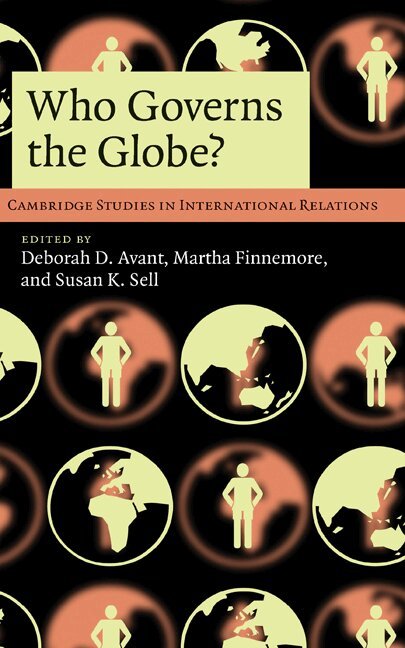
Academics and policymakers frequently discuss global governance but they treat governance as a structure or process, rarely considering who actually does the governing. This volume focuses on the agents of global governance: 'global governors'. The global policy arena is filled with a wide variety of actors such as international organizations, corporations, professional associations, and advocacy groups, all seeking to 'govern' activity surrounding their issues of concern. Who Governs the Globe? lays out a theoretical framework for understanding and investigating governors in world politics. It then applies this framework to various governors and policy arenas, including arms control, human rights, economic development, and global education. Edited by three of the world's leading international relations scholars, this is an important contribution that will be useful for courses, as well as for researchers in international studies and international organizations.
Del 88 - Cambridge Studies in International Relations
Private Power, Public Law
The Globalization of Intellectual Property Rights
Häftad, Engelska, 2003
443 kr
Skickas inom 7-10 vardagar
Susan K. Sell's book shows how power in international politics is increasingly exercised by private interests rather than governments. In 1994 the WTO adopted the Agreement on Trade-Related Aspects of Intellectual Property Rights (TRIPS), which dictated to states how they should regulate the protection of intellectual property. This book argues that TRIPS resulted from lobbying by twelve powerful CEOs of multinational corporations who wished to mould international law to protect their markets. This book examines the politics leading up to TRIPS, the first seven years of its implementation, and the political backlash against TRIPS in the face of the HIV/AIDS crisis. Focusing on global capitalism, ideas, and economic coercion, this work explains the politics behind TRIPS and the controversies created in its wake. It is a fascinating study of the influence of private interests in government decision-making, and in the shaping of the global economy.
Del 88 - Cambridge Studies in International Relations
Private Power, Public Law
The Globalization of Intellectual Property Rights
Inbunden, Engelska, 2003
1 097 kr
Skickas inom 7-10 vardagar
Susan K. Sell's book shows how power in international politics is increasingly exercised by private interests rather than governments. In 1994 the WTO adopted the Agreement on Trade-Related Aspects of Intellectual Property Rights (TRIPS), which dictated to states how they should regulate the protection of intellectual property. This book argues that TRIPS resulted from lobbying by twelve powerful CEOs of multinational corporations who wished to mould international law to protect their markets. This book examines the politics leading up to TRIPS, the first seven years of its implementation, and the political backlash against TRIPS in the face of the HIV/AIDS crisis. Focusing on global capitalism, ideas, and economic coercion, this work explains the politics behind TRIPS and the controversies created in its wake. It is a fascinating study of the influence of private interests in government decision-making, and in the shaping of the global economy.
989 kr
Skickas inom 7-10 vardagar
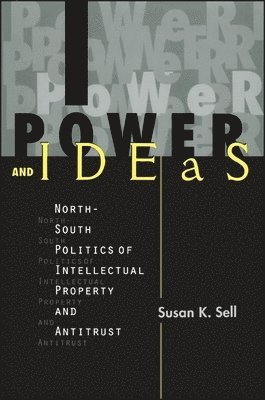
The first comprehensive political-science treatment of the global politics and diplomacy of intellectual property and antitrust, with focus on relations between developing and industrialized countries.Once considered arcane issues, intellectual property protection and antitrust have emerged in the last decade as central items on national and international agendas. Susan K. Sell presents the first comprehensive book-length political science treatment of these issues. She analyzes the North-South politics and diplomacy of intellectual property protection and antitrust in two eras: from the early 1970s to 1985, and from 1985 to the present. For the first era, the book analyzes multilateral negotiations over codes of conduct for technology transfer, restrictive business practices, and intellectual property protection. For the second era, the book focuses on the spread of antitrust policies in developing countries, the use of coercive bilateral diplomacy by the United States in its quest to strengthen global intellectual property protection, and the Uruguay Round of trade talks.Power and Ideas provides historical perspective, a broad introduction to the issues, and an in-depth, substantive analysis of the global politics and diplomacy of intellectual property protection and antitrust. Sell highlights the profound changes underway in both developing and industrialized countries. Drawing upon international relations scholarship on the role of ideas, she emphasizes the importance of understanding how and why policy makers redefined their interests in these areas. By incorporating intersubjective dimensions of politics, the institutionalization of economic ideas, and power asymmetries, Sell explains significant trends that will shape international commerce for years to come.
382 kr
Tillfälligt slut
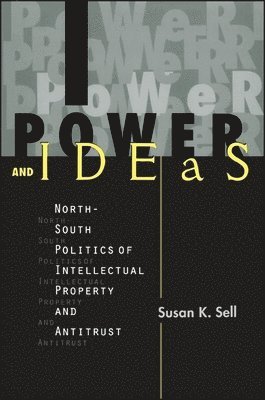
The first comprehensive political-science treatment of the global politics and diplomacy of intellectual property and antitrust, with focus on relations between developing and industrialized countries.Once considered arcane issues, intellectual property protection and antitrust have emerged in the last decade as central items on national and international agendas. Susan K. Sell presents the first comprehensive book-length political science treatment of these issues. She analyzes the North-South politics and diplomacy of intellectual property protection and antitrust in two eras: from the early 1970s to 1985, and from 1985 to the present. For the first era, the book analyzes multilateral negotiations over codes of conduct for technology transfer, restrictive business practices, and intellectual property protection. For the second era, the book focuses on the spread of antitrust policies in developing countries, the use of coercive bilateral diplomacy by the United States in its quest to strengthen global intellectual property protection, and the Uruguay Round of trade talks.Power and Ideas provides historical perspective, a broad introduction to the issues, and an in-depth, substantive analysis of the global politics and diplomacy of intellectual property protection and antitrust. Sell highlights the profound changes underway in both developing and industrialized countries. Drawing upon international relations scholarship on the role of ideas, she emphasizes the importance of understanding how and why policy makers redefined their interests in these areas. By incorporating intersubjective dimensions of politics, the institutionalization of economic ideas, and power asymmetries, Sell explains significant trends that will shape international commerce for years to come.