Deborah D. Avant - Böcker
Visar alla böcker från författaren Deborah D. Avant. Handla med fri frakt och snabb leverans.
5 produkter
5 produkter
412 kr
Skickas inom 7-10 vardagar
Academics and policymakers frequently discuss global governance but they treat governance as a structure or process, rarely considering who actually does the governing. This volume focuses on the agents of global governance: 'global governors'. The global policy arena is filled with a wide variety of actors such as international organizations, corporations, professional associations, and advocacy groups, all seeking to 'govern' activity surrounding their issues of concern. Who Governs the Globe? lays out a theoretical framework for understanding and investigating governors in world politics. It then applies this framework to various governors and policy arenas, including arms control, human rights, economic development, and global education. Edited by three of the world's leading international relations scholars, this is an important contribution that will be useful for courses, as well as for researchers in international studies and international organizations.
Del 114 - Cambridge Studies in International Relations
Who Governs the Globe?
Inbunden, Engelska, 2010
685 kr
Skickas inom 7-10 vardagar
Academics and policymakers frequently discuss global governance but they treat governance as a structure or process, rarely considering who actually does the governing. This volume focuses on the agents of global governance: 'global governors'. The global policy arena is filled with a wide variety of actors such as international organizations, corporations, professional associations, and advocacy groups, all seeking to 'govern' activity surrounding their issues of concern. Who Governs the Globe? lays out a theoretical framework for understanding and investigating governors in world politics. It then applies this framework to various governors and policy arenas, including arms control, human rights, economic development, and global education. Edited by three of the world's leading international relations scholars, this is an important contribution that will be useful for courses, as well as for researchers in international studies and international organizations.
360 kr
Skickas inom 7-10 vardagar
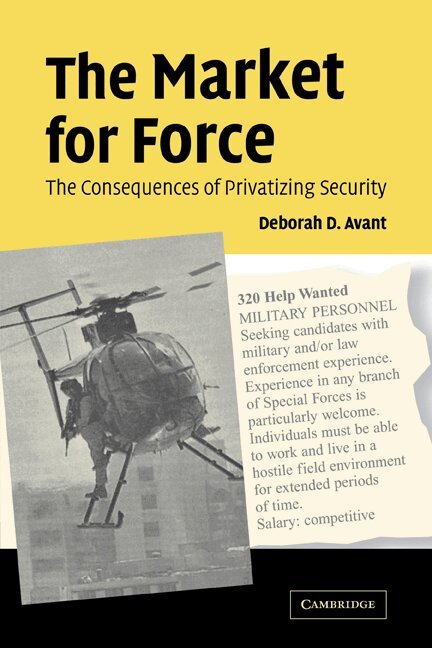
The legitimate use of force is generally presumed to be the realm of the state. However, the flourishing role of the private sector in security over the last twenty years has brought this into question. In this book Deborah Avant examines the privatization of security and its impact on the control of force. She describes the growth of private security companies, explains how the industry works, and describes its range of customers - including states, non-government organisations and commercial transnational corporations. She charts the inevitable trade-offs that the market for force imposes on the states, firms and people wishing to control it, suggests a new way to think about the control of force, and offers a model of institutional analysis that draws on both economic and sociological reasoning. The book contains case studies drawn from the US and Europe as well as Africa and the Middle East.
1 245 kr
Skickas inom 7-10 vardagar
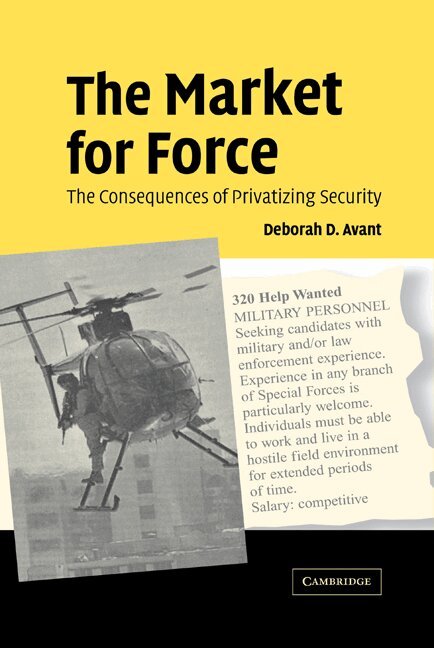
The legitimate use of force is generally presumed to be the realm of the state. However, the flourishing role of the private sector in security over the last twenty years has brought this into question. In this book Deborah Avant examines the privatization of security and its impact on the control of force. She describes the growth of private security companies, explains how the industry works, and describes its range of customers - including states, non-government organisations and commercial transnational corporations. She charts the inevitable trade-offs that the market for force imposes on the states, firms and people wishing to control it, suggests a new way to think about the control of force, and offers a model of institutional analysis that draws on both economic and sociological reasoning. The book contains case studies drawn from the US and Europe as well as Africa and the Middle East.
268 kr
Skickas inom 10-15 vardagar
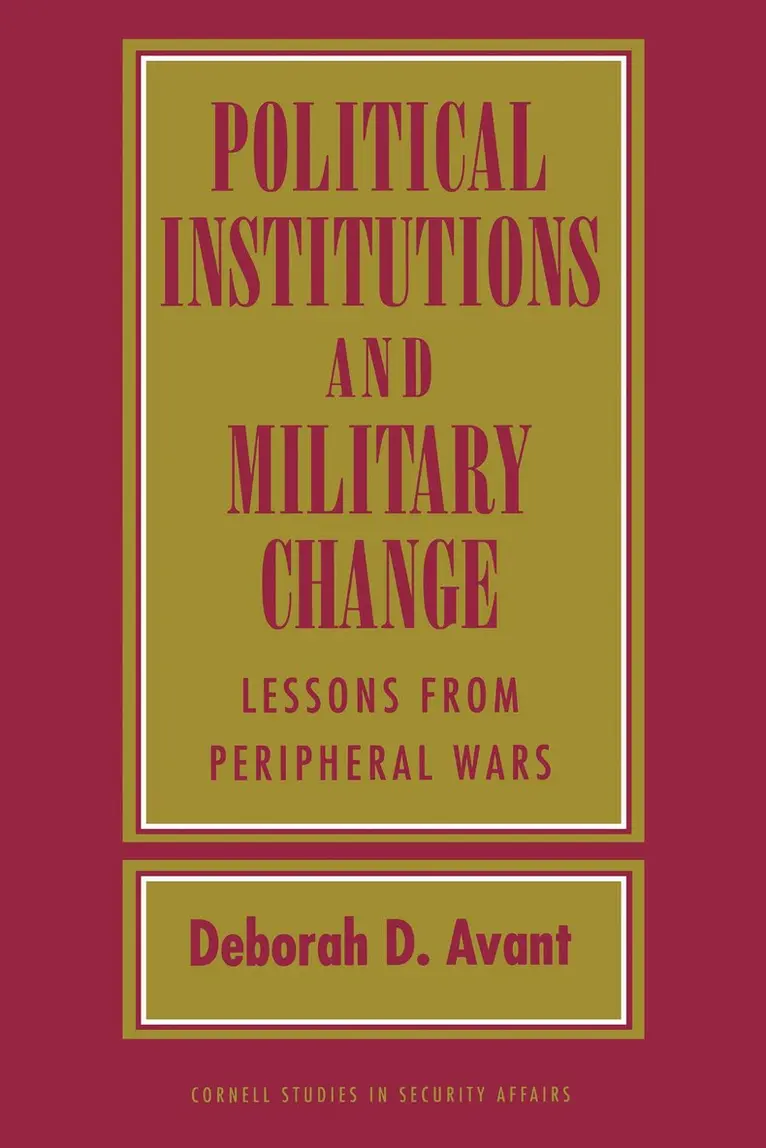
Even powerful states face disaster if their armies do not adapt military doctrine to meet new challenges. Comparing the cases of the United States Army in Vietnam and the British Army during the Boer War and the Malayan Emergency, Political Institutions and Military Change offers an account of the conditions that help shape doctrine within military organizations.Drawing on the new institutional economics, Deborah D. Avant assumes that actors at every level will seek to enhance their political power. Military organizations will thus respond to civilian goals when military leaders expect rewards for their responsiveness. Tracing the evolution of civil-military relations in the United States and Britain, Avant highlights that a nation's political structure has a major impact on the structure of military organizations and their formation of military doctrine.Political Institutions and Military Change discusses how the structural differences between the British and US governments resulted in very different biases within the two armies, and how their political conditions and systems contributed to the relative ease with which the British Army adapted to new peripheral threats and the reluctance with which the US Army responded to change in Vietnam.