Susannah Black - Böcker
Visar alla böcker från författaren Susannah Black. Handla med fri frakt och snabb leverans.
4 produkter
4 produkter
99 kr
Tillfälligt slut
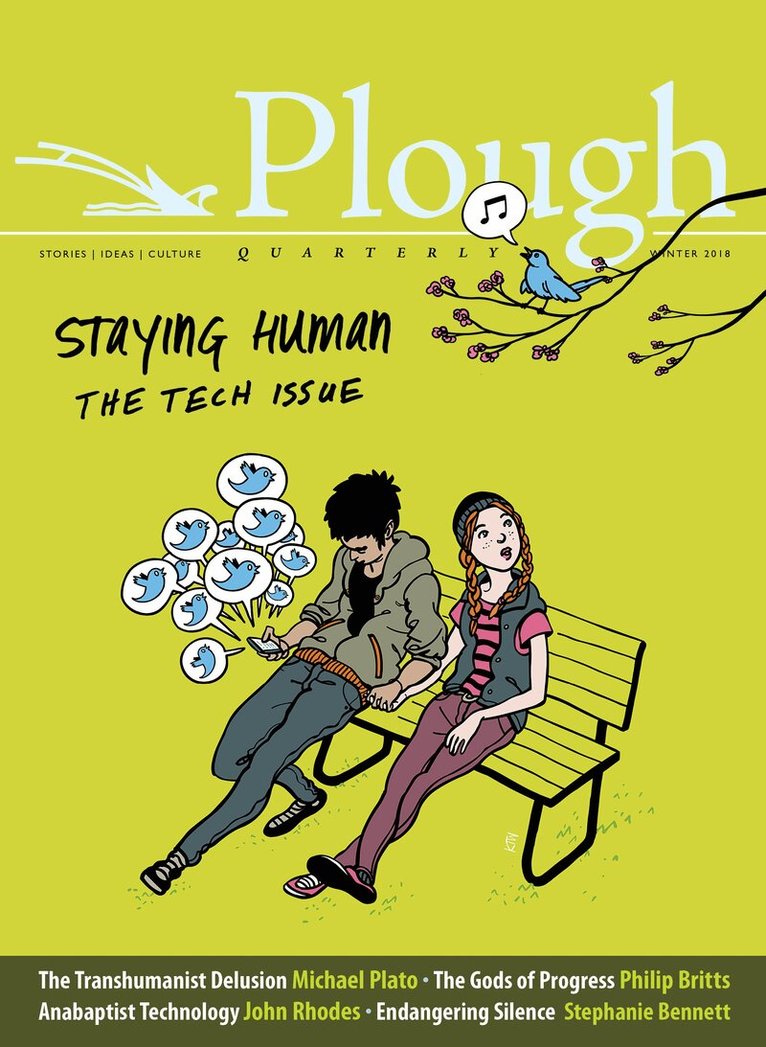
This issue of Plough Quarterly explores the effects of technology on human flourishing.Whether its artificial intelligence, genome editing, Big Tech monopolies, or social media–induced depression, we live in a world that is being reshaped by technology from the ground up. How do we stay human?This issue of Plough Quarterly addresses challenges ranging from the lure of transhumanism to the erosion of silence by the smartphone. Technophobia is no answer, our contributors agree, but neither is a refusal to tackle real dangers. They ask: Why not try living without a computer or a television? Why give tablets to children when Steve Jobs refused to give them to his kids? Why write using a keyboard when you could wield a fountain pen?Technological asceticism of this kind won’t solve society-wide dilemmas. But it can help us maintain the spiritual independence needed to respond to them rightly.Also in this issue: original poetry by Jacob Stratman; reviews of new books by Ian Johnson, Steve Roud, and Markus Rathey; insights from Wendell Berry, Viktor Frankl, Ivan Illich, Carl Sandburg, C. S. Lewis, Alfred Delp, and Christoph Blumhardt; and art by Pieter Bruegel the Elder, Jack Baumgartner, Nicholas Roerich, Rachel Newling, Kay Polk, Suellen McCrary, Stephen Scott Young, Jie Wei Zhou, Kiéra Malone, Torkel Pettersson, Mari Rast, Albrecht Dürer, René Magritte, and Kyle T. Webster.Plough Quarterly features stories, ideas, and culture for people eager to put their faith into action. Each issue brings you in-depth articles, interviews, poetry, book reviews, and art to help you put Jesus’ message into practice and find common cause with others.
103 kr
Skickas inom 11-20 vardagar
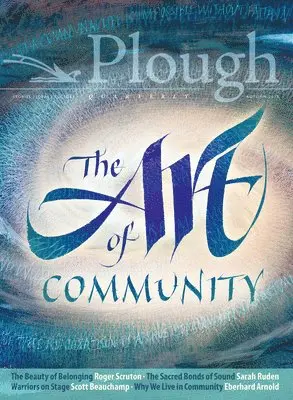
Can beauty save the world?These days criticism of art--whether visual, musical, or literary--is often marked by a suspicion of beauty. What happened to the belief that the creativity of the artist reflects the creativity of the Maker of heaven and earth, and that art can therefore be a channel for divine truth? Anyone who has joined with others to sing Bach’s Saint Matthew Passion or stood before a painting by Raphael or Chagall can attest to this. At such moments, art binds people together. This issue of Plough focuses on art that leads to such community: through theater, painting, music, and the objects and architecture of everyday life. And while art fosters community, building community is itself a work of creativity.Also in this issue: original poetry by Cozine Welch Jr.; reviews of new books by Eliza Griswold, Alissa Quart, Eugene Vodolazkin, and Nathan Englander; and art by Denis Brown, JR, Valérie Jardin, Isaiah King, Isaiah Tanenbaum, George Makary, Oriol Malet, Alex Nwokolo, Ashik and Jenelle Mohan, Raphael, Aaron Douglas, Winslow Homer, Vincent van Gogh, Wassily Kandinsky, and Jason Landsel. Plough Quarterly features stories, ideas, and culture for people eager to put their faith into action. Each issue brings you in-depth articles, interviews, poetry, book reviews, and art to help you put Jesus’ message into practice and find common cause with others.
100 kr
Tillfälligt slut
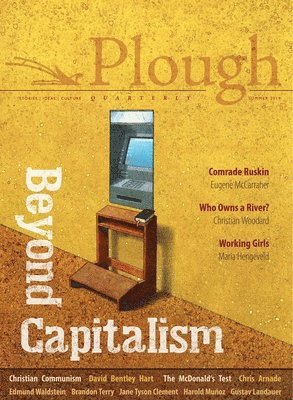
Is there a better way than capitalism?A much-cited recent poll found that more young Americans have a positive view of socialism than of capitalism. There’s a sense of newly opened possibilities: Might this be the moment for a mass movement of solidarity to overthrow the tyranny of concentrated power and wealth? But what exactly is this cause? Socialism’s champions know how to take effective whacks at capitalism, but diagnosis is not yet the cure.This issue of Plough springs from a conviction that there is a better answer beyond capitalism and socialism, a freely chosen life of sharing and caring that overcomes economic exploitation, a way of life that is both thoroughly practical and independent of the state. This vision is much older than Adam Smith and Karl Marx; it lies at the heart of Jesus’ Sermon on the Mount and throughout the New Testament, as well as in the writings of the Old Testament prophets. It is exemplified by the communal life of the first church in Jerusalem, in which “all who believed were together and had all things in common; they would sell their possessions and goods and distribute the proceeds to all, as any had need” (Acts 2:44–45).Also in this issue: poetry by Jane Tyson Clement; reviews of books by Jennifer Berry Hawes, Robert Macfarlane, Emily Bazelon, and John Connell; and art and photography by Wassily Kandinsky, N. C. Wyeth, Deborah Batt, Kari Nielsen, Chris Arnade, William Morris, Hilzías Salazar, Amedeo Modigliani, Benjamin Meader, Bianca Berends, Elise Palmigiani, and Danny Burrows.Plough Quarterly features stories, ideas, and culture for people eager to put their faith into action. Each issue brings you in-depth articles, interviews, poetry, book reviews, and art to help you put Jesus’ message into practice and find common cause with others.
281 kr
Skickas inom 5-8 vardagar
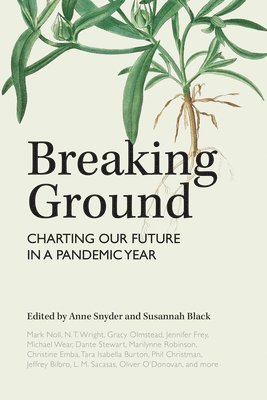
As apandemic and racial reckoning exposed society’s faults, Christian thinkers werelaying the groundwork for a better future. A public health and economic crisis provokedby Covid-19. A social crisis cracked open by the filmed murder of George Floyd.A leadership crisis laid bare as the gravity of a global pandemic met a countrysuffocating in political polarization and idolatry.In the spring of 2020, Comment magazine created apublishing project to tap the resources of a Christian humanist tradition torespond collaboratively and imaginatively to these crises. Plough soonjoined in the venture. So did seventeen other institutions. The web commonsthat resulted – Breaking Ground – became aone-of-a-kind space to probe society’s assumptions, interrogate our own hearts,and imagine what a better future might require.Thisvolume, written in real time during a year that revealed the depths of oursociety’s fissures, provides a wealth of reflections and proposals on whatshould come after. It is an anthology of different lenses of faith seeking tounderstand how best we can serve the broader society and renew ourcivilization.Contributorsinclude Anne Snyder, Susannah Black, Mark Noll, N. T. Wright, Gracy Olmstead,Doug Sikkema, Patrick Pierson, Jennifer Frey, J. L. Wall, Michael Wear, DanteStewart, Joe Nail, Benya Kraus, Patrick Tomassi, Amy Julia Becker, JeffreyBilbro, Marilynne Robinson, Cherie Harder, Joel Halldorf, Irena Dragas Jansen,Katherine Boyle, L. M. Sacasas, Jake Meador, Joshua Bombino, Chelsea LangstonBombino, Aryana Petrosky Roberts, Stuart McAlpine, Heather C. Ohaneson, OliverO’Donovan, W. Bradford Littlejohn, Anthony M. Barr, Michael Lamb, Shadi Hamid,Samuel Kimbriel, Christine Emba, Brandon McGinley, John Clair, Kurt Armstrong,Peter Wehner, Jonathan Haidt, Dhananjay Jagannathan, Phil Christman, GregoryThompson, Duke Kwon, Carlo Lancellotti, Tara Isabella Burton, Charles C.Camosy, Joseph M. Keegin, Luke Bretherton, Tobias Cremer, and Elayne Allen.