Tali Hatuka - Böcker
Visar alla böcker från författaren Tali Hatuka. Handla med fri frakt och snabb leverans.
8 produkter
8 produkter
260 kr
Skickas inom 10-15 vardagar
Violent acts over the past fifteen years have profoundly altered civil rituals, cultural identity, and the meaning of place in Tel Aviv. Three events in particular have shed light on the global rule of urban space in the struggle for territory, resources, and power: the assassination of Prime Minister Rabin in 1995 in the city council square; the suicidal bombing at the Dolphinarium DiscothÈque along the shoreline in 2001; and bombings in the Neve Shaanan neighborhood in 2003. Tali Hatuka uses an interdisciplinary framework of urban theory and sociopolitical theory to shed light on the discourse regarding violent events to include an analysis of the physical space where these events take place. She exposes the complex relationships among local groups, the state, and the city, challenging the national discourse by offering a fresh interpretation of contesting forces and their effect on the urban environment. Perhaps the most valuable contribution of this book is its critical assessment of the current Israeli reality, which is affected by violent events that continually alter the everyday life of its citizens. Although these events have been widely publicized by the media, there is scant literature focusing on their impact on the urban spaces where people live and meet. In addition, Hatuka shows how sociopolitical events become crucial defining moments in contemporary lived experience, allowing us to examine universal questions about the way democracy, ideology, and memory are manifested in the city.
495 kr
Skickas inom 10-15 vardagar
Since the Industrial Revolution, cities and industry have grown together; towns and metropolitan regions have evolved around factories and expanding industries. New Industrial Urbanism explores the evolving and future relationships between cities and places of production, focusing on the spatial implications and physical design of integrating contemporary manufacturing into the city. The book examines recent developments that have led to dramatic shifts in the manufacturing sector – from large-scale mass production methods to small-scale distributed systems; from polluting and consumptive production methods to a cleaner and more sustainable process; from broad demand for unskilled labor to a growing need for a more educated and specialized workforce – to show how cities see new investment and increased employment opportunities. Looking ahead to the quest to make cities more competitive and resilient, New Industrial Urbanism provides lessons from cases around the world and suggests adopting New Industrial Urbanism as an action framework that reconnects what has been separated: people, places, and production. Moving the conversation beyond the reflexively-negative characterizations of industry, more than two centuries after the start of the Industrial Revolution, this book calls to re-consider the ways in which industry creates places, sustains jobs, and supports environmental sustainability in our cities.This book is available as Open Acess through https://www.taylorfrancis.com/.
2 088 kr
Skickas inom 10-15 vardagar
Since the Industrial Revolution, cities and industry have grown together; towns and metropolitan regions have evolved around factories and expanding industries. New Industrial Urbanism explores the evolving and future relationships between cities and places of production, focusing on the spatial implications and physical design of integrating contemporary manufacturing into the city. The book examines recent developments that have led to dramatic shifts in the manufacturing sector – from large-scale mass production methods to small-scale distributed systems; from polluting and consumptive production methods to a cleaner and more sustainable process; from broad demand for unskilled labor to a growing need for a more educated and specialized workforce – to show how cities see new investment and increased employment opportunities. Looking ahead to the quest to make cities more competitive and resilient, New Industrial Urbanism provides lessons from cases around the world and suggests adopting New Industrial Urbanism as an action framework that reconnects what has been separated: people, places, and production. Moving the conversation beyond the reflexively-negative characterizations of industry, more than two centuries after the start of the Industrial Revolution, this book calls to re-consider the ways in which industry creates places, sustains jobs, and supports environmental sustainability in our cities.This book is available as Open Acess through https://www.taylorfrancis.com/.
2 150 kr
Skickas inom 10-15 vardagar
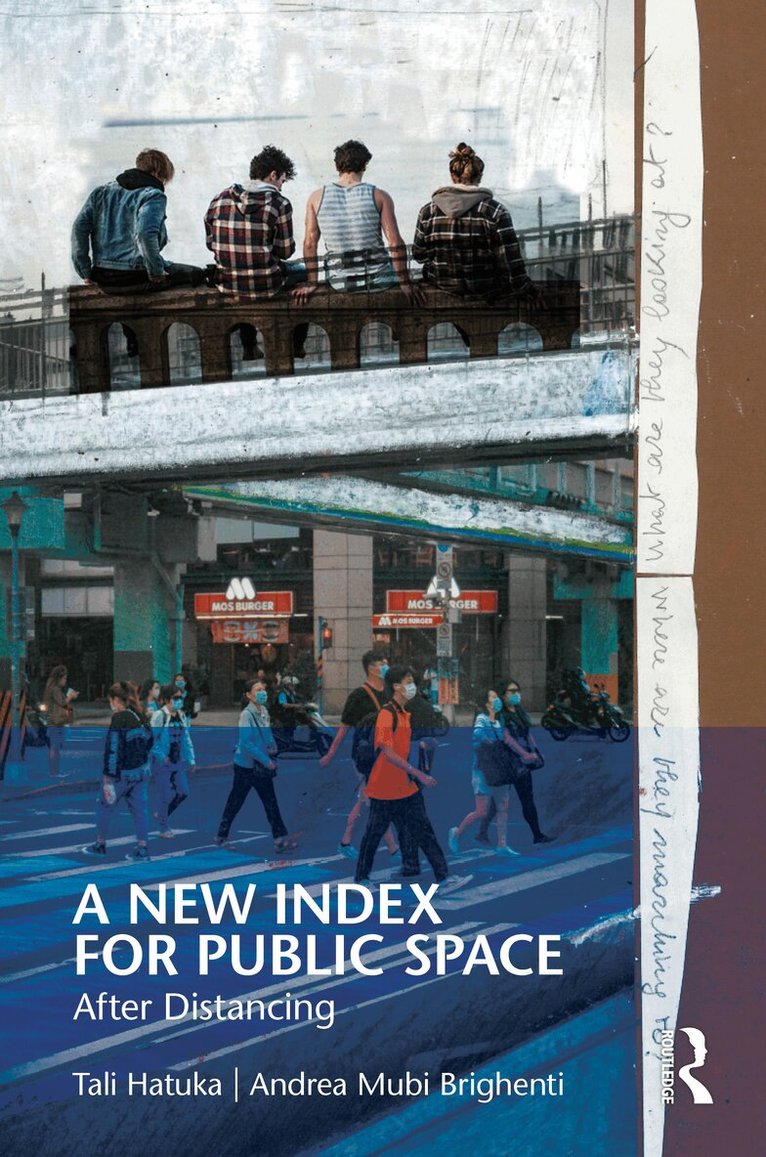
A New Index for Public Space: After Distancing offers readers a re-evaluation of the notion of publicness as a lens to unpack the complexity of urban space. A "new index" is proposed to reconstitute the promises and the predicaments of public space to better prepare for the contemporary challenges of post-pandemic, conflict-ridden society. Part I provides a theoretical introduction to the idea of public space and publicness, laying out the book’s rationale; Part II offers a new index of terms, including affects, alignments, atmosphere, conviviality, diagrams, documenting, flow, and more; and Part III applies the proposed lexicon with a "random walk" approach, inviting the reader to use the lens of nonlinear evolutionary dynamics as a means for envisioning the future of publicness. This book is the outcome of a conversation across disciplines – specifically, urban design and social theory – revolving around the recognition that public space is inherently fragile, messy, conflicted, and evolving. This book will be of interest to urban planners, architects, and urban designers, as well as human geographers, sociologists, political theorists, and those working in community development.
593 kr
Skickas inom 10-15 vardagar
A New Index for Public Space: After Distancing offers readers a re-evaluation of the notion of publicness as a lens to unpack the complexity of urban space. A "new index" is proposed to reconstitute the promises and the predicaments of public space to better prepare for the contemporary challenges of post-pandemic, conflict-ridden society. Part I provides a theoretical introduction to the idea of public space and publicness, laying out the book’s rationale; Part II offers a new index of terms, including affects, alignments, atmosphere, conviviality, diagrams, documenting, flow, and more; and Part III applies the proposed lexicon with a "random walk" approach, inviting the reader to use the lens of nonlinear evolutionary dynamics as a means for envisioning the future of publicness. This book is the outcome of a conversation across disciplines – specifically, urban design and social theory – revolving around the recognition that public space is inherently fragile, messy, conflicted, and evolving. This book will be of interest to urban planners, architects, and urban designers, as well as human geographers, sociologists, political theorists, and those working in community development.
575 kr
Kommande
In an age of increased polarization and fragmentation, improving the prospects for sharing neighborhoods matters more than ever. Focusing on urban design and planning at the neighborhood scale, this collaborative work explores “signals of inclusion,” the sensory gestures, actions, and spatial elements that convey welcome and belonging in shared urban environments. The book reveals how signals of inclusion operate through multiple sensory mechanisms and processes, and how these can counteract exclusionary or hostile urban design practices and policies. The chapters in Part 1 explore a range of inclusive signals in case studies from around the world, including cities in Colombia, Italy, the UK, US, China, Israel, and Canada, offering a contextual presentation of a place, clarifying each author’s approach to the term signals of inclusion, and identifying how this idea is manifest in the neighborhood. Part 2 draws on the case studies to broaden the concept of signals of inclusion beyond specific locations and presents a toolkit for action in implementing an inclusive design agenda. Illustrated with over 100 color images, this book will be of interest to students and scholars in the fields of urban design, urban planning, community development, and human geography, as well as planners, policymakers, and urban design professionals seeking to create more inclusive neighborhoods.
Designing Signals of Inclusion
A Framework for Fostering Shared Neighborhoods
Inbunden, Engelska, 2026
2 325 kr
Kommande
In an age of increased polarization and fragmentation, improving the prospects for sharing neighborhoods matters more than ever. Focusing on urban design and planning at the neighborhood scale, this collaborative work explores “signals of inclusion,” the sensory gestures, actions, and spatial elements that convey welcome and belonging in shared urban environments. The book reveals how signals of inclusion operate through multiple sensory mechanisms and processes, and how these can counteract exclusionary or hostile urban design practices and policies. The chapters in Part 1 explore a range of inclusive signals in case studies from around the world, including cities in Colombia, Italy, the UK, US, China, Israel, and Canada, offering a contextual presentation of a place, clarifying each author’s approach to the term signals of inclusion, and identifying how this idea is manifest in the neighborhood. Part 2 draws on the case studies to broaden the concept of signals of inclusion beyond specific locations and presents a toolkit for action in implementing an inclusive design agenda. Illustrated with over 100 color images, this book will be of interest to students and scholars in the fields of urban design, urban planning, community development, and human geography, as well as planners, policymakers, and urban design professionals seeking to create more inclusive neighborhoods.
603 kr
Skickas inom 7-10 vardagar
Public protests are a vital tool for asserting grievances and creating temporary, yet tangible, communities as the world becomes more democratic and urban in the twenty-first century. While the political and social aspects of protest have been extensively studied, little attention has been paid to the physical spaces in which protests happen. Yet place is a crucial aspect of protests, influencing the dynamics and engagement patterns among participants. In The Design of Protest, Tali Hatuka offers the first extensive discussion of the act of protest as a design: that is, a planned event in a space whose physical geometry and symbolic meaning are used and appropriated by its organizers, who aim to challenge socio-spatial distance between political institutions and the people they should serve.Presenting case studies from around the world, including Tiananmen Square in Beijing; the National Mall in Washington, DC; Rabin Square in Tel Aviv; and the Plaza de Mayo in Buenos Aires, Hatuka identifies three major dimensions of public protests: the process of planning the protest in a particular place; the choice of spatial choreography of the event, including the value and meaning of specific tactics; and the challenges of performing contemporary protests in public space in a fragmented, complex, and conflicted world. Numerous photographs, detailed diagrams, and plans complement the case studies, which draw upon interviews with city officials, urban planners, and protesters themselves.