Terence Irwin - Böcker
Visar alla böcker från författaren Terence Irwin. Handla med fri frakt och snabb leverans.
14 produkter
14 produkter
556 kr
Skickas inom 7-10 vardagar
Spanning over a thousand years from Homer to Saint Augustine, Classical Thought encompasses a vast range of material in succinct style, while remaining clear and lucid even to those with no philosophical or Classical background The major philosophers and philosophical schools are examined---the Presocratics, Socrates, Plato, Aristotle, Stoicism, Epicureanism, Neoplatonism; but other important thinkers, such as Greek tragedians, historians, medical writers, and early Christian writers, are also discussed. The emphasis is naturally on questions of philosophical interest (although the literary and historical background to Classical philosophy is not ignored), and again the scope is broad---ethics, the theory of knowledge, philosophy of mind, philosophical theology. All this is presented in a fully integrated, highly readable text which covers may of the most important areas of ancient thought and in which stress is laid on the variety and continuity of philosophical thinking after Aristotle.
659 kr
Skickas inom 5-8 vardagar
This Oxford Reader seeks to introduce some of the main philosophical questions raised by the Greek and Roman philosophers of classical antiquity. Selections from the writings of ancient philosophers are interspersed with Terence Irwin's incisive commentary, and sometimes with contributions from modern philosophers expounding relevant philosophical positions or discussing particular aspects of classical philosophy. The arrangement of the book is thematic, rather than chronological, allowing the reader to focus on philosophical problems and ideas, but a general introduction places philosophers and schools within their historical context. Irwin brings together contributions which shaped debates about knowledge, freedom, ethics, politics, and religious belief - debates which continue to be contested today, 2500 years from their conception.
764 kr
Skickas inom 5-8 vardagar
This book expounds and examines Plato's answer to the normative question, `how ought we to live?' It discusses Plato's conception of the virtues; his views about the connection between these and happiness; and the account of reason, desire, and motivation that underlies his arguments about the virtues. Irwin traces the development of Plato's moral philosophy, from the Socratic dialogues to its fullest exposition in the Republic. He discusses Plato's reasons for abandoning or modifying some aspects of Socratic ethics, and for believing that he preserves Socrates' essential insights. A brief and selective discussion of the Statesmen, Philebus, and Laws is included. Plato's answer to the epistemological question `how can we know how we ought to live?' is also discussed. His views on knowledge, belief, and inquiry, and his theory of forms, are examined in so far as they are relevant to his ethical views. This book expands the discussion in Plato's Moral Theory (OUP, 1977) to provide an introduction to all important aspects of Plato's ethical thought. A fuller account of the main questions is given, and recent controversies in the interpretation of Plato's ethics are discussed. The book does not presuppose knowledge of Greek, or any extensive knowledge of Plato.
2 236 kr
Skickas inom 5-8 vardagar
Terence Irwin presents a historical and critical study of the development of moral philosophy over two thousand years, from ancient Greece to the Reformation. Starting with the seminal ideas of Socrates, Plato, and Aristotle, he guides the reader through the centuries that follow, introducing each of the thinkers he discusses with generous quotations from their works. He offers not only careful interpretation but critical evaluation of what they have to offer philosophically. This is the first of three volumes which will examine the history of ethics in the Socratic tradition, up to the late 20th century.
659 kr
Skickas inom 5-8 vardagar
Aristotle's reliance on dialectic as a method of philosophy appears to conflict with his metaphysical realist view of his conclusions. This book explores Aristotle's philosophical method and the merits of his conclusions, and shows how he defends dialectic against the objection that it cannot justify a metaphysical realist's claims.The author does not presuppose extensive previous acquaintance with Aristotle. Greek texts are translated, and Greek words transliterated.
Aristotle's Ethical Works: Magna Moralia, Eudemian Ethics, Nicomachean Ethics
Volume I Text and Translation
Inbunden, Engelska, 2026
2 370 kr
Kommande
Terence Irwin examines Aristotle's three ethical works–the Magna Moralia, the Eudemian Ethics, and the Nicomachean Ethics. This book is the first in English to study all three texts in detail and compare them systematically. Aristotle's Ethical Works argues that we can trace a development in his thought by analysing these texts.The main elements of Aristotle's moral philosophy are shown to be common to all three works, but their exposition and defence become clearer and more convincing in his later discussions. While the Nicomachean Ethics is the clearest account of Aristotle's ethics, we can understand its position better by seeing how Aristotle arrived at it.Volume I contains the Greek text with a facing English translation. Volume II contains detailed notes on the text. Volume III contains essays on literary, historical, and philosophical questions abut the three ethical works.The essays can be understood without knowledge of Greek. Some of the notes refer to details of the Greek text, but the main exposition and discussion are accessible to readers without Greek. The Notes are keyed to lemmata in English, and Greek terms used in the Notes are all transliterated.This is the first English commentary on the Greek text of the Eudemian Ethics and Magna Moralia, as well as the first work in English to examine in detail the questions about the authorship of the Magna Moralia. The conclusion, that this is Aristotle's first work on ethics, is defended throughout the Notes and Essays. The Notes on the Nicomachean Ethics also provide the first English commentary on the Greek text for over a century.The Greek text and translation are the basis for the discussion in the notes. The Greek text is based on a fresh examination of the evidence provided by previous editions, and sometimes suggests improvements; these are all defended in the notes. The facing translation aims to provide a readable English version that makes the course of the argument clear.
Aristotle's Ethical Works Magna Moralia, Eudemian Ethics, Nicomachean Ethics
Volume II Notes
Inbunden, Engelska, 2026
2 370 kr
Kommande
Terence Irwin examines Aristotle's three ethical works-the Magna Moralia, the Eudemian Ethics, and the Nicomachean Ethics. This book is the first in English to study all three texts in detail and compare them systematically. Aristotle's Ethical Works argues that we can trace a development in his thought by analysing these texts.The main elements of Aristotle's moral philosophy are shown to be common to all three works, but their exposition and defence become clearer and more convincing in his later discussions. While the Nicomachean Ethics is the clearest account of Aristotle's ethics, we can understand its position better by seeing how Aristotle arrived at it.Volume I contains the Greek text with a facing English translation. Volume II contains detailed notes on the text. Volume III contains essays on literary, historical, and philosophical questions abut the three ethical works.The essays can be understood without knowledge of Greek. Some of the notes refer to details of the Greek text, but the main exposition and discussion are accessible to readers without Greek. The Notes are keyed to lemmata in English, and Greek terms used in the Notes are all transliterated.This is the first English commentary on the Greek text of the Eudemian Ethics and Magna Moralia, as well as the first work in English to examine in detail the questions about the authorship of the Magna Moralia. The conclusion, that this is Aristotle's first work on ethics, is defended throughout the Notes and Essays. The Notes on the Nicomachean Ethics also provide the first English commentary on the Greek text for over a century.The notes help the reader to understand and appreciate Aristotle's moral philosophy. They examine the text paragraph by paragraph, in order to discuss the philosophical content of each of the three works, and to compare their views. They aim at an accurate detailed interpretation that will be a sound basis for philosophical judgments. With this aim in view, the notes also discuss questions of translation and interpretation, examining the syntax and structure of Aristotle's complex sentences.
Aristotle’s Ethical Works Magna Moralia, Eudemian Ethics, Nicomachean Ethics
Volume III Essays
Inbunden, Engelska, 2026
2 370 kr
Kommande
Terence Irwin examines Aristotle's three ethical works-the Magna Moralia, the Eudemian Ethics, and the Nicomachean Ethics. This book is the first in English to study all three texts in detail and compare them systematically. Aristotle's Ethical Works argues that we can trace a development in his thought by analysing these texts. The main elements of Aristotle's moral philosophy are shown to be common to all three works, but their exposition and defence become clearer and more convincing in his later discussions. While the Nicomachean Ethics is the clearest account of Aristotle's ethics, we can understand its position better by seeing how Aristotle arrived at it. Volume I contains the Greek text with a facing English translation. Volume II contains detailed notes on the text. Volume III contains essays on literary, historical, and philosophical questions abut the three ethical works.The essays can be understood without knowledge of Greek. Some of the notes refer to details of the Greek text, but the main exposition and discussion are accessible to readers without Greek. The Notes are keyed to lemmata in English, and Greek terms used in the Notes are all transliterated. This is the first English commentary on the Greek text of the Eudemian Ethics and Magna Moralia, as well as the first work in English to examine in detail the questions about the authorship of the Magna Moralia. The conclusion, that this is Aristotle's first work on ethics, is defended throughout the Notes and Essays. The Notes on the Nicomachean Ethics also provide the first English commentary on the Greek text for over a century.The Essays discuss questions about the three ethical works that are more suitable for continuous treatment. Some essays deal with the composition, order, and integrity of the three ethical works. Others argue for the authenticity of the Magna Moralia. Others discuss philosophical questions that arise in all three works.
3 105 kr
Skickas inom 7-10 vardagar
The Development of Ethics is a selective historical and critical study of moral philosophy in the Socratic tradition, with special attention to Aristotelian naturalism. It discusses the main topics of moral philosophy as they have developed historically, including: the human good, human nature, justice, friendship, and morality; the methods of moral inquiry; the virtues and their connexions; will, freedom, and responsibility; reason and emotion; relativism, subjectivism, and realism; the theological aspect of morality. This volume examines early modern moral philosophy from the sixteenth to the eighteenth century. Volume 3 will continue the story up to Rawls's Theory of Justice.The present volume begins with Suarez's interpretation of Scholastic moral philosophy, and examines seventeenth- and eighteenth- century responses to the Scholastic outlook, to see how far they constitute a distinctively different conception of moral philosophy. The treatments of natural law by Grotius, Hobbes, Cumberland, and Pufendorf are treated in some detail. Disputes about moral facts, moral judgments, and moral motivation, are traced through Cudworth, Clarke, Balguy, Hutcheson, Hume, Price, and Reid. Butler's defence of a naturalist account of morality is examined and compared with the Aristotelian and Scholastic views discussed in Volume 1. The volume ends with a survey of the persistence of voluntarism in English moral philosophy, and a brief discussion of the contrasts and connexions between Rousseau and earlier views on natural law.The emphasis of the book is not purely descriptive, narrative, or exegetical, but also philosophical. Irwin discusses the comparative merits of different views, the difficulties that they raise, and how some of the difficulties might be resolved. The book tries to present the leading moral philosophers of the past as participants in a rational discussion that is still being carried on, and tries to help the reader to participate in this discussion.
3 182 kr
Skickas inom 7-10 vardagar
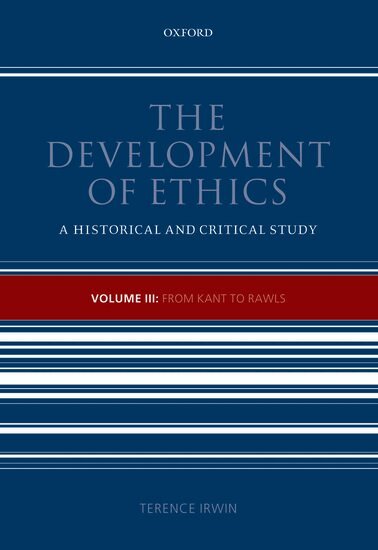
This book is a selective historical and critical study of moral philosophy in the Socratic tradition, with special attention to Aristotelian naturalism. It discusses the main topics of moral philosophy as they have developed historically, including: the human good, human nature, justice, friendship, and morality; the methods of moral inquiry; the virtues and their connexions; will, freedom, and responsibility; reason and emotion; relativism, subjectivism, and realism; the theological aspect of morality. The first volume discusses ancient and mediaeval moral philosophy. The second volume examines early modern moral philosophy from the 16th to the 18th century. This third volume continues the story up to Rawls's Theory of Justice.A comparison between the Kantian and the Aristotelian outlook is one central theme of the third volume. The chapters on Kant compare Kant both with his rationalist and empiricist predecessors and with the Aristotelian naturalist tradition. Reactions to Kant are traced through Hegel, Schopenhauer, Nietzsche, and Kierkegaard. Utilitarian and idealist approaches to Kantian and Aristotelian views are traced through Sidgwick, Bradley, and Green. Mill and Sidgwick provide a link between 18th-century rationalism and sentimentalism and the 20th-century debates in the metaphysics and epistemology of morality. These debates are explored in Moore, Ross, Stevenson, Hare, C.I. Lewis, Heidegger, and in some more recent meta-ethical discussion. This volume concludes with a discussion of Rawls, with special emphasis on a comparison of his position with utilitarianism, intuitionism, Kantianism, naturalism, and idealism.Since this book seeks to be not only descriptive and exegetical, but also philosophical, it discusses the comparative merits of different views, the difficulties that they raise, and how some of the difficulties might be resolved. It presents the leading moral philosophers of the past as participants in a rational discussion in which the contemporary reader can participate.
729 kr
Skickas inom 5-8 vardagar
What is the human good? What are the primary virtues that make a good person? What makes an action right? Must we try to maximize good consequences? How can we know what is right and good? Can morality be rationally justified? In Ethics Through History, Terence Irwin addresses such fundamental questions, making these central debates intelligible to readers without an extensive background in philosophy. He provides a historical and philosophical discussion of major questions and key philosophers in the history of ethics, in the tradition that begins with Socrates onwards. Irwin covers ancient, medieval, and modern moral philosophers whose views have helped to form the agenda for contemporary ethical theory, paying attention to the strengths and weaknesses of their respective positions.
625 kr
Skickas inom 5-8 vardagar
The Development of Ethics is a selective historical and critical study of moral philosophy in the Socratic tradition, with special attention to Aristotelian naturalism, its formation, elaboration, criticism, and defence. It discusses the main topics of moral philosophy as they have developed historically, including: the human good, human nature, justice, friendship, and morality; the methods of moral inquiry; the virtues and their connexions; will, freedom, and responsibility; reason and emotion; relativism, subjectivism, and realism; the theological aspect of morality. This volume examines ancient and medieval philosophy up to the sixteenth century; Volumes 2 and 3 will continue the story up to Rawls's Theory of Justice.The present volume begins with Socrates, the Cyrenaics and Cynics, and Plato, and then offers a fuller account of Aristotle, stressing the systematic naturalism of his position. The Stoic position is compared with the Aristotelian at some length; Epicureans and Sceptics are discussed more briefly. Chapters on early Christianity and on Augustine introduce a fuller examination of Aquinas' revision, elaboration, and defence of Aristotelian naturalism. The volume closes with an account of some criticisms of the Aristotelian outlook by Scotus, Ockham, Machiavelli, and some sixteenth-century Reformers.The emphasis of the book is not purely descriptive, narrative, or exegetical, but also philosophical. Irwin discusses the comparative merits of different views, the difficulties that they raise, and how some of the difficulties might be resolved. The book tries to present the leading moral philosophers of the past as participants in a rational discussion that is still being carried on, and tries to help the reader to participate in this discussion.
625 kr
Skickas inom 5-8 vardagar
The Development of Ethics is a selective historical and critical study of moral philosophy in the Socratic tradition, with special attention to Aristotelian naturalism. It discusses the main topics of moral philosophy as they have developed historically, including: the human good, human nature, justice, friendship, and morality; the methods of moral inquiry; the virtues and their connexions; will, freedom, and responsibility; reason and emotion; relativism, subjectivism, and realism; the theological aspect of morality. This volume examines early modern moral philosophy from the sixteenth to the eighteenth century. Volume 3 will continue the story up to Rawls's Theory of Justice. The present volume begins with Suarez's interpretation of Scholastic moral philosophy, and examines seventeenth- and eighteenth- century responses to the Scholastic outlook, to see how far they constitute a distinctively different conception of moral philosophy. The treatments of natural law by Grotius, Hobbes, Cumberland, and Pufendorf are treated in some detail. Disputes about moral facts, moral judgments, and moral motivation, are traced through Cudworth, Clarke, Balguy, Hutcheson, Hume, Price, and Reid. Butler's defence of a naturalist account of morality is examined and compared with the Aristotelian and Scholastic views discussed in Volume 1. The volume ends with a survey of the persistence of voluntarism in English moral philosophy, and a brief discussion of the contrasts and connexions between Rousseau and earlier views on natural law. The emphasis of the book is not purely descriptive, narrative, or exegetical, but also philosophical. Irwin discusses the comparative merits of different views, the difficulties that they raise, and how some of the difficulties might be resolved. The book tries to present the leading moral philosophers of the past as participants in a rational discussion that is still being carried on, and tries to help the reader to participate in this discussion.
625 kr
Skickas inom 5-8 vardagar
This book is a selective historical and critical study of moral philosophy in the Socratic tradition, with special attention to Aristotelian naturalism. It discusses the main topics of moral philosophy as they have developed historically, including: the human good, human nature, justice, friendship, and morality; the methods of moral inquiry; the virtues and their connexions; will, freedom, and responsibility; reason and emotion; relativism, subjectivism, and realism; the theological aspect of morality. The first volume discusses ancient and mediaeval moral philosophy. The second volume examines early modern moral philosophy from the 16th to the 18th century. This third volume continues the story up to Rawls's Theory of Justice.A comparison between the Kantian and the Aristotelian outlook is one central theme of the third volume. The chapters on Kant compare Kant both with his rationalist and empiricist predecessors and with the Aristotelian naturalist tradition. Reactions to Kant are traced through Hegel, Schopenhauer, Nietzsche, and Kierkegaard. Utilitarian and idealist approaches to Kantian and Aristotelian views are traced through Sidgwick, Bradley, and Green. Mill and Sidgwick provide a link between 18th-century rationalism and sentimentalism and the 20th-century debates in the metaphysics and epistemology of morality. These debates are explored in Moore, Ross, Stevenson, Hare, C.I. Lewis, Heidegger, and in some more recent meta-ethical discussion. This volume concludes with a discussion of Rawls, with special emphasis on a comparison of his position with utilitarianism, intuitionism, Kantianism, naturalism, and idealism. Since this book seeks to be not only descriptive and exegetical, but also philosophical, it discusses the comparative merits of different views, the difficulties that they raise, and how some of the difficulties might be resolved. It presents the leading moral philosophers of the past as participants in a rational discussion in which the contemporary reader can participate.