Thomas F. Cargill - Böcker
Visar alla böcker från författaren Thomas F. Cargill. Handla med fri frakt och snabb leverans.
6 produkter
6 produkter
1 648 kr
Skickas inom 5-8 vardagar
Japan's Postal Savings System (PSS) and Fiscal Investment and Loan Program (FILP) are major institutional features of Japanese finance that support a wide ranging system of government financial intermediation. Despite their size and importance, they have not received extensive attention outside of Japan. These institutions manifest characteristics of the pre-liberalization regime and despite an official policy of liberalization since the mid 1970s, the PSS and FILP have increased their role in the financial system and economy. They resisted reform until 1998, and despite a series of reforms that became effective 01 April 2001, there is concern that reducing the role of government financial intermediation will be a slow and difficult process. The process is complicated by Japan's depressed economy that is now in its second decade of stagnant or declining growth. The book provides an institutional, flow of funds, theoretical, and statistical overview of the PSS and FILP. The book evaluates the contributions these institutions have made to Japan's economic growth and the problems these institutions create as Japan attempts to modernize its financial and economic system. The book provides a positive analysis of the role played by the PSS and the FILP in Japan's impressive growth from 1950 to the late 1980s and the economic and financial distress of the 1990s. The book evaluates the reforms started in 1998 and provides a normative view of what direction reform of the PSS and FILP needs to take if the goals of the 1996 Big Bang announcement are to be realized. Despite the setbacks in the late 1990s and the first years of the new century, the 1996 Big Bang remains the operating framework for financial reform in Japan.
535 kr
Skickas inom 3-6 vardagar
360 kr
Skickas inom 7-10 vardagar
An analysis of the performance of Japan's economic and political institutions from late 1970s to 2007. The authors explain how Japan's flawed response to new economic, political, and technological forces ushered in a lost decade and a half of economic development from 1990. Impressive economic performance in the 1980s masked an 'accident waiting to happen' - the collapse in equity and real estate prices in 1990-1. Japan's iron triangle of politicians, bureaucrats, and client industries, combined with a flawed financial liberalization process and policy errors by the Bank of Japan and the Ministry of Finance, brought Japan to an abyss of deflation, recession, and insolvency by the late 1990s. The turning point was the election of Koizumi as prime minister in 2001. The book explores Koizumi's economic reform, new developments in socioeconomic conditions, the politics and economy after Koizumi, and the economic and political challenges facing Japan in the new century.
718 kr
Skickas inom 7-10 vardagar
An analysis of the performance of Japan's economic and political institutions from late 1970s to 2007. The authors explain how Japan's flawed response to new economic, political, and technological forces ushered in a lost decade and a half of economic development from 1990. Impressive economic performance in the 1980s masked an 'accident waiting to happen' - the collapse in equity and real estate prices in 1990-1. Japan's iron triangle of politicians, bureaucrats, and client industries, combined with a flawed financial liberalization process and policy errors by the Bank of Japan and the Ministry of Finance, brought Japan to an abyss of deflation, recession, and insolvency by the late 1990s. The turning point was the election of Koizumi as prime minister in 2001. The book explores Koizumi's economic reform, new developments in socioeconomic conditions, the politics and economy after Koizumi, and the economic and political challenges facing Japan in the new century.
1 263 kr
Skickas inom 7-10 vardagar
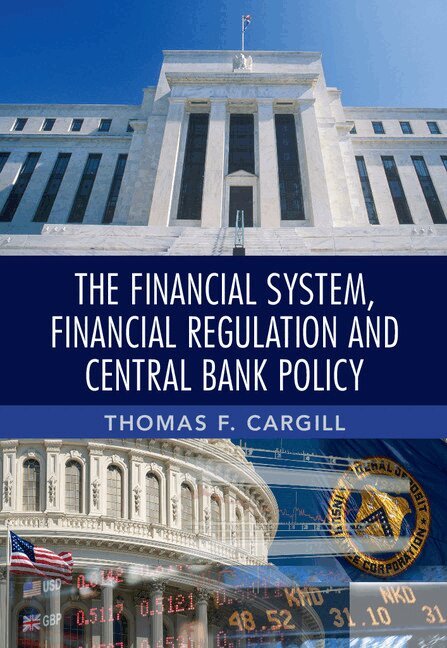
Traditional money and banking textbooks are long, expensive, and full of so much institutional and technical modeling detail that students cannot understand the big picture. Thomas F. Cargill presents a new alternative: a short, inexpensive book without the 'bells and whistles' that teaches students the fundamentals in a clear, narrative form. In an engaging writing style, Cargill explains the three core components of money and banking, and their interactions: 1) the financial system, 2) government regulation and supervision, and 3) central bank policy. Cargill focuses on the interaction between government financial policy and central bank policy and offers a critique of the central bank's role in the economy, the tools it uses, how these tools affect the economy, and how effective these policies have been, providing a more balanced perspective of government policy failure versus market failure than traditional textbooks.
809 kr
Skickas inom 7-10 vardagar
Traditional money and banking textbooks are long, expensive, and full of so much institutional and technical modeling detail that students cannot understand the big picture. Thomas F. Cargill presents a new alternative: a short, inexpensive book without the 'bells and whistles' that teaches students the fundamentals in a clear, narrative form. In an engaging writing style, Cargill explains the three core components of money and banking, and their interactions: 1) the financial system, 2) government regulation and supervision, and 3) central bank policy. Cargill focuses on the interaction between government financial policy and central bank policy and offers a critique of the central bank's role in the economy, the tools it uses, how these tools affect the economy, and how effective these policies have been, providing a more balanced perspective of government policy failure versus market failure than traditional textbooks.