Thomas R. Trautmann - Böcker
Visar alla böcker från författaren Thomas R. Trautmann. Handla med fri frakt och snabb leverans.
8 produkter
8 produkter
267 kr
Skickas inom 7-10 vardagar
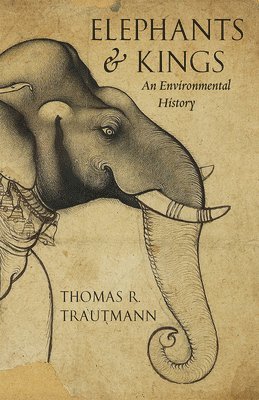
Because of their enormous size, elephants have long been irresistible for kings as symbols of their eminence. In early civilizations - such as Egypt, Mesopotamia, the Indus Civilization, and China - kings used elephants for royal sacrifice, spectacular hunts, public display of live captives, or the conspicuous consumption of ivory - all of them tending toward the elephant's extinction. The kings of India, however, as Thomas R Trautmann shows in this study, found a use for elephants that actually helped preserve their habitat and numbers in the wild: war. Trautmann traces the history of the war elephant in India and the spread of the institution to the West-where elephants took part in some of the greatest wars of antiquity - and Southeast Asia (but not China, significantly), a history that spans 3,000 years and a considerable part of the globe, from Spain to Java. He shows that because elephants eat such massive quantities of food, it was uneconomic to raise them from birth. Rather, in a unique form of domestication, Indian kings captured wild adults and trained them, one by one, through millennia.Kings were thus compelled to protect wild elephants from hunters and elephant forests from being cut down. By taking a wide-angle view of human-elephant relations, Trautmann throws into relief the structure of India's environmental history and the reasons for the persistence of wild elephants in its forests.
503 kr
Skickas inom 7-10 vardagar
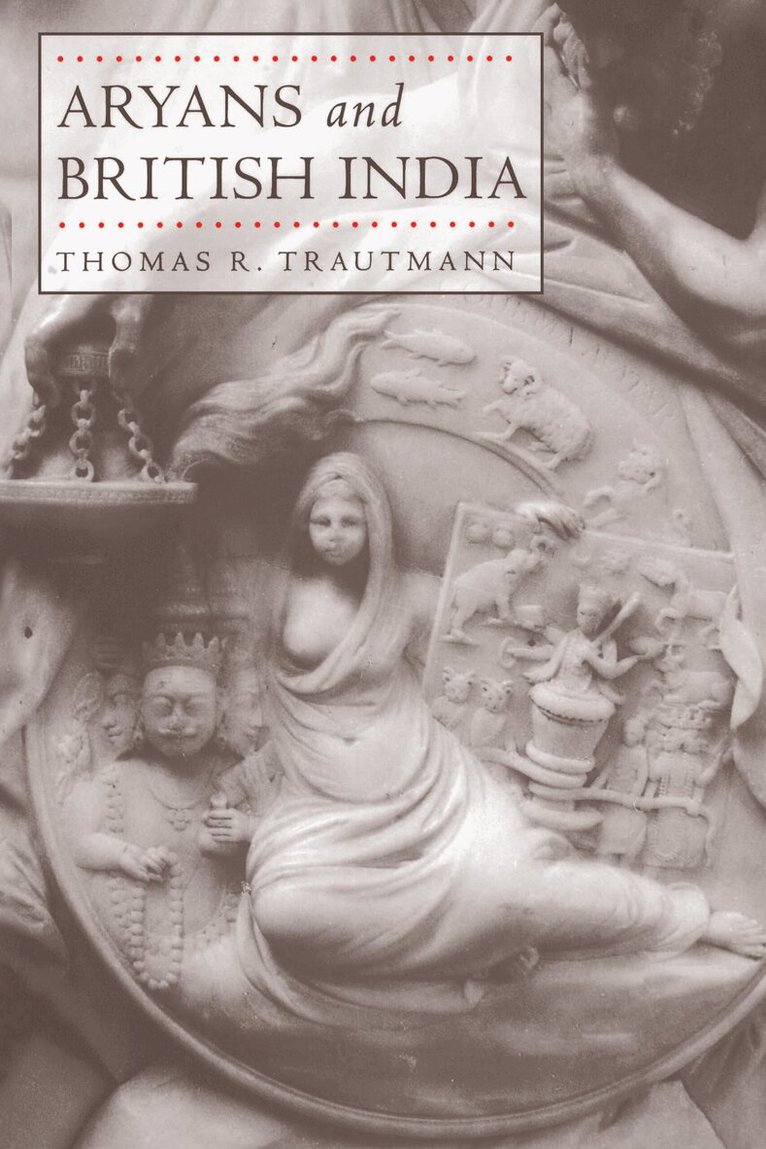
'Aryan,' a word that today evokes images of racial hatred and atrocity, was first used by Europeans to suggest bonds of kinship, as Thomas Trautmann shows in his far-reaching history of British Orientalism and the ethnology of India. When the historical relationship uniting Sanskrit with the languages of Europe was discovered, it seemed clear that Indians and Britons belonged to the same family. Thus the Indo-European or Aryan idea, based on the principle of linguistic kinship, dominated British ethnological inquiry. In the nineteenth century, however, an emergent biological 'race science' attacked the authority of the Orientalists. The spectacle of a dark-skinned people who were evidently civilized challenged Victorian ideas, and race science responded to the enigma of India by redefining the Aryan concept in narrowly 'white' racial terms. By the end of the nineteenth century, race science and Orientalism reached a deep and lasting consensus in regard to India, which Trautmann calls 'the racial theory of Indian civilization,' and which he undermines with his powerful analysis of colonial ethnology in India.His work of reassessing British Orientalism and the Aryan idea will be of great interest to historians, anthropologists, and cultural critics.
1 363 kr
Skickas inom 3-6 vardagar
British rule of India brought together two very different traditions of scholarship about language, whose conjuncture led to several intellectual breakthroughs of lasting value. Two of these were especially important: the conceptualization of the Indo-European language family by Sir William Jones at Calcutta in 1786 - proposing that Sanskrit is related to Persian and languages of Europe - and the conceptualization of the Dravidian language family of South India by F.W. Ellis at Madras in 1816 - the 'Dravidian proof', showing that the languages of South India are related to one another but are not derived from Sanskrit. These concepts are valid still today, centuries later. This book continues the examination Thomas R. Trautmann began in "Aryans and British India" (1997). While the previous book focused on Calcutta and Jones, the current volume examines these developments from the vantage of Madras, focusing on Ellis, Collector of Madras, and the Indian scholars with whom he worked at the College of Fort St. George, making use of the rich colonial record.Trautmann concludes by showing how elements of the Indian analysis of language have been folded into historical linguistics and continue in the present as unseen but nevertheless living elements of the modern.
260 kr
Skickas inom 10-15 vardagar
Lewis Henry Morgan of Rochester, New York, lawyer and pioneering anthropologist, was the leading American contributor of his generation to the social sciences. Among the classic works whose conjunction in the 1860s gave modern anthropology its shape, Morgan's massive and technical Systems of Consanguinity and Affinity of the Human Family was decisive. Thomas R. Trautmann offers a new interpretation of the genesis of "kinship" and of the role it played in late nineteenth-century intellectual history. This Bison Books edition features a new introduction and appendices by the author.
457 kr
Kommande
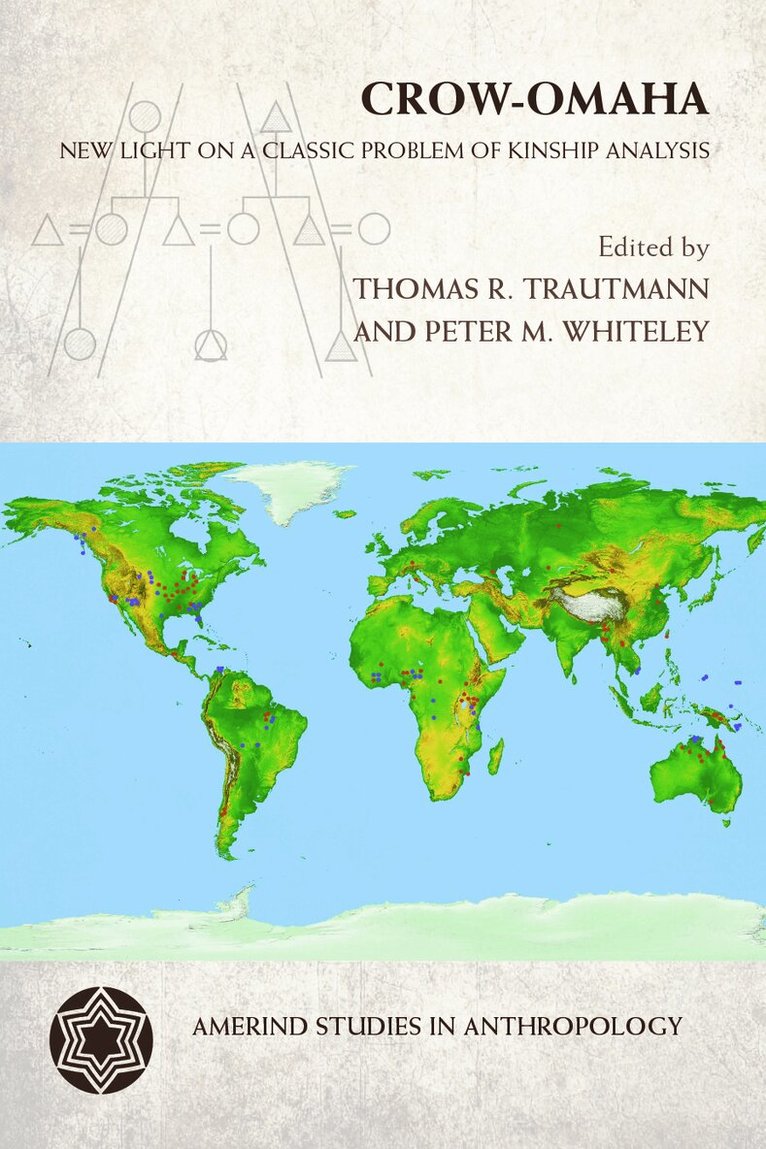
The “Crow-Omaha problem” has perplexed anthropologists since it was first described by Lewis Henry Morgan in 1871. During his worldwide survey of kinship systems, Morgan learned with astonishment that some Native American societies call some relatives of different generations by the same terms. Why? Intergenerational “skewing” in what came to be named “Crow” and “Omaha” systems has provoked a wealth of anthropological arguments, from Rivers to Radcliffe-Brown, from Lowie to LÉvi-Strauss, and many more. Crow-Omaha systems, it turns out, are both uncommon and yet found distributed around the world. For anthropologists, cracking the Crow-Omaha problem is critical to understanding how social systems transform from one type into another, both historically in particular settings and evolutionarily in the broader sweep of human relations. This volume examines the Crow-Omaha problem from a variety of perspectives—historical, linguistic, formalist, structuralist, culturalist, evolutionary, and phylogenetic. It focuses on the regions where Crow-Omaha systems occur: Native North America, Amazonia, West Africa, Northeast and East Africa, aboriginal Australia, northeast India, and the Tibeto-Burman area. The international roster of authors includes leading experts in their fields. The book offers a state-of-the-art assessment of Crow-Omaha kinship and carries forward the work of the landmark volume Transformations of Kinship, published in 1998. Intended for students and scholars alike, it is composed of brief, accessible chapters that respect the complexity of the ideas while presenting them clearly. The work serves as both a new benchmark in the explanation of kinship systems and an introduction to kinship studies for a new generation of students. Series Note: Formerly titled Amerind Studies in Archaeology, this series has recently been expanded and retitled Amerind Studies in Anthropology to incorporate a high quality and number of anthropology titles coming in to the series in addition to those in archaeology.
Library of Lewis Henry Morgan and Mary Elizabeth Morgan
Transactions, American Philosophical Society (vols. 84. Part 6 and 84, Part 7)
Inbunden, Engelska, 1994
638 kr
Skickas inom 10-15 vardagar
190 kr
Skickas inom 7-10 vardagar
Kinship and History in South Asia presents four papers given at a small conference of kinship studies scholars, “Kinship and History in South Asia,” at the University of Toronto in 1973. They draw upon one another and show several common concerns, particularly the theoretical importance of Dravidian systems. Yey they remain specialist studies, each within its own raison d’être. Brendra E. F. Beck contributes a study of the “kinship nucleus” in Tamil folklore, Levi-Straussian both in its treatment of kinship and of mythology. George L. Hart’s study of woman and the sacred in the ancient Tamil literature of the Sangam attempts to elucidate this literature in its own terms, and also to relate it to Beck’s “kinship nucleus.” Thomas R. Trautmann presents a critical examination of the evidence for cross-cousin marriage in early North India, attempting to determine historical fact from literary materials. Narendra K. Wagle offers a survey of the kinship categories to be found in the Pali Jatakas.
217 kr
Skickas inom 5-8 vardagar