Tina Lu – författare
Visar alla böcker från författaren Tina Lu. Handla med fri frakt och snabb leverans.
4 produkter
4 produkter
Del 304 - Harvard East Asian Monographs
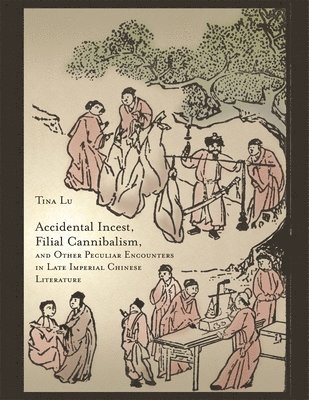
Accidental Incest, Filial Cannibalism, and Other Peculiar Encounters in Late Imperial Chinese Literature
Inbunden, Engelska, 2009
380 kr
Skickas inom 5-8 vardagar
Described as “all under Heaven,” the Chinese empire might have extended infinitely, covering all worlds and cultures. That ideology might have been convenient for the state, but what did late imperial people really think about the scope and limits of the human community?Writers of late imperial fiction and drama were, the author argues, deeply engaged with questions about the nature of the Chinese empire and of the human community. Fiction and drama repeatedly pose questions concerning relations both among people and between people and their possessions: What ties individuals together, whether permanently or temporarily? When can ownership be transferred, and when does an object define its owner? What transforms individual families or couples into a society?Tina Lu traces how these political questions were addressed in fiction through extreme situations: husbands and wives torn apart in periods of political upheaval, families so disrupted that incestuous encounters become inevitable, times so desperate that people have to sell themselves to be eaten.
2 002 kr
Skickas inom 10-15 vardagar
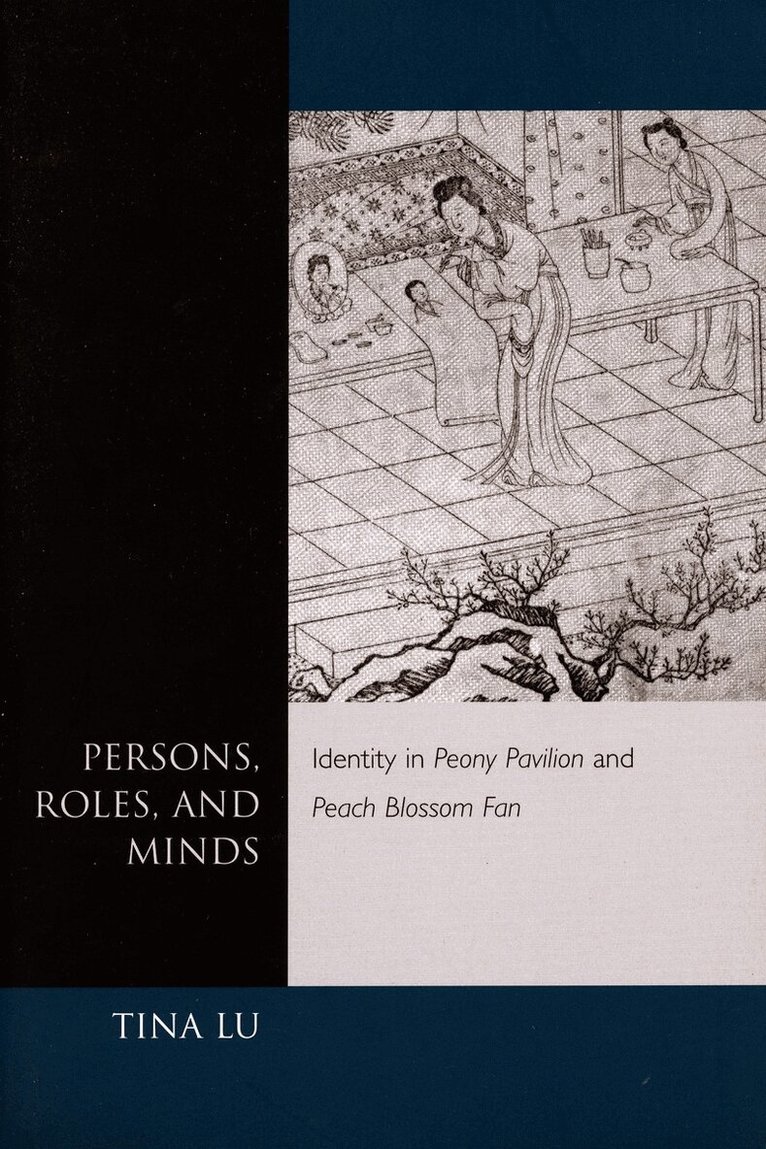
Focusing on two late-Ming or early-Qing plays central to the Chinese canon, this thought-provoking study explores crucial questions concerning personal identity. How is a person, as opposed to a ghost or animal, to be defined? How can any specific person (as distinguished, for example, from an impostor or twin) be identified? Both plays are chuanqi, representatives of a monumental genre that represents Chinese dramatic literature at its most complex: Tang Xianzu's Peony Pavilion is a romantic comedy in 55 acts, and Kong Shangren's Peach Blossom Fan narrates the fall of the Ming Dynasty in 40 acts.No reader of Chinese literature would find a sexual encounter between a young man and a female ghost surprising. In Peony Pavilion, however, the lovers actually marry and join human society—a possibility that invites speculation on the nature of personhood and agency. By contrast, Peach Blossom Fan addresses the question of identity in an explicitly political fashion. After the fall of Beijing, many men put forward imperial claims. Who, in a time of turmoil, is truly the Emperor? In a Confucian society, where hierarchy and identity are so interdependent, how does the lack of certainty about the Emperor's identity affect all human identities?The question of personal identity is intrinsically bound up with questions of agency, legal responsibility, and participation within a polity. Confucian patriarchy, in particular, implies an anxiety of identity: in order to serve one's father appropriately, one must first know who he is. Drawing on related contemporary sources, the author combines a range of perspectives, including literary criticism, philosophy, jurisprudence, and art history.
484 kr
Skickas inom 5-8 vardagar
Focusing on two late-Ming or early-Qing plays central to the Chinese canon, this thought-provoking study explores crucial questions concerning personal identity. How is a person, as opposed to a ghost or animal, to be defined? How can any specific person (as distinguished, for example, from an impostor or twin) be identified? Both plays are chuanqi, representatives of a monumental genre that represents Chinese dramatic literature at its most complex: Tang Xianzu's Peony Pavilion is a romantic comedy in 55 acts, and Kong Shangren's Peach Blossom Fan narrates the fall of the Ming Dynasty in 40 acts.No reader of Chinese literature would find a sexual encounter between a young man and a female ghost surprising. In Peony Pavilion, however, the lovers actually marry and join human society—a possibility that invites speculation on the nature of personhood and agency. By contrast, Peach Blossom Fan addresses the question of identity in an explicitly political fashion. After the fall of Beijing, many men put forward imperial claims. Who, in a time of turmoil, is truly the Emperor? In a Confucian society, where hierarchy and identity are so interdependent, how does the lack of certainty about the Emperor's identity affect all human identities?The question of personal identity is intrinsically bound up with questions of agency, legal responsibility, and participation within a polity. Confucian patriarchy, in particular, implies an anxiety of identity: in order to serve one's father appropriately, one must first know who he is. Drawing on related contemporary sources, the author combines a range of perspectives, including literary criticism, philosophy, jurisprudence, and art history.
484 kr
Skickas inom 5-8 vardagar
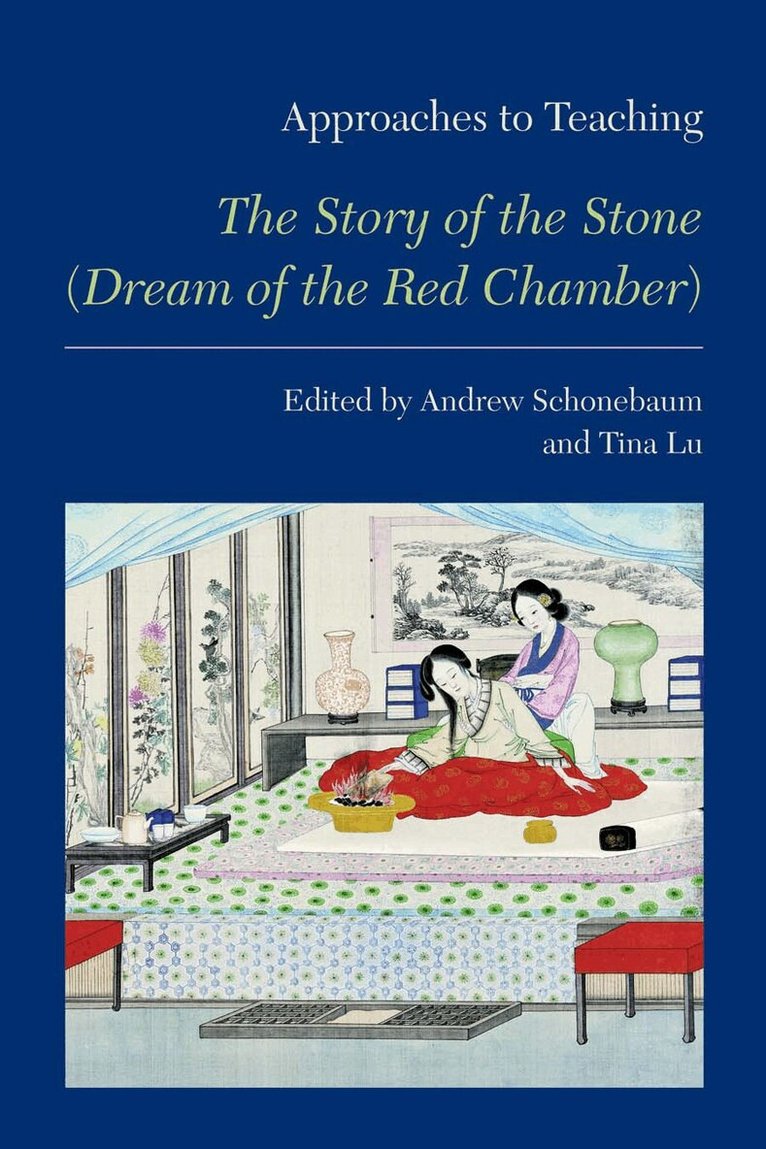
The Story of the Stone (or Dream of the Red Chamber), a Chinese novel by Cao Xueqin and continued by Gao E, tells of an amazing garden, of a young man’s choice between two beautiful women, of his journey toward enlightenment, and of the moral and financial decline of a powerful family. Published in 1792, it depicts virtually every facet of life in eighteenth-century China—and has influenced culture in China ever since.Part 1 of this volume, “Materials,” provides information and resources that will help teachers and students begin and pursue their study of Stone. The essays that constitute part 2, “Approaches,” introduce major topics to be covered in the classroom: Chinese religion, medicine, history, traditions of poetry, material culture, sexual mores, servants; Stone in film and on television; and the formidable challenges of translation into English that were faced by David Hawkes and then by John Minford.