Tobias Scheer – författare
2 492 kr
Skickas inom 5-8 vardagar
2 428 kr
Läs direkt efter köp
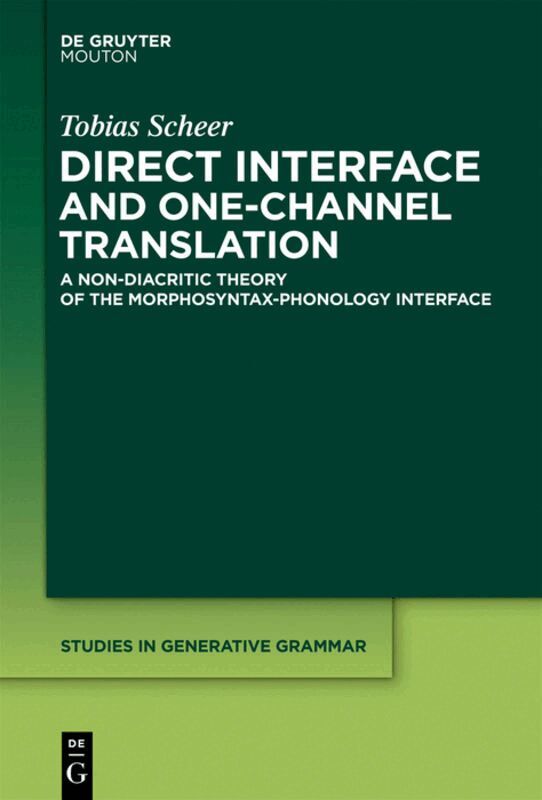
Following up on the Guide to Morphosyntax-Phonology Interface Theories (2011), written from a theory-neutral point of view, this book lays out the author’s approach to the representational side of the interface. The book is thus about how information is transmitted to phonology when an object is inserted into phonological representations (as opposed to the derivational means, i.e. phase theory today). The idea of Direct Interface is that diacritics such as hash-marks in SPE or prosodic constituency since the early 80s, which mediate between morpho-syntax and phonology, are illegal in a modular environment where computational systems can only process domain-specific vocabulary. Direct Interface instead holds that only truly phonological vocabulary can carry morpho-syntactic information. It is shown that of all representational objects only syllabic space qualifies. Couched in CVCV (or strict CV), i.e. Government Phonology, this insight is then applied in detailed case studies of Belarusian, Corsican, Greek and the exhaustive lexical inventory of sonorant-obstruent-initial words in 13 Slavic languages,. In this sense, the book is the 2nd volume of A Lateral Theory of Phonology (2004).
3 869 kr
Skickas inom 5-8 vardagar
2 842 kr
Skickas inom 5-8 vardagar
2 779 kr
Läs direkt efter köp
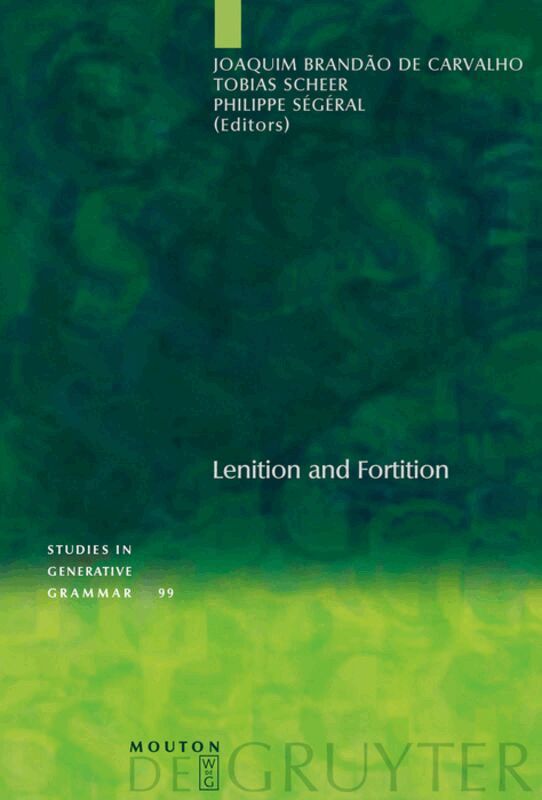
There are books on tone, coronals, the internal structure of segments, vowel harmony, and a couple of other topics in phonology. This book aims to fill the gap for Lenition and Fortition, which is one of the first phenomena that was addressed by phonologists in the 19th century, and ever since contributed to phonological thinking. It is certainly one of the core phenomena that is found in the phonology of natural language: together with assimilations, the other important family of phenomena, Lenition and Fortition constitute the heart of what phonology can do to sound.The book aims to provide an overall treatment of the question in its many aspects: historical, typological, synchronic, diachronic, empirical and theoretical. Various current approaches to phonology are represented.The book is structured into three parts: 1) properties and behaviour of Lenition/Fortition, 2) lenition patterns in particular languages and language families, 3) how Lenition/Fortition work. Part 1 describes the properties of lenition and fortition: what counts as such? What kind of behaviour is observed? Which factors bear on it (positional, stress-related)? Which role has it played in phonology since (and even before) the 19th century? The everything-you-always-wanted-to-know-about-lenition-and-fortition philosophy that guides the conception of the book supposes a descriptive, generalisation-oriented style of writing that relies on a kind of phonological lingua franca, rather than on theory-laden vocabulary. Also, no prior knowledge other than about general phonological categories should be required when reading through Part 1. The goal is to provide a broad picture of what lenition is, how it behaves, which factors it is conditioned by and what generalisations it obeys. This record may then be used as a yardstick for competing theories.Part 2 presents a number of case studies that show how Lenition/Fortition behave in a number of languages that include systems which are notoriously emblematic for Lenition/Fortition: Celtic, Western Romance, Germanic and Finnish.Finally, Part 3 is concerned with the analysis of the patterns that have been described in Parts 1 and 2. Given their analytic orientation, Part 3 chapters are theory-specific. They look at the same empirical record, or at a subset thereof, and try to explain what they see. Even though Part 3 chapters are couched in a specific theoretical environment that most of the time supposes prior conceptual knowledge, authors have been asked to assure theoretical interoperability as much as they could.
3 457 kr
Skickas inom 5-8 vardagar
3 586 kr
Läs direkt efter köp
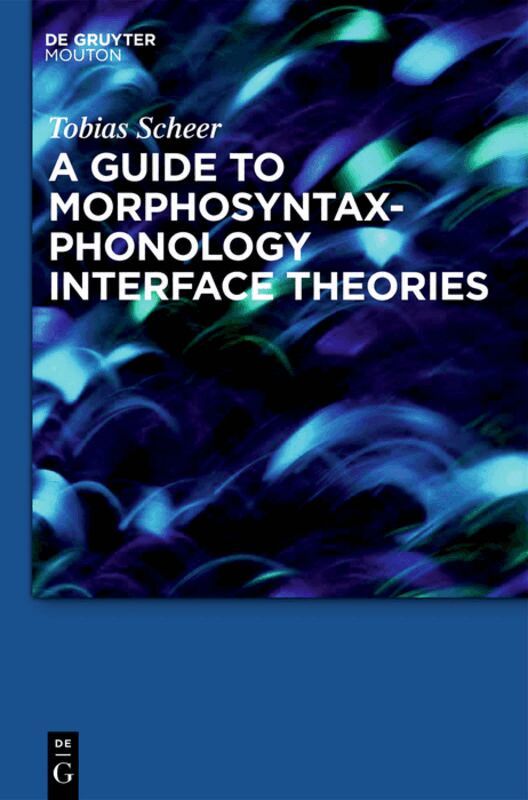
This book reviews the history of the interface between morpho-syntax and phonology roughly since World War II. Structuralist and generative interface thinking is presented chronologically, but also theory by theory from the point of view of a historically interested observer who however in the last third of the book distills lessons in order to assess present-day interface theories, and to establish a catalogue of properties that a correct interface theory should or must not have. The book also introduces modularity, the rationalist theory of the (human) cognitive system that underlies the generative approach to language, from a Cognitive Science perspective. Modularity is used as a referee for interface theories in the book. Finally, the book locates the interface debate in the landscape of current minimalist syntax and phase theory and fosters intermodular argumentation: how can we use properties of morpho-syntactic theory in order to argue for or against competing theories of phonology (and vice-versa)?
5 854 kr
Läs direkt efter köp
The existing major works on the history of the French language were published more than fifty years ago and are characterized by a largely a-theoretical approach. More than a hundred years after Ferdinand Brunot began to publish his monumental work, the ambition of the Grande Grammaire Historique du Français (GGHF) is to present the evolution of the French language in its totality, building on the contributions achieved by descriptive and theoretical research in recent decades. It also offers several innovative aspects.
The GGHF is a grammar organized by themes rather than by periods, and it reflects all major areas currently under debate in linguistics (phonetics / phonology, morphology, syntax, semantics, etc.). In addition, it is based on a balanced corpus of several million words that has been designed especially for the GGHF (with a selection of representative texts for each century). The consideration of this corpus and the quantification of facts enable the authors to establish a close relationship between variation and change: we believe that the interaction of these two aspects is the cornerstone for the interpretation of the evolution of French and of language in general. In addition to the description of the evolution of French, the analysis of language change thus also aims to contribute to the study of the evolution of language as such.
List of coordinators
Yvonne Cazal (University of Caen Normandie, CRISCO, France): Part 4
Bernard Combettes (University of Lorraine, ATILF, France): Parts 5, 6 and 8
Walter De Mulder (University of Antwerp, GaP / C-APP, Belgium): Parts 7 and 9
Peter Koch (University of Tübingen, Romanisches Seminar, Germany): Part 9
Christiane Marchello-Nizia (ENS Lyon, ICAR, France): Parts 5 and 6
Gabriella Parussa (Sorbonne Nouvelle University-Paris 3, CLESTHIA, France): Part 4
Sophie Prévost (CNRS / ENS-University PSL / Sorbonne Nouvelle University, Lattice, France): Parts 1 and 6
Tobias Scheer (University of Côte d’Azur / CNRS, BCL, France): Part 3
Gilles Siouffi (Sorbonne University, STIH, France): Part 2
Esme Winter-Froemel (University of Würzburg, Neuphilologisches Institut / Romanistik, Germany): Part 9
List of contributors
Dany Amiot (DA), University of Lille, STL, France; Wendy Ayres-Bennett (WAB), Cambridge University, Modern and Medieval Languages and Linguistics, UK; Claire Badiou-Monferran (CBM), Sorbonne Nouvelle University-Paris 3, CLESTHIA, France; Sylvie Bazin-Tacchella (SBT), University of Lorraine, ATILF, France; Eva Buchi (EB), CNRS / University of Lorraine, ATILF, France; Anne Carlier (AC), Sorbonne University, STIH, France; Yvonne Cazal (YC), University of Caen Normandie, CRISCO, France; Bernard Combettes (BC), University of Lorraine, ATILF, France; Walter De Mulder (WDM), University of Antwerp, GaP / C-APP, Belgium; Monique Dufresne (MD), University of Queen’s, Canada; Benjamin Fagard (BF), CNRS / ENS-University PSL / Sorbonne Nouvelle University, Lattice, France; Randall Gess (RG), Carleton University, Canada; Julie Glikman (JG), University of Strasbourg, LiLPa, France; Céline Guillot-Barbance (CGB), ENS Lyon, IHRIM, France; Maj-Britt Mosegaard Hansen (MBMH), University of Manchester, Linguistics and English Language, UK; Thomas Hoelbeek (TH), Free University of Bruxelles (VUB), Département de Linguistique Appliquée, Belgium; Haike Jacobs (HJ), Radboud University, Centre for Language Studies, The Netherlands; Peter Koch (PK), University of Tübingen, Romanisches Seminar, Germany; Annie Kuyumcuyan (AK), University of Strasbourg, LiLPa, France; Bernard Laks (BL), Paris Nanterre University, Modyco, France; Elena Llamas-Pombo (ELP), University of Salamanca, IEMYRhd, Spain; Christiane Marchello-Nizia (CMN), ENS Lyon, ICAR, France; Evelyne Oppermann-Marsaux (EOM), Sorbonne Nouvelle University-Paris 3, CLESTHIA, France; Gabriella Parussa (GP), Sorbonne Nouvelle University-Paris 3, CLESTHIA, France; Adeline Patard (AP), University of Caen Normandie, CRISCO, France; Sophie Prévost (SP), CNRS / ENS-University PSL / Sorbonne Nouvelle University, Lattice, France; Magali Rouquier (MR), University Toulouse-Jean Jaurès, France; Tobias Scheer (TS), University of Côte d’Azur / CNRS, BCL, France; Catherine Schnedecker (CS), University of Strasbourg, LiLPa, France; Lene Schøsler (LS), University of Copenhagen, Institut for Engelsk, Germansk og Romansk, Denmark; Philippe Ségéral (PS), Saint-Germain-Village, France; Gilles Siouffi (GS), Sorbonne University, STIH, France; Anne Vanderheyden (AV), University of Antwerp, GaP, Belgium; Esme Winter-Froemel (EWF), University of Würzburg, Neuphilologisches Institut / Romanistik, Germany.
3 543 kr
Läs direkt efter köp
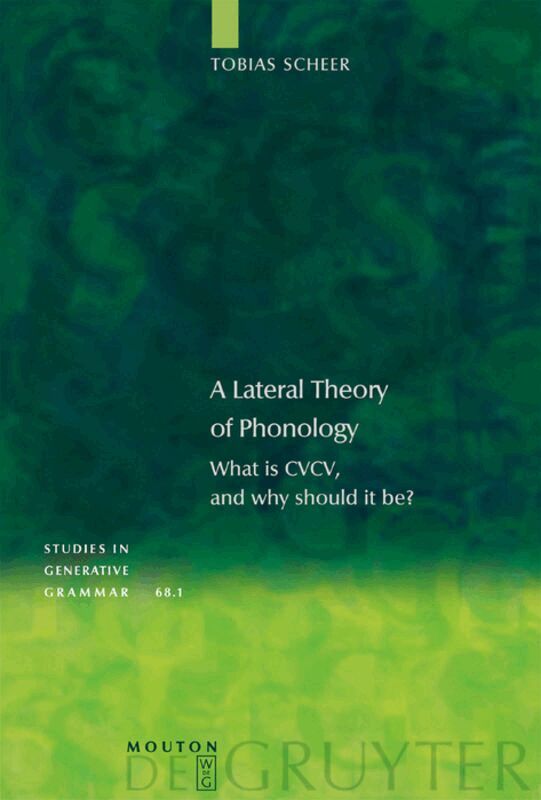
This book presents a development of Jean Lowenstamm''s idea that phonological constituent structure can be reduced to a strict sequence of non-branching Onsets and non-branching Nuclei. The approach at hand is known as ''CVCV'', and emerged from Government Phonology. Since its very beginnings in the early 80s, the central claim of this theory has been that syllable-based generalisations are due to lateral relations among constituents, rather than to the familiar arboreal structure. This book shows that Standard Government Phonology did not go far enough in implementing this idea. CVCV completes the missing steps: structure and causality are fully lateralised. Detailed discussion is offered how basic phonological objects and processes such as Codas, closed syllables, long vowels, geminates, syllabic consonants, vowel-zero alternations, closed syllable shortening, compensatory lengthening, lenition and the like can be represented within the CVCV frame. The first part of the book is called "What is CVCV ?". It presents the properties of the theory. The second part focuses on the reasons why it is worthwhile considering CVCV a valuable and viable approach. The primary goal of the book is not to engage the dialogue with other phonological theories. Rather, it aims at establishing a player in the general game: defining the properties of a theory is always prior to its comparison with other models. In the current OT-dominated phonological scene, then, CVCV appears as a true theory of the 80s insofar as it is representational at core: representations exist and are primitive, rather than arising as accidental results from a heterogeneous set of constraints. The original analyses presented in this book are grounded in the languages that the author is best familiar with, i.e. (Western) Slavic, French, German and some Semitic. Particular attention is paid to diachronic evidence in its relation to the synchronic state of languages.
333 kr
Skickas inom 3-6 vardagar
317 kr
Läs direkt efter köp
L’Abrégé de Phonétique Historique est une introduction à l’évolution de la phonétique du français depuis le latin, à travers l''ancien français, le moyen français, le français classique et jusqu''au français moderne. Présentant les faits principaux de manière succincte et pédagogique, il s’adresse aux étudiants qui préparent l’épreuve d’ancien français de l’agrégation de Lettres Modernes et aux professeurs.
Basé sur la partie concernant la phonétique historique de la Grande Grammaire Historique du Français (GGHF), l’ouvrage valorise les acquis de la tradition séculaire dans le domaine (depuis Bourciez jusqu’à Straka), mais engage également les développements de la phonologie moderne – et ce en particulier concernant la structure syllabique et les représentations autosegmentales plus largement. Il prend le parti d’une présentation par position syllabique, plutôt que par les voyelles et consonnes individuelles. Ainsi les consonnes en position forte (initiale et appuyée) sont examinées ensemble, et il en va de même pour la position intervocalique et la coda. Le même principe régit la présentation des voyelles, en position libre et entravée.
L''Abrégé est accompagné d''une série de ressources supplémentaires en ligne ("Annexes" à télécharger ci-dessous) : un index lexical avec son mode d''emploi, une liste de 180 mots importants pour le concours, des exercices supplémentaires ainsi qu''une liste d''errata.
328 kr
Läs direkt efter köp
L’Abrégé de Phonétique Historique est une introduction à l’évolution de la phonétique du français depuis le latin, à travers l''ancien français, le moyen français, le français classique et jusqu''au français moderne. Présentant les faits principaux de manière succincte et pédagogique, il s’adresse aux étudiants qui préparent l’épreuve d’ancien français de l’agrégation de Lettres Modernes et aux professeurs.
Basé sur la partie concernant la phonétique historique de la Grande Grammaire Historique du Français (GGHF), l’ouvrage valorise les acquis de la tradition séculaire dans le domaine (depuis Bourciez jusqu’à Straka), mais engage également les développements de la phonologie moderne – et ce en particulier concernant la structure syllabique et les représentations autosegmentales plus largement. Il prend le parti d’une présentation par position syllabique, plutôt que par les voyelles et consonnes individuelles. Ainsi les consonnes en position forte (initiale et appuyée) sont examinées ensemble, et il en va de même pour la position intervocalique et la coda. Le même principe régit la présentation des voyelles, en position libre et entravée.
L''Abrégé est accompagné d''une série de ressources supplémentaires en ligne ("Annexes" à télécharger ci-dessous) : un index lexical avec son mode d''emploi, une liste de 180 mots importants pour le concours, des exercices supplémentaires ainsi qu''une liste d''errata.