changement en français
Etudes de linguistique diachronique
2 033 kr
Skickas inom 3-6 vardagar
Etudes de linguistique diachronique
2 033 kr
Skickas inom 3-6 vardagar
Dépendances syntaxiques, morphosyntaxe verbale, grammaticalisation
1 924 kr
Skickas inom 3-6 vardagar
Cet ouvrage rassemble 14 articles consacrés à la linguistique diachronique du français. Ils portent plus spécifiquement sur trois thèmes majeurs des recherches actuelles sur l’évolution du français. Le premier thème est celui de l’évolution des relations de dépendance, qui ont connu des changements importants dans l’histoire du français, qu’il s’agisse de mouvements vers une plus grande dépendance, ou au contraire vers une plus grande autonomie, et ce à différents niveaux du système linguistique. La vitalité des travaux en morpho-syntaxe verbale est incontestable, et fournit la matière du second thème. Enfin, le processus de grammaticalisation et les changements afférents constituent le troisième thème. La vitalité de la recherche en diachronie du français est illustrée par l’origine des auteurs, qui appartiennent à la communauté académique internationale (France, Suisse, Belgique, Canada, Danemark, Espagne, République Tchèque).
Etudes en hommage à Bernard Combettes
2 467 kr
Skickas inom 3-6 vardagar
Etudes de linguistique diachronique
2 224 kr
Skickas inom 3-6 vardagar
6 113 kr
Läs direkt efter köp
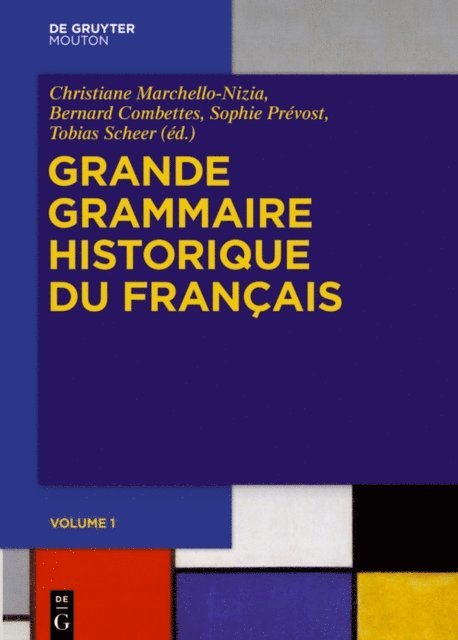
The existing major works on the history of the French language were published more than fifty years ago and are characterized by a largely a-theoretical approach. More than a hundred years after Ferdinand Brunot began to publish his monumental work, the ambition of the Grande Grammaire Historique du Français (GGHF) is to present the evolution of the French language in its totality, building on the contributions achieved by descriptive and theoretical research in recent decades. It also offers several innovative aspects.
The GGHF is a grammar organized by themes rather than by periods, and it reflects all major areas currently under debate in linguistics (phonetics / phonology, morphology, syntax, semantics, etc.). In addition, it is based on a balanced corpus of several million words that has been designed especially for the GGHF (with a selection of representative texts for each century). The consideration of this corpus and the quantification of facts enable the authors to establish a close relationship between variation and change: we believe that the interaction of these two aspects is the cornerstone for the interpretation of the evolution of French and of language in general. In addition to the description of the evolution of French, the analysis of language change thus also aims to contribute to the study of the evolution of language as such.
List of coordinators
Yvonne Cazal (University of Caen Normandie, CRISCO, France): Part 4
Bernard Combettes (University of Lorraine, ATILF, France): Parts 5, 6 and 8
Walter De Mulder (University of Antwerp, GaP / C-APP, Belgium): Parts 7 and 9
Peter Koch (University of Tübingen, Romanisches Seminar, Germany): Part 9
Christiane Marchello-Nizia (ENS Lyon, ICAR, France): Parts 5 and 6
Gabriella Parussa (Sorbonne Nouvelle University-Paris 3, CLESTHIA, France): Part 4
Sophie Prévost (CNRS / ENS-University PSL / Sorbonne Nouvelle University, Lattice, France): Parts 1 and 6
Tobias Scheer (University of Côte d’Azur / CNRS, BCL, France): Part 3
Gilles Siouffi (Sorbonne University, STIH, France): Part 2
Esme Winter-Froemel (University of Würzburg, Neuphilologisches Institut / Romanistik, Germany): Part 9
List of contributors
Dany Amiot (DA), University of Lille, STL, France; Wendy Ayres-Bennett (WAB), Cambridge University, Modern and Medieval Languages and Linguistics, UK; Claire Badiou-Monferran (CBM), Sorbonne Nouvelle University-Paris 3, CLESTHIA, France; Sylvie Bazin-Tacchella (SBT), University of Lorraine, ATILF, France; Eva Buchi (EB), CNRS / University of Lorraine, ATILF, France; Anne Carlier (AC), Sorbonne University, STIH, France; Yvonne Cazal (YC), University of Caen Normandie, CRISCO, France; Bernard Combettes (BC), University of Lorraine, ATILF, France; Walter De Mulder (WDM), University of Antwerp, GaP / C-APP, Belgium; Monique Dufresne (MD), University of Queen’s, Canada; Benjamin Fagard (BF), CNRS / ENS-University PSL / Sorbonne Nouvelle University, Lattice, France; Randall Gess (RG), Carleton University, Canada; Julie Glikman (JG), University of Strasbourg, LiLPa, France; Céline Guillot-Barbance (CGB), ENS Lyon, IHRIM, France; Maj-Britt Mosegaard Hansen (MBMH), University of Manchester, Linguistics and English Language, UK; Thomas Hoelbeek (TH), Free University of Bruxelles (VUB), Département de Linguistique Appliquée, Belgium; Haike Jacobs (HJ), Radboud University, Centre for Language Studies, The Netherlands; Peter Koch (PK), University of Tübingen, Romanisches Seminar, Germany; Annie Kuyumcuyan (AK), University of Strasbourg, LiLPa, France; Bernard Laks (BL), Paris Nanterre University, Modyco, France; Elena Llamas-Pombo (ELP), University of Salamanca, IEMYRhd, Spain; Christiane Marchello-Nizia (CMN), ENS Lyon, ICAR, France; Evelyne Oppermann-Marsaux (EOM), Sorbonne Nouvelle University-Paris 3, CLESTHIA, France; Gabriella Parussa (GP), Sorbonne Nouvelle University-Paris 3, CLESTHIA, France; Adeline Patard (AP), University of Caen Normandie, CRISCO, France; Sophie Prévost (SP), CNRS / ENS-University PSL / Sorbonne Nouvelle University, Lattice, France; Magali Rouquier (MR), University Toulouse-Jean Jaurès, France; Tobias Scheer (TS), University of Côte d’Azur / CNRS, BCL, France; Catherine Schnedecker (CS), University of Strasbourg, LiLPa, France; Lene Schøsler (LS), University of Copenhagen, Institut for Engelsk, Germansk og Romansk, Denmark; Philippe Ségéral (PS), Saint-Germain-Village, France; Gilles Siouffi (GS), Sorbonne University, STIH, France; Anne Vanderheyden (AV), University of Antwerp, GaP, Belgium; Esme Winter-Froemel (EWF), University of Würzburg, Neuphilologisches Institut / Romanistik, Germany.