Toby Mayer - Böcker
Visar alla böcker från författaren Toby Mayer. Handla med fri frakt och snabb leverans.
3 produkter
3 produkter
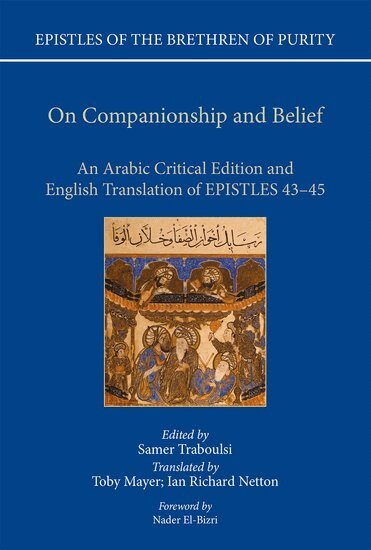
On Companionship and Belief
An Arabic Critical Edition and English Translation of Epistles 43-45
Inbunden, Engelska, 2017
878 kr
Skickas inom 5-8 vardagar
The Ikhwan al-Safa' (Brethren of Purity), the anonymous adepts of a tenth-century esoteric fraternity based in Basra and Baghdad, hold an eminent position in the history of science and philosophy in Islam due to the wide reception and assimilation of their monumental encyclopaedia, the Rasa 'il Ikhwan al-Safa' (Epistles of the Brethren of Purity). This compendium contains fifty-two epistles offering synoptic accounts of the classical sciences and philosophies of the age; divided into four classificatory parts, it treats themes in mathematics, logic, natural philosophy, psychology, metaphysics, and theology, in addition to didactic fables. Epistles 43-45 succeed the extended description of religions and creeds that opens the final section of the corpus, on the theological sciences. Epistle 43 explains briefly the need for purifying one's soul by performing virtuous acts, after which one can follow the 'straight path' to God. The extremely diverse Epistle 44 is no dry exercise in abstruse theology; rather, it is characterized by the most delightful anecdotes, designed to inform the reader of a deeper truth, that of the hereafter following the soul's separation from the body at death. Alongside references to many of the Prophets encountered in the Qur'an, this Epistle shows a familiarity with other religions such as Christianity, Judaism, and Buddhism. Epistle 45 focuses on companionship and friendship, resonating strongly with the word 'Brethren' by which the authors distinguish themselves. The volume overall is united in its underlying themes of the immortality of the soul and the profound need for mutual cooperation, informed in parts by the general Neoplatonism of the entire corpus, as well as by Aristotelian and Platonic motifs.
370 kr
Skickas inom 7-10 vardagar
Only preserved in a single manuscript in Tehran, this remarkable twelfth-century Qur'anic commentary by Muhammad b. 'Abd al-Karim al- Shahrastani marks the achievement of a lifelong, arduous quest for knowledge. Shahrastani began writing Mafatih al-asrar or Keys to the Arcana towards the end of his life and the work reflects the brilliant radicalism of his more private religious views. The introduction and opening chapter of this virtually unknown work is presented here in a bilingual edition, which also includes an introduction and contextual notes by Toby Mayer.In Keys to the Arcana, Shahrastani breaks down the text of the Qur'an and analyses it from a linguistic point of view, with reference to the history of Qur'anic interpretation. The author's ultimate aim is to use an elaborate set of complimentary concepts - the 'keys' of the work's title - to unearth the esoteric meanings of the Qur'anic verses, which he calls the 'arcana' of the verses (asrar al-ayat). A historian of religious and philosophical doctrines, Shahrastani has generally been considered to be a spokesman for the Sunni religious establishment under the Seljuqs. The complimentary concepts in question, however, appear to derive from the Isma'ili Shi'i intellectual tradition, indicating that the author may have been secretly involved in the Isma'ili movement. Shahrastani 's unusually esoteric and highly systematic exegesis of the Qur'an provides a vivid picture of the mature state of scriptural commentary in the twelfth-century CE. Dr Mayer's meticulous translation of Shahrastani 's Introduction and Commentary on Surat al-Fatiha, supplemented by the Arabic text, allows the reader and scholar access to this intriguing Muslim intellectual work for the first time.
980 kr
Skickas inom 7-10 vardagar
Only preserved in a single manuscript in Tehran, this remarkable twelfth-century Qur'anic commentary by Muhammad b. 'Abd al-Karim al- Shahrastānī marks the achievement of a lifelong, arduous quest for knowledge. Shahrastānī began writing Mafatih al-asrār or Keys to the Arcana towards the end of his life and the work reflects the brilliant radicalism of his more private religious views. The introduction and opening chapter of this virtually unknown work is presented here in a bilingual edition, which also includes an introduction and contextual notes by Dr Toby Mayer.In Keys to the Arcana, Shahrastānī breaks down the text of the Qur'an and analyses it from a linguistic point of view, with reference to the history of Qur'anic interpretation. The author's ultimate aim is to use an elaborate set of complementary concepts - the 'keys' of the work's title - to unearth the esoteric meanings of Qur'anic verses, which he calls the 'arcana' of the verses (asrār al-āyāt). A historian of religious and philosophical doctrines, Shahrastānī has generally been considered to be a spokesman for the Sunni religious establishment under the Seljuqs. The complementary concepts in question, however, appear to derive, in part, from the Isma'ili Shi'i intellectual tradition, indicating that the author may have been secretly involved in the Isma'ili movement. Shahrastānī 's unusually esoteric and highly systematic exegesis of the Qur'an provides a vivid picture of the mature state of scriptural commentary in the twelfth-century CE. Dr Mayer's meticulous translation of Shahrastānī 's Introduction and Commentary on Sūrat al-Fatiha, supplemented by the Arabic text, allows the reader and scholar access to this intriguing Muslim intellectual work for the first time.