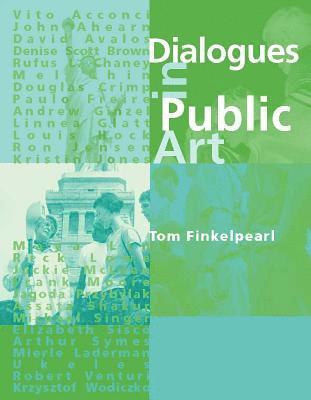
Tom Finkelpearl – författare
Visar alla böcker från författaren Tom Finkelpearl. Handla med fri frakt och snabb leverans.
4 produkter
4 produkter
403 kr
Tillfälligt slut
1 365 kr
Skickas inom 7-10 vardagar
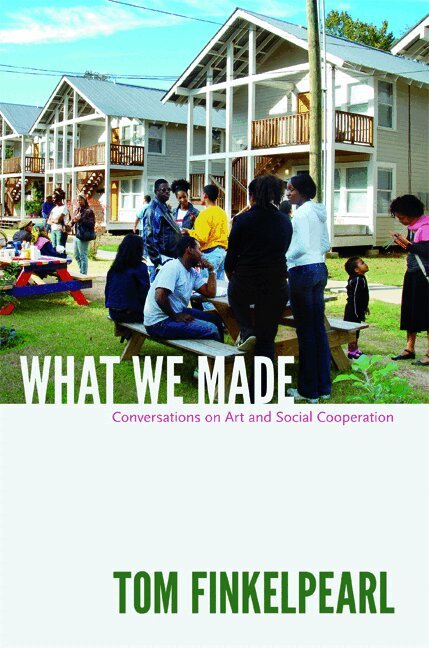
In What We Made, Tom Finkelpearl examines the activist, participatory, coauthored aesthetic experiences being created in contemporary art. He suggests social cooperation as a meaningful way to think about this work and provides a framework for understanding its emergence and acceptance. In a series of fifteen conversations, artists comment on their experiences working cooperatively, joined at times by colleagues from related fields, including social policy, architecture, art history, urban planning, and new media. Issues discussed include the experiences of working in public and of working with museums and libraries, opportunities for social change, the lines between education and art, spirituality, collaborative opportunities made available by new media, and the elusive criteria for evaluating cooperative art. Finkelpearl engages the art historians Grant Kester and Claire Bishop in conversation on the challenges of writing critically about this work and the aesthetic status of the dialogical encounter. He also interviews the often overlooked co-creators of cooperative art, "expert participants" who have worked with artists. In his conclusion, Finkelpearl argues that pragmatism offers a useful critical platform for understanding the experiential nature of social cooperation, and he brings pragmatism to bear in a discussion of Houston's Project Row Houses.Interviewees. Naomi Beckwith, Claire Bishop, Tania Bruguera, Brett Cook, Teddy Cruz, Jay Dykeman, Wendy Ewald, Sondra Farganis, Harrell Fletcher, David Henry, Gregg Horowitz, Grant Kester, Mierle Laderman Ukeles, Pedro Lasch, Rick Lowe, Daniel Martinez, Lee Mingwei, Jonah Peretti, Ernesto Pujol, Evan Roth, Ethan Seltzer, and Mark Stern
422 kr
Skickas
In What We Made, Tom Finkelpearl examines the activist, participatory, coauthored aesthetic experiences being created in contemporary art. He suggests social cooperation as a meaningful way to think about this work and provides a framework for understanding its emergence and acceptance. In a series of fifteen conversations, artists comment on their experiences working cooperatively, joined at times by colleagues from related fields, including social policy, architecture, art history, urban planning, and new media. Issues discussed include the experiences of working in public and of working with museums and libraries, opportunities for social change, the lines between education and art, spirituality, collaborative opportunities made available by new media, and the elusive criteria for evaluating cooperative art. Finkelpearl engages the art historians Grant Kester and Claire Bishop in conversation on the challenges of writing critically about this work and the aesthetic status of the dialogical encounter. He also interviews the often overlooked co-creators of cooperative art, "expert participants" who have worked with artists. In his conclusion, Finkelpearl argues that pragmatism offers a useful critical platform for understanding the experiential nature of social cooperation, and he brings pragmatism to bear in a discussion of Houston's Project Row Houses.Interviewees. Naomi Beckwith, Claire Bishop, Tania Bruguera, Brett Cook, Teddy Cruz, Jay Dykeman, Wendy Ewald, Sondra Farganis, Harrell Fletcher, David Henry, Gregg Horowitz, Grant Kester, Mierle Laderman Ukeles, Pedro Lasch, Rick Lowe, Daniel Martinez, Lee Mingwei, Jonah Peretti, Ernesto Pujol, Evan Roth, Ethan Seltzer, and Mark Stern
664 kr
Skickas inom 5-8 vardagar
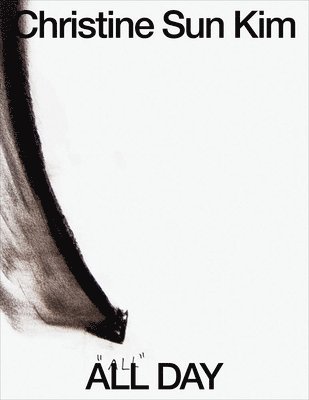
“[Her] poetic and political art pushes viewers to consider the limits, and misunderstandings, that come with communication in any language.” —Andrew Russeth, the New York TimesThis volume surveys Christine Sun Kim’s works across painting, sculpture, drawing, moving image, performance, large-scale murals and collaborations with other artists made between 2011 and 2024. Kim’s practice considers how sound operates in society, deconstructing the politics of sound and exploring how oral languages operate as social currency. Identifying as Deaf and Korean American, Kim draws on musical notation, written language, infographics, American Sign Language (ASL) and the use of the body, strategically deploying humor to examine communication with her family and her community and to create new channels of dialogue with wide audiences.Published alongside the traveling exhibition, All Day All Night is brimming with supplementary texts from curators, artists and scholars, including an interview between Christine Sun Kim and exhibition curators Tom Finkelpearl, Jennie Goldstein and Pavel S. Pys; scholarly contributions by Seth Kim-Cohen, Jeffrey Yasuo Mansfield and Park McArthur; and an intimate artist timeline compiled by Brandon Eng and Rose Pallone. A substantial plate section follows these enriching text contributions.Christine Sun Kim (born 1980) is an American artist based in Berlin. Her work explores her relationship to spoken and signed languages, to her built and social environments and to the world at large. Kim has exhibited and performed internationally, including at the Queens Museum, New York (2022); the Drawing Center, New York (2022); Whitney Biennial, New York (2019); Albright-Knox Art Gallery, Buffalo (2019); and the Art Institute of Chicago (2018).