Ulrich Hoffrage - Böcker
Visar alla böcker från författaren Ulrich Hoffrage. Handla med fri frakt och snabb leverans.
4 produkter
4 produkter
301 kr
Skickas inom 7-10 vardagar
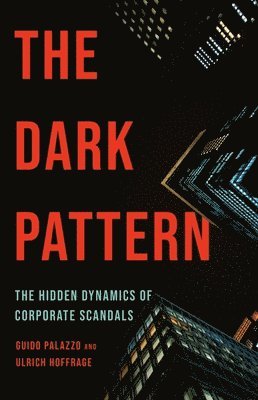
From the creators of the theory of ethical blindness comes an investigation into how corporate scandals happen, revealing the common pattern behind them and how your organization can avoid themToo often, the stories of corporate scandals are narrated like Hollywood movies in which once-celebrated CEOs are unmasked as sociopaths and ultimately convicted for their crimes. What we fail to realize, however, is that most bad things are done by average people with honorable values and without bad intentions.In The Dark Pattern, two experts in business ethics and decision-making challenge the conventional view that corporate misconduct happens because of a handful of bad actors. Instead, the book shows how entire organizations can fall off the moral cliff because good people become ethically blind.Drawing on the latest insights from behavioral science, the authors identify nine toxic elements that lead to corporate scandals and offer nine actionable lessons for building morally resilient organizations. Essential reading for business leaders, The Dark Pattern offers real-world guidance for defending companies against the subtle dynamics of moral erosion.
1 888 kr
Skickas inom 5-8 vardagar
Simple Heuristics in a Social World invites readers to discover the simple heuristics that people use to navigate the complexities and surprises of environments populated with others. The social world is a terrain where humans and other animals compete with conspecifics for myriad resources, including food, mates, and status, and where rivals grant the decision maker little time for deep thought, protracted information search, or complex calculations. Yet, the social world also encompasses domains where social animals such as humans can learn from one another and can forge alliances with one another to boost their chances of success.According to the book's thesis, the undeniable complexity of the social world does not dictate cognitive complexity as many scholars of rationality argue. Rather, it entails circumstances that render optimization impossible or computationally arduous: intractability, the existence of incommensurable considerations, and competing goals. With optimization beyond reach, less can be more. That is, heuristics--simple strategies for making decisions when time is pressing and careful deliberation an unaffordable luxury--become indispensible mental tools. As accurate as or even more accurate than complex methods when used in the appropriate social environments, these heuristics are good descriptive models of how people make many decisions and inferences, but their impressive performance also poses a normative challenge for optimization models. In short, the Homo socialis may prove to be a Homo heuristicus whose intelligence reflects ecological rather than logical rationality.
560 kr
Skickas inom 10-15 vardagar
With hindsight, we tend to exaggerate what we had known with foresight. This phenomenon can be observed in a memory design in which previous judgements have to be recalled after outcome information has been made available, or in a hypothetical design in which participants receive outcome information but are asked to ignore it when subsequently judging what they would have said without this information. Since the introduction of this so-called hindsight bias or knew-it-all-along effect to the psychological literature in the mid-seventies, there has been immense research on this topic. This special issue presents ten articles that describe the most recent theoretical developments and empirical results. After a brief introductory overview of the state of the art, the issue commences with two process models (SARA, Pohl, Eisenhauer & Hardt; and RAFT, Hertwig, Fanselow & Hoffrage), which are formalized enough to allow for computer simulations. Subsequently, Hardt and Pohl demonstrate how the hindsight bias is related to the phenomenon of anchoring, and Schwarz and Stahlberg propose that due to meta-cognitive processes, the outcome information is deliberately chosen as such an anchor. In a variant of the meta-cognitive approach, Werth and Strack argue that ease of retrieval of an answer is used as a cue to infer its correctness and to determine one's confidence in its correctness. Similarly, Pezzo proposes a model that predicts hindsight bias from feelings that arise when trying to make sense of the outcome information in light of prior expectations. Mark et al. and Renner adopt a motivational perspective and explore the impact of self-relevance of the outcome information. Blank, Fischer, and Erdfelder report a successful replication of the hindsight bias in two political elections, and Musch explains some of the variance in hindsight bias using personality factors.
Fremdenfeindlichkeit und Rechtsextremismus
Dokumentation einer multidisziplinären Vortragsreihe
Häftad, Tyska, 2002
303 kr
Skickas inom 10-15 vardagar
Schon seit längerem berichten die Medien über erhebliche rechtsextreme und fremdenfeindliche Aktivitäten in unserem Land. Vor rund zwei Jah ren verfestigte sich indessen innerhalb kurzer Zeit der Eindruck, dass Häufigkeit und Intensität der Übergriffe deutlich zunahmen. Fast täglich wurden nun Ereignisse mit rechtsextremem und fremdenfeindlichem Hintergrund gemeldet. Dies führte zu einer Intensivierung der Auseinan dersetzung darüber, wie man dieser unheilvollen Entwicklung entgegen steuern könnte. Gleichzeitig wuchs die Zahl derjenigen Bürgerinnen und Bürger, die das Bedürfnis verspürten, nicht nur über die sich immer be drohlicher darstellende Entwicklung zu diskutieren, sondern auch selber etwas dagegen zu tun. In dieser Situation haben wir - der Mitarbeiterausschuss des Max Planck-Instituts fUr Bildungsforschung, Berlin - uns Gedanken darüber gemacht, welchen Beitrag wir denn selbst leisten könnten. Dabei ließen wir uns nicht allein von persönlicher Betroffenheit leiten, sondern auch von unserer funktionalen Verantwortung. Die Max-Planck-Gesellschaft bzw. ihre mehr als 80 Forschungsinstitute beschäftigen eine große Zahl ausländischer Wissenschaftler. Diese werden zusehends verunsichert durch das nicht eben ausländerfreundliche Klima in unserem Land. Es schien ein elementares Gebot der Solidarität, diesen Kolleginnen und Kol legen zu zeigen, dass sie nicht allein stehen. Traditionell kooperieren Wis senschaftler der Max-Planck-Gesellschaft intensiv mit Forschungseinrich tungen im Ausland. Es kann uns nicht gleichgültig sein, wie das Ausland die Entwicklung in Deutschland beurteilt.