Vanessa Casado-Perez – författare
Visar alla böcker från författaren Vanessa Casado-Perez. Handla med fri frakt och snabb leverans.
3 produkter
3 produkter
569 kr
Skickas inom 10-15 vardagar
While water is an increasingly scarce resource, most existing methods to allocate it are neither economically nor environmentally efficient. In these circumstances, water markets offer developed countries a form of regulatory response capable of overcoming many of the shortcomings of current water management. The debate on water markets is, however, a polarized one. This is mostly a result of the misunderstanding of the roles played by governments in water markets. Proponents mistakenly portrayed them as leaving governments, for the most part, out of the picture. Opponents, in turn, understand commodification of water and administration by public agencies as incompatible. Casado Pérez argues that both sides of the debate overlook that water markets require a deeper and more varied governmental intervention than markets for other goods. Drawing on economic theories of regulation based on market failure, she explains the different roles governments should play to ensure a well-functioning water market, and concludes that only the visible hand of governments can ensure the success of water markets. Casado Pérez proves her case by examining case studies of California and Spain to assess the success of their water markets. She explores why water markets were more extensively institutionalized in California than in Spain in the first ten years since their introduction and how the role of governments in each case study impacted water market operation.This unique analysis of governmental roles in water markets, alongside qualitative studies of California and Spain, offers valuable guidance to understand environmental markets and to face the challenges presented by water management in regions with periodical droughts.
2 131 kr
Skickas inom 10-15 vardagar
While water is an increasingly scarce resource, most existing methods to allocate it are neither economically nor environmentally efficient. In these circumstances, water markets offer developed countries a form of regulatory response capable of overcoming many of the shortcomings of current water management. The debate on water markets is, however, a polarized one. This is mostly a result of the misunderstanding of the roles played by governments in water markets. Proponents mistakenly portrayed them as leaving governments, for the most part, out of the picture. Opponents, in turn, understand commodification of water and administration by public agencies as incompatible. Casado Pérez argues that both sides of the debate overlook that water markets require a deeper and more varied governmental intervention than markets for other goods. Drawing on economic theories of regulation based on market failure, she explains the different roles governments should play to ensure a well-functioning water market, and concludes that only the visible hand of governments can ensure the success of water markets. Casado Pérez proves her case by examining case studies of California and Spain to assess the success of their water markets. She explores why water markets were more extensively institutionalized in California than in Spain in the first ten years since their introduction and how the role of governments in each case study impacted water market operation.This unique analysis of governmental roles in water markets, alongside qualitative studies of California and Spain, offers valuable guidance to understand environmental markets and to face the challenges presented by water management in regions with periodical droughts.
1 633 kr
Skickas inom 7-10 vardagar
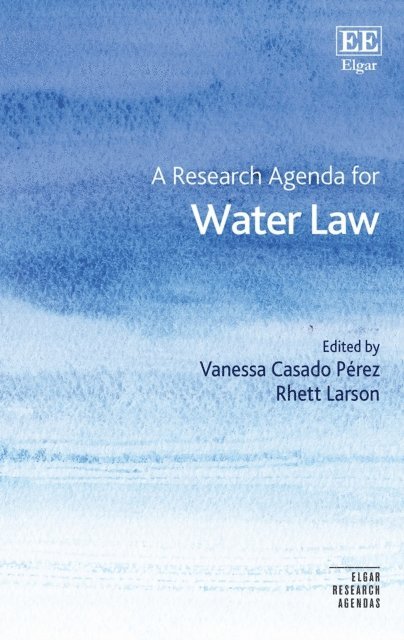
Elgar Research Agendas outline the future of research in a given area. Leading scholars are given the space to explore their subject in provocative ways, and map out the potential directions of travel. They are relevant but also visionary.This timely Research Agenda provides imaginative solutions to existing and emerging challenges for the study, application, and development of water law. It argues for a dynamic approach to water law, anticipating how water and its relationship to humanity will shift due to climate change, modern societal norms and values, and technological innovation.Bringing together leading experts and rising new voices, this Research Agenda analyses local, national, and international water law. It explores the pressing issues of today and tomorrow, and identifies areas for further research to ensure legal regimes can respond to future challenges for water provision. Contributors consider the legal personhood of rivers, water quality, international basins, water markets, and the role of indigenous groups in water management. Ultimately, this Research Agenda provides a portfolio of options for responding to the uncertain natural, social, and political future of water.Providing a cutting-edge overview of the challenges facing water law locally, nationally, and internationally, A Research Agenda for Water Law will be a valuable resource for scholars of water law, environmental law, and public international law. It will also be essential reading for policy-makers seeking to build future-facing water law regimes.