Wendell Clausen - Böcker
Visar alla böcker från författaren Wendell Clausen. Handla med fri frakt och snabb leverans.
2 produkter
2 produkter
518 kr
Skickas inom 5-8 vardagar
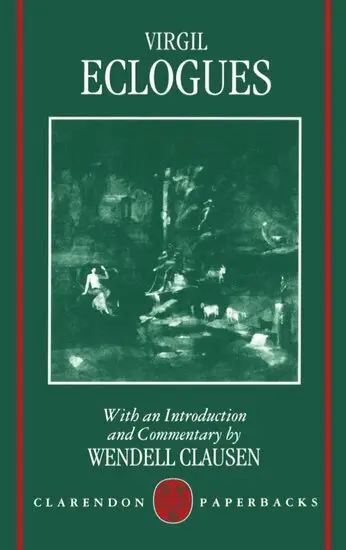
Surprising though it may seem, this is the first full-scale scholarly commentary in English on Virgil's Eclogues. Written between about 42 and 35 BC, these ten short pastorals are among the best known poems in Latin literature. They have inspired numerous poets - Sidney, Ronsard, and others - and at the same time have held enduring fascination among scholars for their sophistaicated and allusive blend of Theocritean idyll and contemporary Roman history.Professor Clausen's commentary will provide a comprehensive guide to the poems and the considerable scholarship surrounding them, and should be indispensable to all serious students of Virgil's poetry. Special attention is paid throughout the commentary to the important question of Virgil's use of Theocritus and other Hellenistic poets, with translations provided of all Greek passages. There are many new and illuminating observations on Virgil's poetic style and vocabulary, often with reference to his Latin predecessors: Lucretius, Catullus and (virtually unnoticed by previous scholars) Plautus. A third feature of the commentary is a new examination of the plants and trees in the poems - both their exact identification and their significance. There are helpful introductions to each poem, as well as a comprehensive general introduction to the Eclogues as a whole, in which Professor Clausen discusses the nature of ancient pastoral poetry, the structure of the Eclogues, and the composition of a pastoral landscape by Virgil and Theocritus.
Del 95 - Harvard Studies in Classical Philology
Harvard Studies in Classical Philology, Volume 95
Inbunden, Engelska, 1993
451 kr
Skickas inom 7-10 vardagar
This volume of eighteen articles offers: Andrew R. Dyck, “The Fragments of Heliodorus Homericus”; Hayden Pelliccia, “Aeschylus, Eumenides 64–88 and the Ex Cathedra Language of Apollo”; G. Zuntz, “Aeschyli Prometheus”; Georgia Ann Machemer, “Medicine, Music, and Magic: The Healing Grace of Pindar’s Fourth Nemean”; Carlo O. Pavese, “On Pindar fr. 169”; Deborah Steiner, “Pindar’s ‘Oggetti Parlanti’”; Heinz-Günther Nesselrath, “Parody and Later Greek Comedy”; Noel Robertson, “Athens’ Festival of the New Wine”; Richard F. Thomas, “Two Problems in Theocritus (Id. 5.49, 22.66)”; Nita Krevans, “Ilia’s Dream: Ennius, Virgil, and the Mythology of Seduction”; Benjamin Victor, “Remarks on the Andria of Terence”; Cynthia Damon, “Comm. Pet. 10”; Harold Gotoff, “Oratory: The Art of Illusion”; Henri J. W. Wijsman, “Ascanius, Gargara and Female Power in Georgics 3.269–270”*; Robert V. Albis, “Aeneid 2.57–59: The Ennian Background”; Mario Geymonat, “Callimachus at the End of Aeneas’ Narration”; Alessandro Barchiesi, “Future Reflexive: Two Modes of Allusion and Ovid’s Heroides”; and Monika Asztalos, “Boethius as a Transmitter of Greek Logic to the Latin West: The Categories.”* By misunderstanding this article was published in an uncorrected form in HSCP, vol. 94 (1992). Any reference should be made to the article as published here.