W.G. Kepner - Böcker
Visar alla böcker från författaren W.G. Kepner. Handla med fri frakt och snabb leverans.
4 produkter
4 produkter
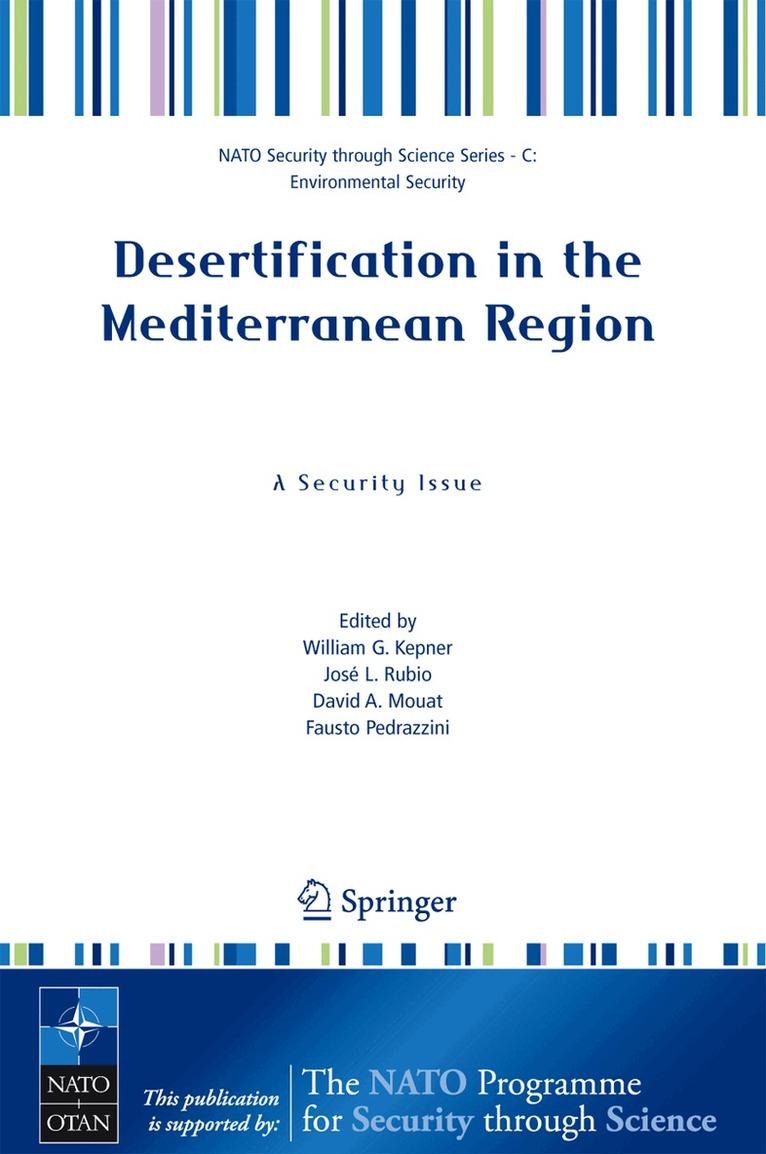
Desertification in the Mediterranean Region. A Security Issue
Proceedings of the NATO Mediterranean Dialogue Workshop, held in Valencia, Spain, 2-5 December 2003
Inbunden, Engelska, 2005
3 178 kr
Skickas inom 10-15 vardagar
Desertification in the Mediterranean Region: a Security Issue 1 2 William G. Kepner & Jose Luis Rubio 1. U.S. Environmental Protection Agency, Office of Research and Development, P.O. Box 93478, Las Vegas, Nevada, USA, 89193-3478 (kepner.william@epa.gov) 2. Centro de Investigaciones sobre Desertificacion-CIDE, (CSIC, Universitat de Valencia, Generalitat Valenciana),Cami de la Marjal, s/n Apartado Oficial, 46470 Albal, Valencia, Spain (jose.l.rubio@uv.es) Security issues related to desertification in the Mediterranean Region were the subject of a special NATO workshop held on 2-5 December 2003 at the Museum of Sciences Principe Felipe in Valencia, Spain. This workshop was organized by the U.S. Environmental Protection Agency (Las Vegas, Nevada, USA), Centre for Desertification Research (Valencia, Spain), and the Desert Research Institute (Reno, Nevada, USA) on behalf of the NATO Science Committee and the NATO Committee on the Challenges of Modern Society (Public Diplomacy Division). Additionally, the European Society for Soil Conservation participated as a collaborating institution.Other participating institutions included the Spanish Ministry of Environment, Generalitat Valencia (Department of Territory and Housing), the Secretariat of the United Nations Convention to Combat Desertification and the City of Art & Sciences of Valencia which hosted the Meeting.
Desertification in the Mediterranean Region. A Security Issue
Proceedings of the NATO Mediterranean Dialogue Workshop, held in Valencia, Spain, 2-5 December 2003
Häftad, Engelska, 2005
3 178 kr
Skickas inom 10-15 vardagar
Desertification in the Mediterranean Region: a Security Issue 1 2 William G. Kepner & Jose Luis Rubio 1. U.S. Environmental Protection Agency, Office of Research and Development, P.O. Box 93478, Las Vegas, Nevada, USA, 89193-3478 (kepner.william@epa.gov) 2. Centro de Investigaciones sobre Desertificacion-CIDE, (CSIC, Universitat de Valencia, Generalitat Valenciana),Cami de la Marjal, s/n Apartado Oficial, 46470 Albal, Valencia, Spain (jose.l.rubio@uv.es) Security issues related to desertification in the Mediterranean Region were the subject of a special NATO workshop held on 2-5 December 2003 at the Museum of Sciences Principe Felipe in Valencia, Spain. This workshop was organized by the U.S. Environmental Protection Agency (Las Vegas, Nevada, USA), Centre for Desertification Research (Valencia, Spain), and the Desert Research Institute (Reno, Nevada, USA) on behalf of the NATO Science Committee and the NATO Committee on the Challenges of Modern Society (Public Diplomacy Division). Additionally, the European Society for Soil Conservation participated as a collaborating institution.Other participating institutions included the Spanish Ministry of Environment, Generalitat Valencia (Department of Territory and Housing), the Secretariat of the United Nations Convention to Combat Desertification and the City of Art & Sciences of Valencia which hosted the Meeting.
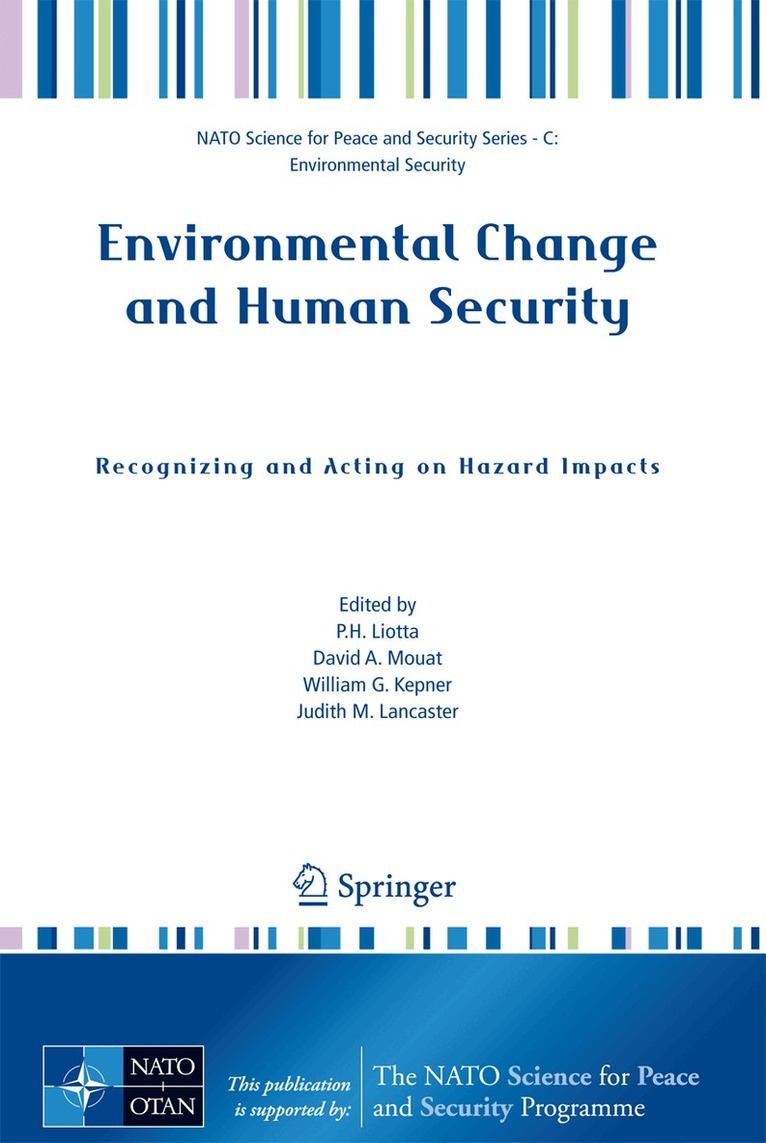
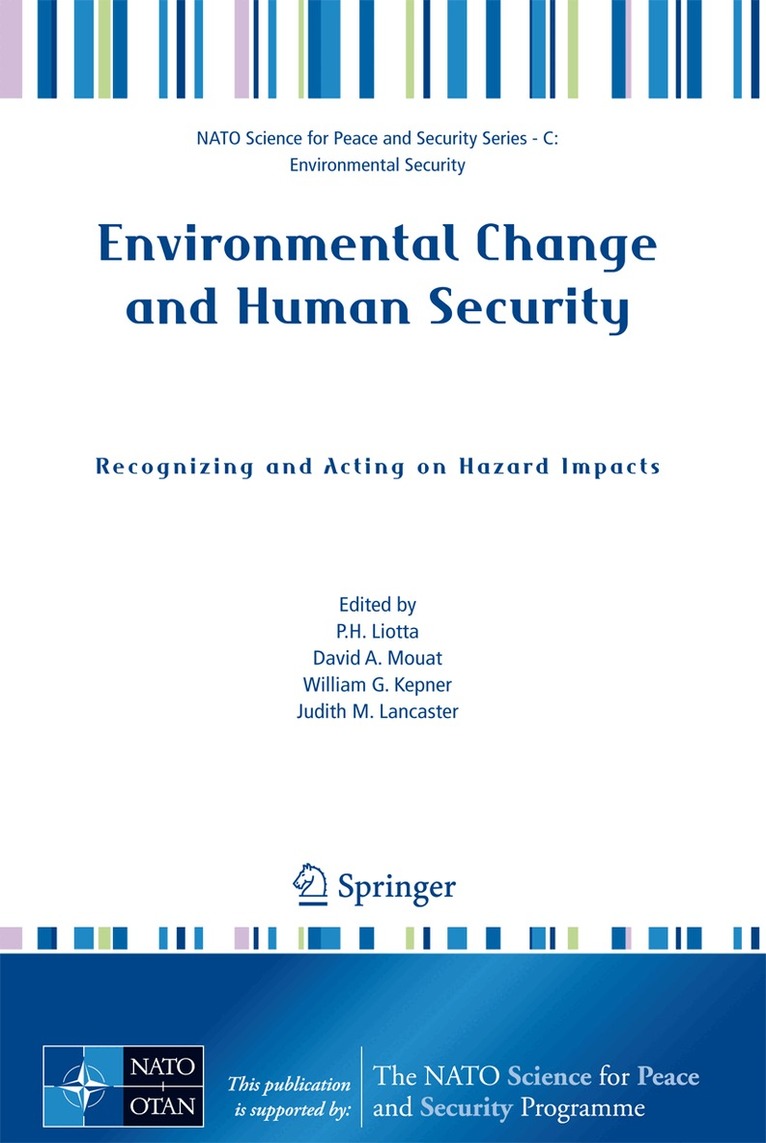
Environmental Change and Human Security: Recognizing and Acting on Hazard Impacts
Inbunden, Engelska, 2008
2 121 kr
Skickas inom 10-15 vardagar
Environmental and Human Security: Then and Now 1 2 ALAN D. HECHT AND P. H. LIOTTA * 1 U. S. Environmental Protection Agency Office of Research and Development 2 Pell Center for International Relations and Public Policy Salve Regina University 1. Nontraditional Threats to Security The events of September 11, 2001 have sharpened the debate over the meaning of being secure. Before 9/11 there were warnings in all parts of the world that social and environmental changes were occurring. While there was prosperity in North America and Western Europe, there was also increasing recognition that local and global effects of ecosystem degradation posed a serious threat. Trekking from Cairo to Cape Town thirty years after living in Africa as a young teacher, for example, travel writer Paul Theroux concluded that development in sub-Saharan Africa had failed to improve the quality of life for 300 million people: “Africa is materially more decrepit than it was when I first knew it—hungrier, poorer, less educated, more pessimistic, more corrupt, and you can’t tell the politicians from the witch-doctors” (2002). While scholars and historians will debate the causes of 9/11 for some time, one message is clear: An often dizzying array of nontraditional threats and complex vulnerabilities define security today. We must understand them, and deal with them, or suffer the consequences. Environmental security has always required att- tion to nontraditional threats linked closely with social and economic well-being.
Environmental Change and Human Security: Recognizing and Acting on Hazard Impacts
Häftad, Engelska, 2008
2 121 kr
Skickas inom 10-15 vardagar
Environmental and Human Security: Then and Now 1 2 ALAN D. HECHT AND P. H. LIOTTA * 1 U. S. Environmental Protection Agency Office of Research and Development 2 Pell Center for International Relations and Public Policy Salve Regina University 1. Nontraditional Threats to Security The events of September 11, 2001 have sharpened the debate over the meaning of being secure. Before 9/11 there were warnings in all parts of the world that social and environmental changes were occurring. While there was prosperity in North America and Western Europe, there was also increasing recognition that local and global effects of ecosystem degradation posed a serious threat. Trekking from Cairo to Cape Town thirty years after living in Africa as a young teacher, for example, travel writer Paul Theroux concluded that development in sub-Saharan Africa had failed to improve the quality of life for 300 million people: “Africa is materially more decrepit than it was when I first knew it—hungrier, poorer, less educated, more pessimistic, more corrupt, and you can’t tell the politicians from the witch-doctors” (2002). While scholars and historians will debate the causes of 9/11 for some time, one message is clear: An often dizzying array of nontraditional threats and complex vulnerabilities define security today. We must understand them, and deal with them, or suffer the consequences. Environmental security has always required att- tion to nontraditional threats linked closely with social and economic well-being.