William H. Durham - Böcker
Visar alla böcker från författaren William H. Durham. Handla med fri frakt och snabb leverans.
7 produkter
7 produkter
580 kr
Skickas inom 5-8 vardagar
The terrestrial organisms of the Galápagos Islands live under conditions unlike those anywhere else. At the edge of a uniquely rich mid-ocean upwelling, their world is also free of mammalian predators and competitors, allowing them to live unbothered, exuberant lives. With its giant tortoises, marine iguanas, flightless cormorants, and forests of giant daisies, there's no question that this is a magnificent place. Long before people traversed the Earth, evolution endowed native species with adaptations to these special conditions and to perturbations like El Niño events and periodic droughts. As the islands have grown ever-more connected with humanity, those same adaptations now make its species vulnerable. Today, the islands are best viewed as one big social-ecological system where the ability of each native organism to survive and reproduce is a product of human activity in addition to ecological circumstances. In this book, William H. Durham takes readers on a tour of Galápagos and the organisms that inhabit these isolated volcanic islands. Exuberant Life offers a contemporary synthesis of what we know about the evolution of its curiously wonderful organisms, how they are faring in the tumultuous changing world around them, and how evolution can guide our efforts today for their conservation. The book highlights the ancestry of a dozen specific organisms in these islands, when and how they made it to the Galápagos, as well as how they have changed in the meantime. Durham traces the strengths and weaknesses of each species, arguing that the mismatch between natural challenges of their habitats and the challenges humans have recently added is the main task facing conservation efforts today. Such analysis often provides surprises and suggestions not yet considered, like the potential benefits to joint conservation efforts between tree finches and tree daisies, or ways in which the peculiar evolved behaviors of Nazca and blue-footed boobies can be used to benefit both species today. In each chapter, a social-ecological systems framework is used to highlight links between human impact, including climate change, and species status today, Historically, the Galápagos have played a central role in our understanding of evolution; what these islands now offer to teach us about conservation may well prove indispensable for the future of the planet.
447 kr
Skickas inom 7-10 vardagar
The Social Causes of Environmental Destruction in Latin America is a timely examination of critical cases of land degradation, deforestation, and resource depletion in Central and South America. The contributors—seasoned researchers with years of experience in the regions they discuss—convincingly document the idea that the causes of environmental destruction have their origins in social relations, specifically the dynamics of social classes with fundamentally divergent interests. The conditions facing impoverished families on the one hand, and the granting of land on a concessionary basis to powerful individuals and corporations on the other, create incentives to extensive land use without conservation. The book thus refutes simplistic arguments that address environmental destruction as an outcome of population growth and suggests that advocacy for social equity is not merely an idealistic quest but an ecological imperative. This book is essential reading for anyone interested in development issues and should appeal particularly to anthropologists, sociologists, economists, demographers, and geographers.
320 kr
Skickas inom 7-10 vardagar
Looking at both population and land tenure dynamics in their historical context, this study challenges the view that the 1969 conflict between El Salvador and Honduras was primarily a response to population pressure. The author demonstrates that land scarcity, a principal cause of the war, was largely a product of the concentration of landholdings.The analysis focuses on the emigration of 300,000 Salvadoreans to Honduras in the years before the war, inquiring into the reasons for the emigration, its impact on local agricultural economies, and its relation to the conflict. Answers to these questions are based on a new interpretation of national statistics and on original survey research in peasant communities. The author has used an interdisciplinary approach, drawing on the perspectives of anthropology, ecology, history, demography, and geography.In addition to its value as a case study in human ecology, this book gives a clear account of the nature and origins of ecological pressures in rural Central America. The book is illustrated with 21 photographs and 7 maps.
1 891 kr
Skickas inom 10-15 vardagar
A Stanford University Press classic.
615 kr
Skickas inom 7-10 vardagar
A Stanford University Press classic.
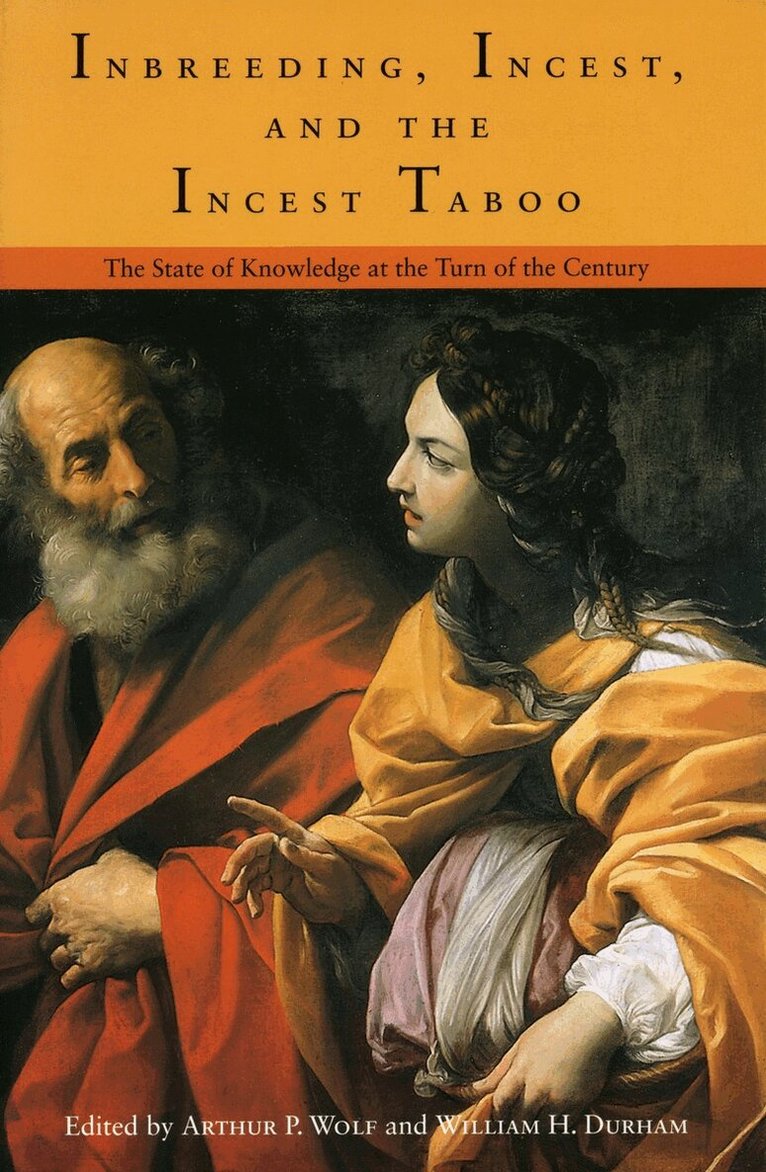
Inbreeding, Incest, and the Incest Taboo
The State of Knowledge at the Turn of the Century
Inbunden, Engelska, 2004
1 170 kr
Skickas inom 7-10 vardagar
Is inbreeding harmful? Are human beings and other primates naturally inclined to mate with their closest relatives? Why is incest widely prohibited? Why does the scope of the prohibition vary from society to society? Why does incest occur despite the prohibition? What are the consequences? After one hundred years of intense argument, a broad consensus has emerged on the first two questions, but the debate over the others continues.That there is a biological basis for the avoidance of inbreeding seems incontrovertible, but just how injurious inbreeding really is for successive generations remains an open question. Nor has there been any conclusion to the debate over Freud's view that the incest taboo is necessary because humans are sexually attracted to their closest relatives—a claim countered by Westermarck's argument for the sexually inhibiting effects of early childhood association.This book brings together contributions from the fields of genetics, behavioral biology, primatology, biological and social anthropology, philosophy, and psychiatry which reexamine these questions.
Inbreeding, Incest, and the Incest Taboo
The State of Knowledge at the Turn of the Century
Häftad, Engelska, 2004
284 kr
Skickas inom 7-10 vardagar
Is inbreeding harmful? Are human beings and other primates naturally inclined to mate with their closest relatives? Why is incest widely prohibited? Why does the scope of the prohibition vary from society to society? Why does incest occur despite the prohibition? What are the consequences? After one hundred years of intense argument, a broad consensus has emerged on the first two questions, but the debate over the others continues.That there is a biological basis for the avoidance of inbreeding seems incontrovertible, but just how injurious inbreeding really is for successive generations remains an open question. Nor has there been any conclusion to the debate over Freud's view that the incest taboo is necessary because humans are sexually attracted to their closest relatives—a claim countered by Westermarck's argument for the sexually inhibiting effects of early childhood association.This book brings together contributions from the fields of genetics, behavioral biology, primatology, biological and social anthropology, philosophy, and psychiatry which reexamine these questions.