
William S. Hanson – författare
Visar alla böcker från författaren William S. Hanson. Handla med fri frakt och snabb leverans.
3 produkter
3 produkter
Inbunden, Engelska, 2012
1 105 kr
Skickas inom 10-15 vardagar
Historical archives of vertical photographs and satellite images acquired for other purposes (mainly declassified military reconnaissance) offer considerable potential for archaeological and historical landscape research. They provide a unique insight into the character of the landscape as it was over half a century ago, before the destructive impact of later 20th century development and intensive land use. They provide a high quality photographic record not merely of the landscape at that time, but offer the prospect of the better survival of remains reflecting its earlier history, whether manifest as earthworks, cropmarks or soilmarks. These various sources of imagery also provide an opportunity to examine from the air areas of Europe and beyond whose skies are still not open to traditional archaeological aerial reconnaissance. Tens of millions of such images are held in archives around the world, but their research potential goes very largely untapped. A primary aim of this volume is to draw to wider attention the existence, scope and potential access to historical archival aerial and satellite photographs, in order to encourage their use in a range of archaeological and landscape research. By drawing attention to this massive archival resource, providing examples of its successful application to archaeological/landscape questions, and offering advice how to access and utilise the resource, the volume seeks to bring this material to wider attention, demonstrate its huge potential for archaeology, encourage its further use and stimulate a new approach to archaeological survey and the study of landscape evolution internationally.
Häftad, Engelska, 2014
1 105 kr
Skickas inom 10-15 vardagar
Historical archives of vertical photographs and satellite images acquired for other purposes (mainly declassified military reconnaissance) offer considerable potential for archaeological and historical landscape research. They provide a unique insight into the character of the landscape as it was over half a century ago, before the destructive impact of later 20th century development and intensive land use. They provide a high quality photographic record not merely of the landscape at that time, but offer the prospect of the better survival of remains reflecting its earlier history, whether manifest as earthworks, cropmarks or soilmarks. These various sources of imagery also provide an opportunity to examine from the air areas of Europe and beyond whose skies are still not open to traditional archaeological aerial reconnaissance. Tens of millions of such images are held in archives around the world, but their research potential goes very largely untapped. A primary aim of this volume is to draw to wider attention the existence, scope and potential access to historical archival aerial and satellite photographs, in order to encourage their use in a range of archaeological and landscape research. By drawing attention to this massive archival resource, providing examples of its successful application to archaeological/landscape questions, and offering advice how to access and utilise the resource, the volume seeks to bring this material to wider attention, demonstrate its huge potential for archaeology, encourage its further use and stimulate a new approach to archaeological survey and the study of landscape evolution internationally.
Del 64 - Archaeopress Roman Archaeology
Antonine Wall: Papers in Honour of Professor Lawrence Keppie
Häftad, Engelska, 2020
450 kr
Tillfälligt slut
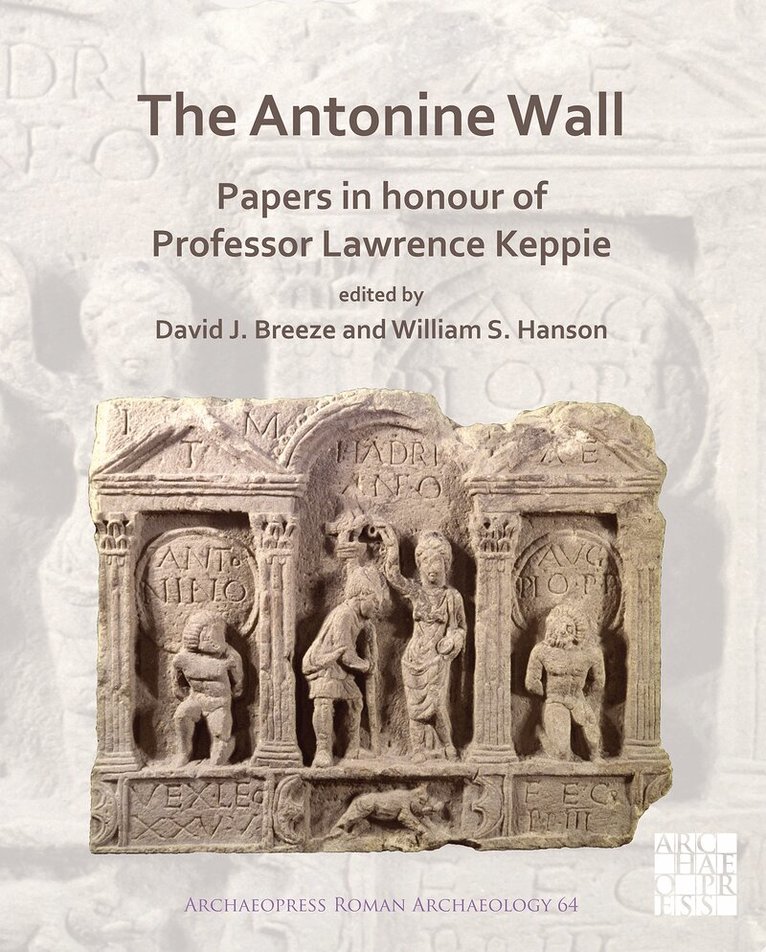
The Antonine Wall, the Roman frontier in Scotland, was the most northerly frontier of the Roman Empire for a generation from AD 142. It is a World Heritage Site and Scotland’s largest ancient monument. Today, it cuts across the densely populated central belt between Forth and Clyde. In this volume, nearly 40 archaeologists, historians and heritage managers present their researches on the Antonine Wall in recognition of the work of Lawrence Keppie, formerly Professor of Roman History and Archaeology at the Hunterian Museum, Glasgow University, who spent much of his academic career recording and studying the Wall. The 32 papers cover a wide variety of aspects, embracing the environmental and prehistoric background to the Wall, its structure, planning and construction, military deployment on its line, associated artefacts and inscriptions, the logistics of its supply, as well as new insights into the study of its history. Due attention is paid to the people of the Wall, not just the officers and soldiers, but their womenfolk and children.Important aspects of the book are new developments in the recording, interpretation and presentation of the Antonine Wall to today's visitors. Considerable use is also made of modern scientific techniques, from pollen, soil and spectrographic analysis to geophysical survey and airborne laser scanning. In short, the papers embody present-day cutting edge research on, and summarise the most up-to-date understanding of, Rome's shortest-lived frontier.The editors, Professors Bill Hanson and David Breeze, who themselves contribute several papers to the volume, have both excavated sites on, and written books about, the Antonine Wall.