William W. Clark - Böcker
Visar alla böcker från författaren William W. Clark. Handla med fri frakt och snabb leverans.
2 produkter
2 produkter
875 kr
Skickas inom 10-15 vardagar
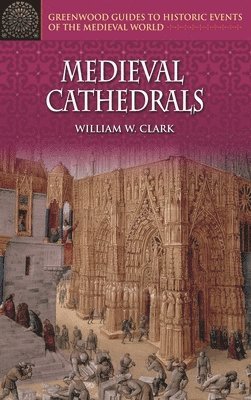
An introduction to the medieval cathedral, those churches that are regarded as the greatest achievements of medieval architecture. Details their social history, who built them, how they were built, and why. Forty photos and maps help to guide the reader through a narrated tour of these awe-inspiring churches.When we think of cathedrals, we usually envision the great Gothic Buildings of 12th- and 13th-century Europe. But other than being a large church, a cathedral is neither a specific building type nor specifically medieval. What a makes a large church a cathedral is the presence of a single item of furniture: the chair (in Latin: cathedra) or throne that is the symbol of the ecclesiastical and spiritual authority of a bishop. This book is an introduction to the medieval cathedral, those churches that are usually regarded as among the greatest achievements of medieval architecture.While cathedrals were often the most prominent urban structure in many European cities, their construction was never a civic responsibility, but remained the responsibility of the clergy in charge of the day to day activities and services. Beginning with an overview of the social history of cathedrals, Clark examines such topics as patrons, builders and artists, and planning and construction; and provides an in-depth examination of the French Cathedral at Reims—a seminal building with significant technological advances, important sculptural programs, a surviving bishop's palace, and other structures. The volume concludes with a series of illustrations, a selection of original texts, and a selected bibliography for further study. A full index is also provided.
2 357 kr
Skickas inom 10-15 vardagar
This collection of essays presents the exciting and innovative work being done in the field of medieval architectural history by scholars affiliated with AVISTA, one of the most active sponsors of such research in the Anglo-American scholarly community. These studies constitute a snapshot of the range of new interpretive strategies being deployed by researchers in the reassessment of previous scholarship and identification of new modes of inquiry. In recent years, the study of medieval architecture has been transformed by the emergence of new critical perspectives and new technologies. The contributors to this book are among those at the forefront of these developments. Several of the essays present dramatic reinterpretations of canonical monuments including the Abbey of Saint-Denis, Beauvais Cathedral and Notre-Dame in Paris. Others consider broader methodological issues such as the applications of geometry, workshop practice, and the shaping of historical narratives. Still others demonstrate how high-tech scanning and visualization methods can enhance our understanding of construction methods and the behavior of buildings. The publication of this collection of pioneering essays should foster further exploration by clarifying the state of research, by establishing specific historical arguments, and by providing models of inquiry to inspire emerging scholars.