Wolpert - Böcker
Visar alla böcker från författaren Wolpert. Handla med fri frakt och snabb leverans.
3 produkter
3 produkter
213 kr
Skickas inom 5-8 vardagar
Mahatma Gandhi passionately courted suffering thoroughout most of his life. The intensity of Gandhi's yogic resolve to dedicate himself to the nationalist struggle for liberating India from British imperial rule inspired millions of ordinary people to follow his passionate lead on the arduous road to freedom. Gandhi taught his followers to set aside fear of prison, physical punishment, or death, while at the same time insisting that violence had no place in the Satyagraha campaign, arguing that non-violence or love was the essence of God.Early influenced by the non-violence teachings of Jainism, Jesus Christ, and Buddha, Gandhi insisted throughout the last six decades of his life on the primacy of love for one's adversary in any conflict, convinced that this mighty power would ultimatle disarm the cruelest enemy. He developed passionate techniques of non-violent struggle against the racial and political discrimination and injustice first in South Africa and then in India. In addition to his political leadership, Gandhi was also a religious reformer, who worked to try to remove the stain of untouchability from Hinduism's outcasts. Inspired by Ruskin, Tolstoy and Thoreau, he also renounced industrial violence and pollution and took up cotton-spinning, revitalizing India's handicrafts industry, which had been all but destroyed by foreign industrial competition.Paradoxically, though hailed as free India's father, Gandhi was never invited by his closest Congress disciples to join them in running India's first government. And though he was worshipped by millions of Hindus as their virtual god, a Brahman of his own faith, supported by many others, assassinated him. Gandhi's face adorns India's currency today and his birthday is still nationally celebrated, yet the long-term impact of his message of love and non-violence is unclear in modern India's nuclear-armed industrial state.
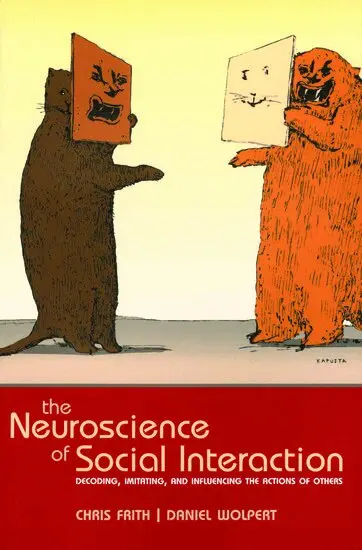
The Neuroscience of Social Interaction
Decoding, imitating and influencing the actions of others
Häftad, Engelska, 2004
1 633 kr
Skickas inom 7-10 vardagar
Humans, like other primates, are intensely social creatures. One of the main functions of our brains is to enable us to be as skilful in social interactions as we are in our interactions with the physical world. Any differences between human brains and those of our nearest relatives, the great apes, are likely to be linked to our unique achievements in social interaction and communication rather than our motor or perceptual skills. Unique to humans is the ability to mentalise (or mind read), that is to perceive and communicate mental states, such as beliefs and desires.A key problem facing neuroscience is to uncover the biological mechanisms underlying our ability to read other minds and to show how these mechanisms evolved. To solve this problem we need to do experiments in which people (or animals) interact with one another rather than behaving in isolation. Such experiments are now being conducted in increasing numbers and many of the leading exponents of such experiments have contributed to this volume. 'The Neuroscience of Social Interactions' will be an important step in uncovering the biological mechanisms underlying social interactions - undoubtedly one of the major programmes for neuroscience in the twenty-first century.
592 kr
Skickas inom 3-6 vardagar
This is a scientist's view of the culture of science; authoritative and informed and at the same time mercifully accessible to those who find cohabiting with this culture a puzzling experience.