W.S. Anglin – författare
Visar alla böcker från författaren W.S. Anglin. Handla med fri frakt och snabb leverans.
9 produkter
9 produkter
Inbunden, Engelska, 1994
685 kr
Skickas inom 10-15 vardagar
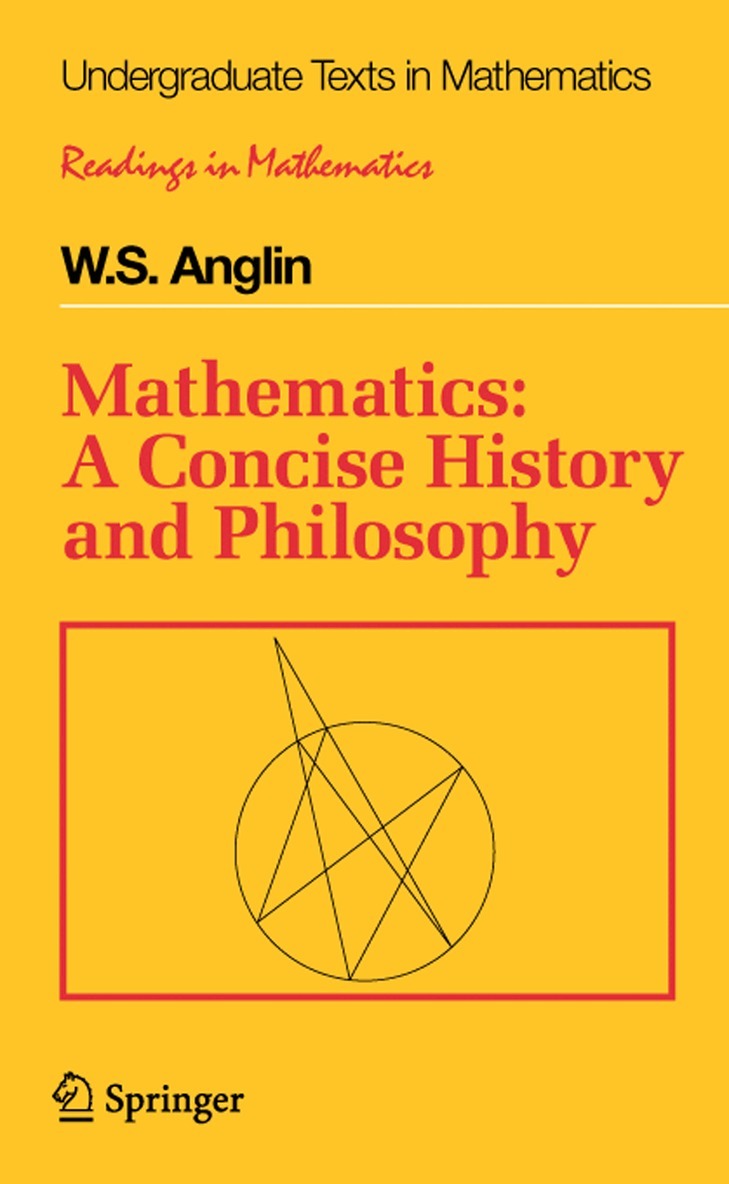
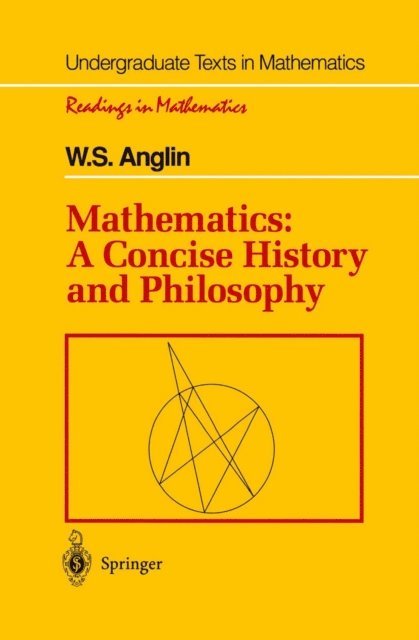
This is a concise introductory textbook for a one-semester (40-class) course in the history and philosophy of mathematics. It is written for mathemat ics majors, philosophy students, history of science students, and (future) secondary school mathematics teachers. The only prerequisite is a solid command of precalculus mathematics. On the one hand, this book is designed to help mathematics majors ac quire a philosophical and cultural understanding of their subject by means of doing actual mathematical problems from different eras. On the other hand, it is designed to help philosophy, history, and education students come to a deeper understanding of the mathematical side of culture by means of writing short essays. The way I myself teach the material, stu dents are given a choice between mathematical assignments, and more his torical or philosophical assignments. (Some sample assignments and tests are found in an appendix to this book. ) This book differs from standard textbooks in several ways. First, it is shorter, and thus more accessible to students who have trouble coping with vast amounts of reading. Second, there are many detailed explanations of the important mathematical procedures actually used by famous mathe maticians, giving more mathematically talented students a greater oppor tunity to learn the history and philosophy by way of problem solving.
Inbunden, Engelska, 1995
868 kr
Skickas inom 10-15 vardagar
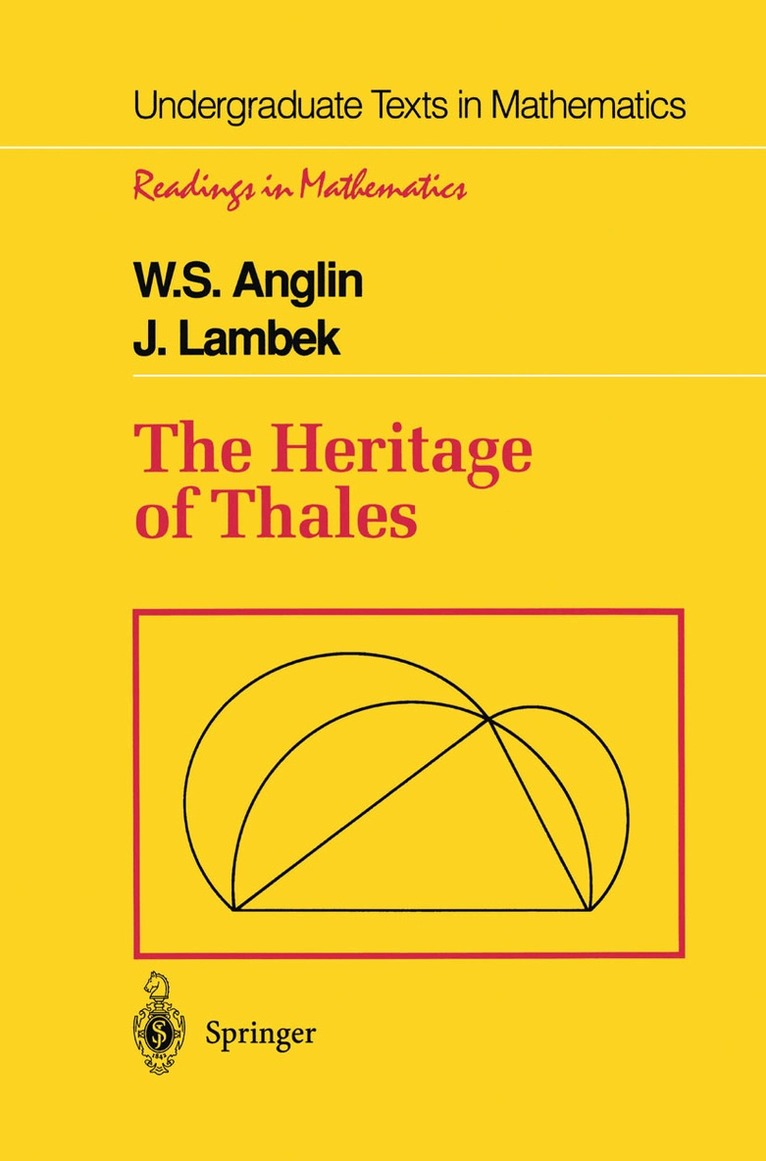
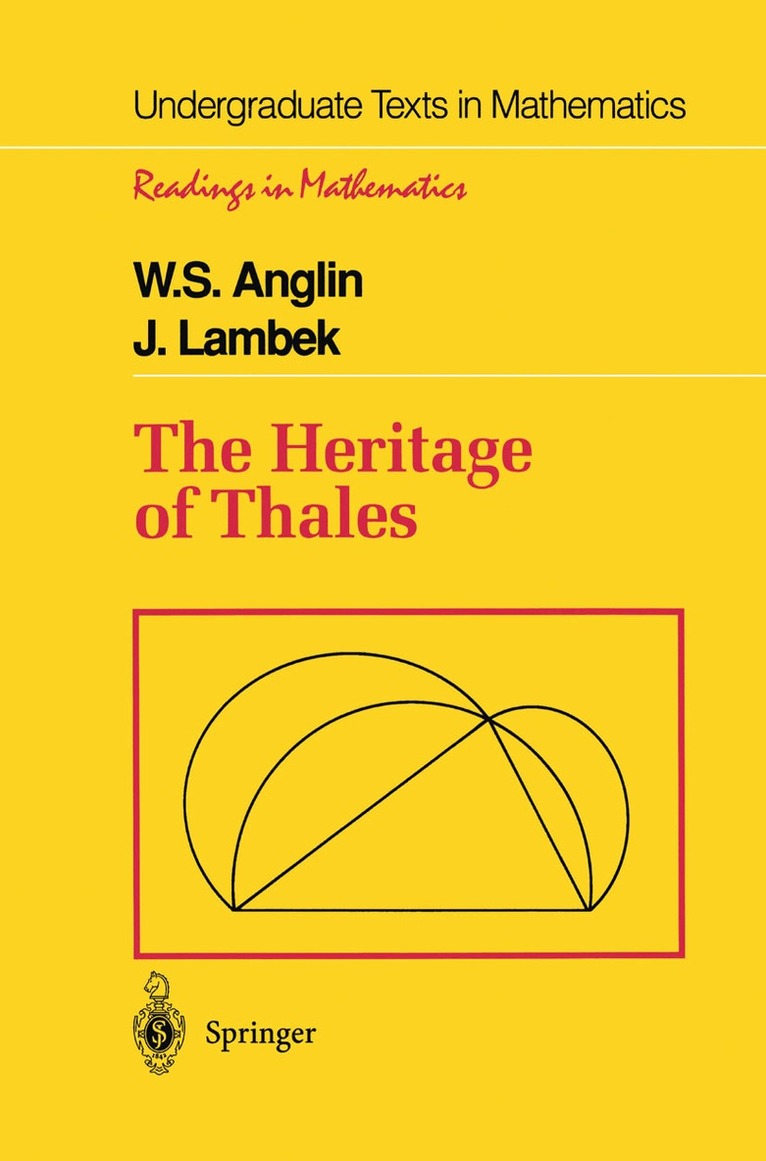
This is intended as a textbook on the history, philosophy and foundations of mathematics, primarily for students specializing in mathematics, but we also wish to welcome interested students from the sciences, humanities and education. We have attempted to give approximately equal treatment to the three subjects: history, philosophy and mathematics. History We must emphasize that this is not a scholarly account of the history of mathematics, but rather an attempt to teach some good mathematics in a historical context. Since neither of the authors is a professional historian, we have made liberal use of secondary sources. We have tried to give ref cited facts and opinions. However, considering that this text erences for developed by repeated revisions from lecture notes of two courses given by one of us over a 25 year period, some attributions may have been lost. We could not resist retelling some amusing anecdotes, even when we suspect that they have no proven historical basis. As to the mathematicians listed in our account, we admit to being colour and gender blind; we have not attempted a balanced distribution of the mathematicians listed to meet today's standards of political correctness. Philosophy Both authors having wide philosophical interests, this text contains perhaps more philosophical asides than other books on the history of mathematics. For example, we discuss the relevance to mathematics of the pre-Socratic philosophers and of Plato, Aristotle, Leibniz and Russell. We also have vi Preface presented some original insights.
Del 8 - Texts in the Mathematical Sciences
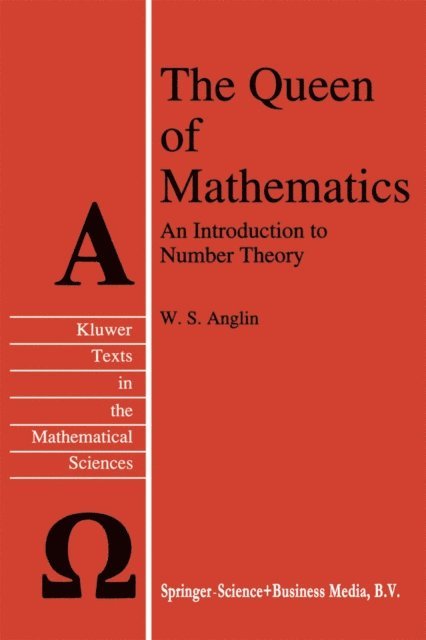
Queen of Mathematics
An Introduction to Number Theory
Inbunden, Engelska, 1995
1 945 kr
Skickas inom 10-15 vardagar
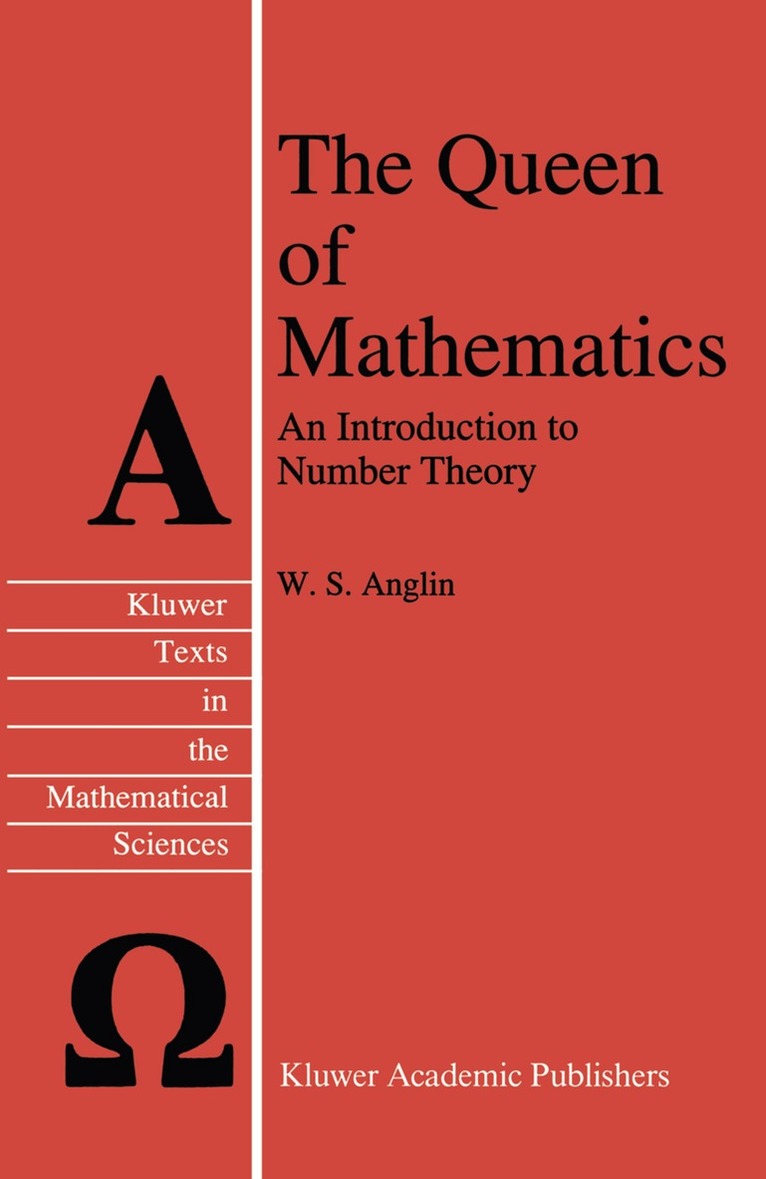
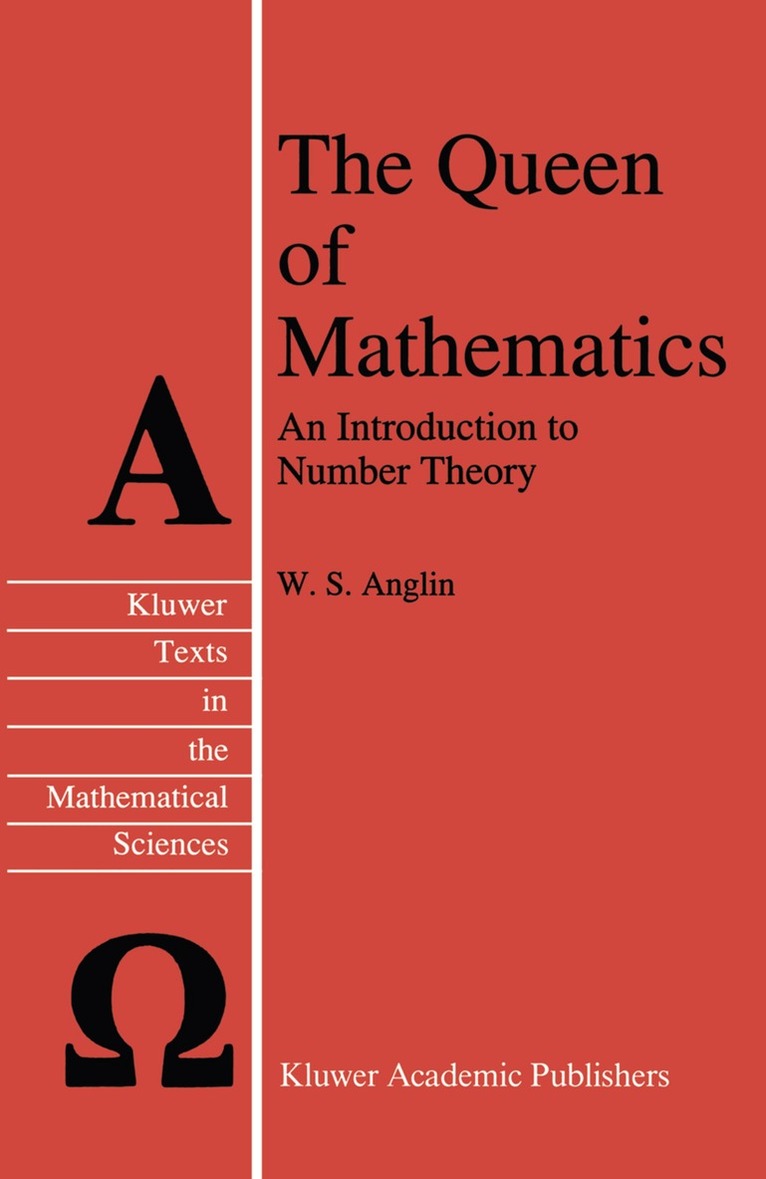
Like other introductions to number theory, this one includes the usual curtsy to divisibility theory, the bow to congruence, and the little chat with quadratic reciprocity. It also includes proofs of results such as Lagrange's Four Square Theorem, the theorem behind Lucas's test for perfect numbers, the theorem that a regular n-gon is constructible just in case phi(n) is a power of 2, the fact that the circle cannot be squared, Dirichlet's theorem on primes in arithmetic progressions, the Prime Number Theorem, and Rademacher's partition theorem. We have made the proofs of these theorems as elementary as possible. Unique to The Queen of Mathematics are its presentations of the topic of palindromic simple continued fractions, an elementary solution of Lucas's square pyramid problem, Baker's solution for simultaneous Fermat equations, an elementary proof of Fermat's polygonal number conjecture, and the Lambek-Moser-Wild theorem.
E-bok
PDF, Engelska, 2012764 kr
Läs direkt efter köp
This is intended as a textbook on the history, philosophy and foundations of mathematics, primarily for students specializing in mathematics, but we also wish to welcome interested students from the sciences, humanities and education. We have attempted to give approximately equal treatment to the three subjects: history, philosophy and mathematics. History We must emphasize that this is not a scholarly account of the history of mathematics, but rather an attempt to teach some good mathematics in a historical context. Since neither of the authors is a professional historian, we have made liberal use of secondary sources. We have tried to give ref cited facts and opinions. However, considering that this text erences for developed by repeated revisions from lecture notes of two courses given by one of us over a 25 year period, some attributions may have been lost. We could not resist retelling some amusing anecdotes, even when we suspect that they have no proven historical basis. As to the mathematicians listed in our account, we admit to being colour and gender blind; we have not attempted a balanced distribution of the mathematicians listed to meet today''s standards of political correctness. Philosophy Both authors having wide philosophical interests, this text contains perhaps more philosophical asides than other books on the history of mathematics. For example, we discuss the relevance to mathematics of the pre-Socratic philosophers and of Plato, Aristotle, Leibniz and Russell. We also have vi Preface presented some original insights.
E-bok
PDF, Engelska, 2012870 kr
Läs direkt efter köp
This is a concise introductory textbook for a one-semester (40-class) course in the history and philosophy of mathematics. It is written for mathemat ics majors, philosophy students, history of science students, and (future) secondary school mathematics teachers. The only prerequisite is a solid command of precalculus mathematics. On the one hand, this book is designed to help mathematics majors ac quire a philosophical and cultural understanding of their subject by means of doing actual mathematical problems from different eras. On the other hand, it is designed to help philosophy, history, and education students come to a deeper understanding of the mathematical side of culture by means of writing short essays. The way I myself teach the material, stu dents are given a choice between mathematical assignments, and more his torical or philosophical assignments. (Some sample assignments and tests are found in an appendix to this book. ) This book differs from standard textbooks in several ways. First, it is shorter, and thus more accessible to students who have trouble coping with vast amounts of reading. Second, there are many detailed explanations of the important mathematical procedures actually used by famous mathe maticians, giving more mathematically talented students a greater oppor tunity to learn the history and philosophy by way of problem solving.
Häftad, Engelska, 2012
621 kr
Skickas inom 10-15 vardagar
This is intended as a textbook on the history, philosophy and foundations of mathematics, primarily for students specializing in mathematics, but we also wish to welcome interested students from the sciences, humanities and education. We have attempted to give approximately equal treatment to the three subjects: history, philosophy and mathematics. History We must emphasize that this is not a scholarly account of the history of mathematics, but rather an attempt to teach some good mathematics in a historical context. Since neither of the authors is a professional historian, we have made liberal use of secondary sources. We have tried to give ref cited facts and opinions. However, considering that this text erences for developed by repeated revisions from lecture notes of two courses given by one of us over a 25 year period, some attributions may have been lost. We could not resist retelling some amusing anecdotes, even when we suspect that they have no proven historical basis. As to the mathematicians listed in our account, we admit to being colour and gender blind; we have not attempted a balanced distribution of the mathematicians listed to meet today's standards of political correctness. Philosophy Both authors having wide philosophical interests, this text contains perhaps more philosophical asides than other books on the history of mathematics. For example, we discuss the relevance to mathematics of the pre-Socratic philosophers and of Plato, Aristotle, Leibniz and Russell. We also have vi Preface presented some original insights.
Häftad, Engelska, 2012
685 kr
Skickas inom 10-15 vardagar
This is a concise introductory textbook for a one-semester (40-class) course in the history and philosophy of mathematics. It is written for mathemat ics majors, philosophy students, history of science students, and (future) secondary school mathematics teachers. The only prerequisite is a solid command of precalculus mathematics. On the one hand, this book is designed to help mathematics majors ac quire a philosophical and cultural understanding of their subject by means of doing actual mathematical problems from different eras. On the other hand, it is designed to help philosophy, history, and education students come to a deeper understanding of the mathematical side of culture by means of writing short essays. The way I myself teach the material, stu dents are given a choice between mathematical assignments, and more his torical or philosophical assignments. (Some sample assignments and tests are found in an appendix to this book. ) This book differs from standard textbooks in several ways. First, it is shorter, and thus more accessible to students who have trouble coping with vast amounts of reading. Second, there are many detailed explanations of the important mathematical procedures actually used by famous mathe maticians, giving more mathematically talented students a greater oppor tunity to learn the history and philosophy by way of problem solving.
Del 8 - Texts in the Mathematical Sciences
Queen of Mathematics
An Introduction to Number Theory
Häftad, Engelska, 2011
1 945 kr
Skickas inom 10-15 vardagar
Like other introductions to number theory, this one includes the usual curtsy to divisibility theory, the bow to congruence, and the little chat with quadratic reciprocity. It also includes proofs of results such as Lagrange's Four Square Theorem, the theorem behind Lucas's test for perfect numbers, the theorem that a regular n-gon is constructible just in case phi(n) is a power of 2, the fact that the circle cannot be squared, Dirichlet's theorem on primes in arithmetic progressions, the Prime Number Theorem, and Rademacher's partition theorem. We have made the proofs of these theorems as elementary as possible. Unique to The Queen of Mathematics are its presentations of the topic of palindromic simple continued fractions, an elementary solution of Lucas's square pyramid problem, Baker's solution for simultaneous Fermat equations, an elementary proof of Fermat's polygonal number conjecture, and the Lambek-Moser-Wild theorem.
E-bok
PDF, Engelska, 20122 524 kr
Läs direkt efter köp
Like other introductions to number theory, this one includes the usual curtsy to divisibility theory, the bow to congruence, and the little chat with quadratic reciprocity. It also includes proofs of results such as Lagrange''s Four Square Theorem, the theorem behind Lucas''s test for perfect numbers, the theorem that a regular n-gon is constructible just in case phi(n) is a power of 2, the fact that the circle cannot be squared, Dirichlet''s theorem on primes in arithmetic progressions, the Prime Number Theorem, and Rademacher''s partition theorem. We have made the proofs of these theorems as elementary as possible. Unique to The Queen of Mathematics are its presentations of the topic of palindromic simple continued fractions, an elementary solution of Lucas''s square pyramid problem, Baker''s solution for simultaneous Fermat equations, an elementary proof of Fermat''s polygonal number conjecture, and the Lambek-Moser-Wild theorem.