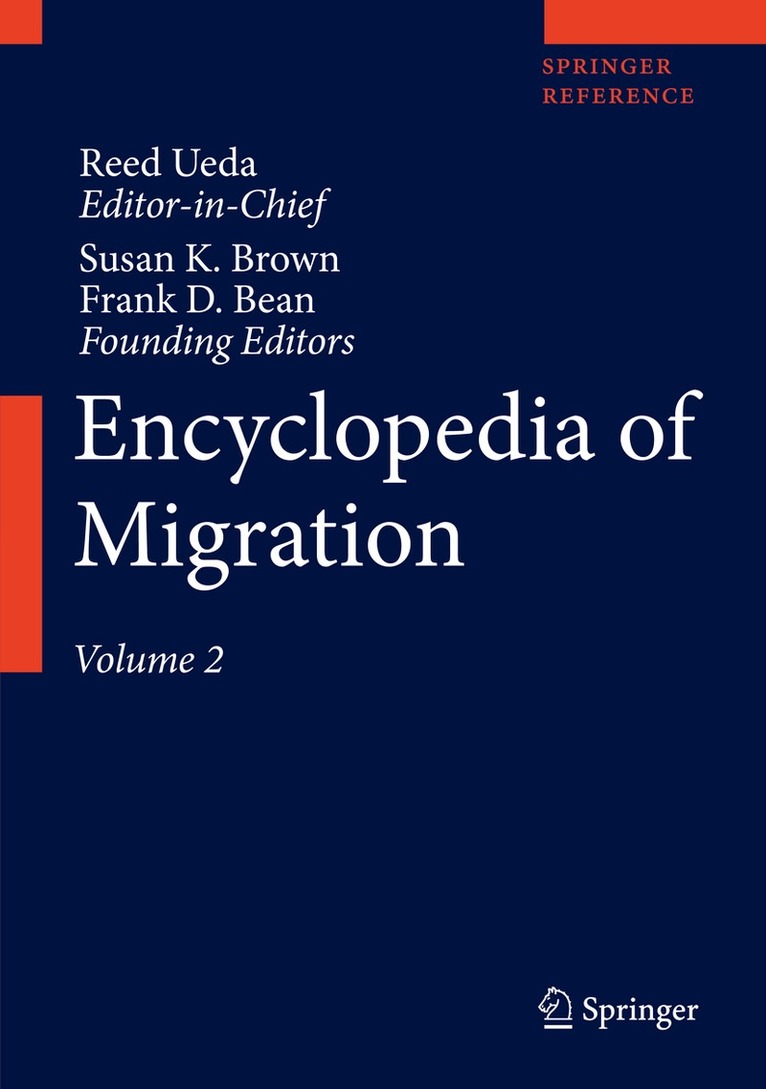
Beskrivning
Produktinformation
- Utgivningsdatum:2026-10-26
- Höjd:178 x 254 x undefined mm
- Språk:Engelska
- Antal sidor:2 000
- Förlag:Springer
- EAN:9789400727878
Utforska kategorier
Mer om författaren
Dr. Ueda is a historian of the United States and of migration. He has explored global migration and its effects on societies and regions in Postwar Immigrant America (St. Martin's Press) and Crosscurrents: Atlantic and Pacific Migration in the Making of a Global America (Oxford University Press). He studied the role of local migrations in the rise of public education in Avenues to Adulthood (Cambridge University Press). Dr. Ueda was a research editor of the Harvard Encyclopedia of American Ethnic Groups (awarded the Waldo Leland Prize of the American Historical Association) and co-editor (with Mary C. Waters and Helen Marrow) of New Americans (Harvard University Press).He is also co-editor of the Journal of Interdisciplinary History (MIT Press). Dr. Ueda's research has been supported by fellowships from the Woodrow Wilson International Center, the National Endowment for the Humanities, the American Council of Learned Societies, and the Charles Warren Center at Harvard.A member of the Tufts History Department faculty since 1981, Dr. Ueda has been a visiting professor at Harvard University and Brandeis University. He is co-chair of a consortium, the Inter-University Committee on International Migration at the MIT Center for International Studies.Dr. Bean is a social scientist with 35 years of experience as a researcher, teacher, administrator and public policy analyst. His PhD is in sociology and his dissertation was written in social psychology. As a graduate student at Duke University, in addition to his work in sociology and social psychology (with Alan C. Kerckhoff, Kurt Back and Edward E. Jones), he took courses in demography and worked on research projects for three distinguished demographers (Reynolds Farley, Nathan Keyfitz and Hal Winsborough), all of whom subsequently became foundational leaders in population studies at prestigious universities in the United States (Michigan, Harvard and Wisconsin respectively). As the founding Director of both the Population Studies Center and the Immigration Policy Research Center at The Urban Institute in Washington, DC, Dr. Bean has also conducted work in and developed extensive knowledge about the economics of population and migration. He is currently Chancellor's Professor of Sociology and Economics at the University of California, Irvine.Dr. Brown is a tenured Associate Professor of Sociology at the University of California, Irvine. She is a sociologist/demographer whose areas of specialization are immigration, residential segregation and urban sociology. As a result of conducting research in these areas, she has also developed considerable expertise in geography and urban policy. In addition to her academic and research specializations, she also brings more than fifteen years of journalistic experience as a reporter and editor starting when she was on the staff of the Harvard Crimson and including nearly twelve years with the St. Louis-Post Dispatch.
Innehållsförteckning
- TOPICS AND SUBTOPICS: (first draft)Basic Outlines of MigrationMigration comprises a foundational unit of the study of any population. Measured in conjunction with births and deaths, migration into and out of any place determines the ultimate size of the population. Migration is a specialized form of moving that involves distinct components of distance, duration and residence. Conceptually, migration is often differentiated into internal and international flows. Internal migration historically has consisted in large part of continued urbanization of a previously rural population, but it may also show counterstreams moving from cities to suburbs. International vs. internalDistance and activity space, duration, and national versus local boundaries.Change in circulationPartial vs. total displacement migrationInternational as product of Westphalian system of nation-statesGrowth of regulation in 20th centuryGrowth in typologies of migrantsDiasporas may exist without nation-state identificationKinds of migrationPrimitive, or nomadicVoluntary, or agent-based, within large groups or clans or small-scale, as individuals or householdsAuthorized, legal, documentedUnauthorized, illegal, undocumented; "aliens"Involuntary, or forced, impelled.Displacement, warfare; environmental degradation and disasterHuman trafficking, slaveryRefugees, asyleesCircular, or returning migration, sojourner vs. settlerStep migrationNon-migrationInternational: students, tourists, business travelers; foreign-born vs. immigrantsInternal: Recurrent movement (commuting, daily crossings, seasonal work)II. Measurement of Migration and Statistical MethodologyThis topic covers the general demographic and statistical concepts underpinning migration research. Initially, migration research followed a standardized set of concepts and measurements derived from demographic research and often dependent upon the geographical units within which data are collected. However, the research has expanded into multiple fields with many methodologies, both qualitative and quantitative. Demographic conceptsFlows vs. stocksAreas of origin and destinationEmigration and immigrationDifferential migrationGross and net migrationComponents of change (residual) estimation; forward survival.Status and propensity rates, probabilities, in-migration, out-migration rates, net migrationEstimates and population projectionsDistance, distance decay, gravity modelsEfficiency: ratio of streams to counterstreamsMigration historiesEconomic and sociological models Econometric models and general models of inequality, within and between cities or countriesMultivariate regression analysisEthnographiesSpatial analysisGeographic Information Systems, with database of attribute information, boundary files, digital map layers, analysis tools and user interface.Political and data units: e.g. wards, counties, metropolitan areas, states, provinces, nationsIII. Migration DataMigration data vary widely across countries, both in terms of scope of collection and basic understanding of the definition of migration. This section examines the types of data collection instruments and their components.CensusesFrequency, coverage, de facto vs. de jure, usual residence, field checking, coverage error and content, net and differential undercounts, continuous measurement, migration questions, dual-system estimation, demographic analysisTypes of files and unit coverage: e.g. region, division, state, county, minor civil division/townships, places, census tracts, block groups, blocks.Administrative recordsPopulation registers, universal and partial; ports of entry and/or exit, passports and visas issued, immigration yearbooks, tax records, social welfare/security records, city directories, postal stops, school enrollments, construction permits, utility usage.SurveysSampling issues, sample bias, panel studies, attrition. Other sourcesNaturalizations and change of migration status Apprehensions and deportations; denaturalizationsAsylee petitions, United Nations High Commissioner for RefugeesIV. Migration TheoriesNo one theoretical perspective dominates the study of migration. Rather, multiple social science perspectives, all relatively new, compete with one another. This section will cover each theory and the underlying social, cultural and economic concepts.Evolution of migration theoriesRavenstein’s lawsIntervening opportunities (Stouffer)Intervening obstacles (Lee)Demographic transitionPopulation pressure"Push-pull"Classical and neoclassical economicsMacro- and micro-theoryRegional labor supply and demandEquilibrium wage marketsOpportunity costsMarginal productivity of laborRational-actor and human capital modelsFactor mobilityDiscounted net returns over timeExpected earnings gap vs. absolute wage differentialNew household economicsCredit and risk markets, insurance for crops, unemployment and retirementHousehold-level decision makingRelative deprivationMigration and intermediate investmentLabor-market segmentationStructural inflation and status (occupational) hierarchiesReference wagesEconomic dualism and bifurcated labor markets; primary and secondary sectorsEthnic enclaves and enclave economiesDemographic shifts in labor supplyWorld systemsHistorical-structuralist view of uneven development; dependency theoryCore-periphery dichotomyBrain drainLand consolidation and agricultural displacementExport-processing zonesCultural linkagesGlobal cities and hourglass economyStructuration; institutional theory"Structure-agency problematic" (Giddens)Intermediary institutions connect potential migrants to jobsSocial networksRole of informationChain migration, "auspices" of migration (Tilly and Brown)Forms of fungible capital: social, human, financial, culturalEnforceable trustStrong and weak tiesUtility maximizationCumulative causationSocial context of migrationCulture of migrationSocial labeling of jobsMigration hump, density function, cumulative density functionPolitical economy and state structureHegemonic stability in a geopolitical order <Cultural citizenshipIX. Migration PolicyPolicy strongly affects both internal and international migration. This section describes current and past policies across a range of countries. It includes legislation, legal cases, specific government offices and informal policy practices.International migrationEntrance policiesHealth and literacy testsQuotasVisa requirements, types of visasPermanent vs. temporary visa typesPriorities for admittance, employment categoriesFamily reunification and sponsorshipExit policiesDeportation and denaturalizationCriminalization of immigrantsResidence requirementsIncorporation policies, job banks and civics and language trainingCitizenshipJus soli vs. jus sanguinisDual citizenshipGuest workersSpecific flows, e.g. Gastarbeiter, bracerosRepatriationRestrictions on employmentControl of immigrationBorder policiesBureaucraciesMigrants’ rightsCivil protectionsSecondary and tertiary education; tuitionAccess to jobsInternal migrationHome ownership, mortgage interest tax deductions, lending practices, housing institutionsTransportation: commuting, highway systems and public transportationJob training, job transfers and tax policyResidency requirements (e.g. hukou in China) and floating populations X. Global InstitutionsA large body of literature covers the global economic and political institutions that enable transfer of capital, investment, and the movement of people. This section covers some of the institutional actors and treaties that have enabled global movement of goods and people, from the Pax Romana to the Peace of Westphalia to the United Nations, the International Monetary Fund and the General Agreement on Tariffs and Trade.XI. Fiscal and Economic Aspects of MigrationThis section explores the effects of immigration on receiving and sending countries, to the economy as a whole and as a net fiscal burden at the national and regional levels.RemittancesMultiplier (second round) effectsShort-run income effects (income elasticities) and income distributionConsumption vs. investment usesRepatriation of foreign earningsCommunity developmentEconomic effectsReturns to scaleWages of nativesProductivity of labor and capitalRevenues and expendituresWelfare expendituresTax streams XII. Major Migration StreamsA comprehensive account of migration will include the major migrations of both historical and contemporary times. These will include international settlements and internal displacements.Receiving CountriesColonization: USA, Canada, Australia, New Zealand, Siberia, South Africa, Israel, Latin AmericaContemporary labor importation: Europe, Japan, Middle East, Africa (refugees)Sending countriesTraditional: Europe, China, India, PhilippinesContemporary: East Asia, South Asia, Africa, Latin America, CaribbeanPrehistoric migrationsHomo erectus, Neanderthals, Cro-MagnonPaleo-Indian Indo-EuropeanAboriginal seafarersEarly historical migrationMediterranean (e.g. Phoenician, Greek, Roman)CelticBantuLapita in New GuineaTurk and Mongol, steppe peoplesHuns and those they displaced: Goths and VandalsAnglo-SaxonArabViking in western Europe and RussiaNormanGermans eastwardToltec and AztecAfrican slavesHistorical diasporas: JewsRomaItalians and other EuropeansChineseArmeniansXIII. Other
Du kanske också är intresserad av
At the Crossroads
Frank D. Bean, Rodolfo O. de la Garza, Bryan R. Roberts, Sidney Weintraub
675 kr
- Signerad!
- -30%
- -22%
- -30%
- Nyhet
Hjärnans akilleshälar : hur din hjärna lurar dig, och vad du kan göra åt det
Anders Hansen
289 kr