ActaRom-4° – serie
Visar alla böcker i serien ActaRom-4°. Handla med fri frakt och snabb leverans.
5 produkter
5 produkter
741 kr
Skickas inom 5-8 vardagar
This volume presents a series of case studies that trace the ways in which audiences across Europe have attempted to return to Pompeii by emulating its interior decorations since the city’s rediscovery in the mid-eighteenth century. As such, it is about both the impact of Pompeian antiquity on the present and the reception in the present of that antique past, exploring the variety of ways in which Pompeian domestic space and decoration have been revived (and for what purposes and audiences). The contributions to the volumes compare the ways in which Pompeian wall decorations were interpreted and adapted, given new context and put to serve new social and political purposes, both close to their place of discovery, in the Kingdom of Naples, and in the far-off European periphery, represented by Denmark and Sweden. The many images presented to the reader in this volume confirm colour, fantasy and playfulness, alongside an almost academic orthodoxy of structure, as trademarks of a defined neo-Pompeian style. The volume brings together scholars from different disciplines; archaeologists, arthistorians, pigment technicians and decorators, all of whom have participated in this collective effort to achieve new understanding and appreciation of past and present manifestations of the Pompeian idiom.
741 kr
Skickas inom 5-8 vardagar
This book has various aims: presenting and discussing the roof-tiles discovered at Poggio Civitate, trying to reconstruct the many roofs they once covered, and outlining the general development of roof-tiles and tiled roofs in Central Italy during the period from c. 650 to 200 BC. Moreover, it also brings the author’s earlier studies of skylight-tiles and Archaic simas up to date. Five chapters present typological features of separate tile categories (Ch. I), distribution of terracottas (including the decorative ones) on various roofs (Ch. II), technical issues concerning the production of tiles, their placement on roofs and the collapse of these roofs (Ch. III), plastic and painted decoration (Ch. IV), and the conclusions that can be drawn concerning the chronology of the Poggio Civitate roofs together with a sketch of the introduction and early diffusion of tiled roofs in Central Italy (Ch. V). In one of the appendices letters and signs found on more than three hundred Poggio Civitate tiles are presented and discussed in detail.
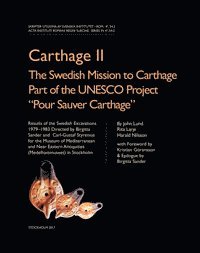
Carthage II: The Swedish Mission to Carthage Part of the UNESCO Project "Pour Sauver Carthage"
Inbunden, Engelska, 2018
659 kr
Skickas inom 5-8 vardagar
This second and final volume on the Swedish participation in the UNESCO project "Pour Sauver Carthage" 1979–1983 presents three detailed studies of excavated material from the Swedish main Site A at Carthage: terracotta lamps, animal bones and coins. The site is situated in central Carthage on the highest point of the saddle between the Carthaginian heights Byrsa and Juno. Excavations unearthed somewhat unexpectedly a building complex with a small Roman and Late Antique bath. Approximately 7000 finds were registered, and of them only the three categories presented in this volume have been analyzed in their entirety. They show that the latest building complex was used through to the 7th century AD. Circa 893 (mainly fragments of) terracotta lamps found at Site A are published and analytically studied in Chapter 1. A large amount of bones from mammals, birds and fish are studied and analysed in Chapter 2. The catalogue of the coinage in Chapter 3 contains description of coins from the Swedish excavations at Site A and B. Of 1281 discovered coins 508 coins are considered identifiable and discussed here with photographs. Epilogue of this volume presents a summary of the excavation and its results.
624 kr
Skickas inom 5-8 vardagar
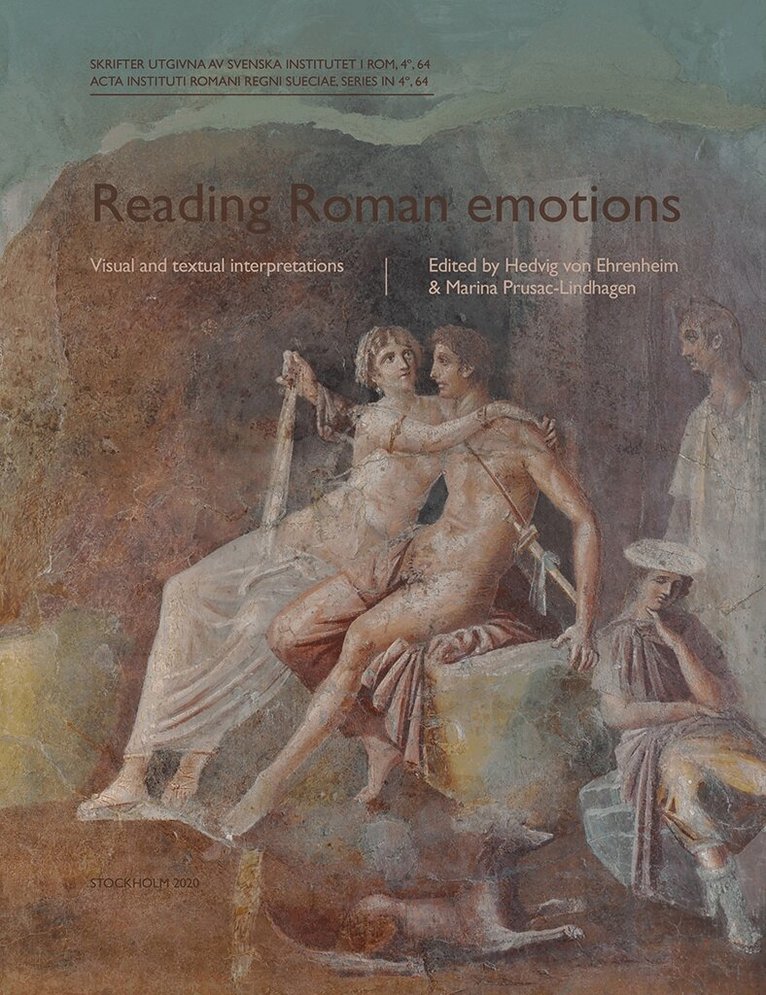
This volume is a contribution to the study of culturally bound emotions and emotional response in ancient Rome. Approaches to the study of ancient emotions and how they were culturally specific, appreciated and understood have recently come to the centre of attention, but not so much in the visual as in the literary culture. When socially and affectively contextualized, the material culture of ancient Rome is a potential goldmine of information with regard to emotions. The chapters in the present volume take the reader on a tour through various cases that demonstrate how emotions were expressed through the arts. The tour starts with a fresh view of how emotion history can be used to recover feelings from the visual culture of the past. Visual culture includes animated performances, and the reader is invited to revel in Roman drama, oratory, and love poetry. Words are often clear, but can images reveal laughter and joy, sadness, grief and mourning, virtue and anger? This volume argues that yes, they can, and through the study of emotions it is also possible to obtain a deeper understanding of the Romans and their social and cultural codes. Table of contents Preface Hedvig von Ehrenheim & Marina Prusac-Lindhagen | Introduction Susan Matt | 1. Recovering emotion from visual culture Gesine Manuwald | 2.“artifices scaenici, qui imitantur adfectus”. Displaying emotions in Roman drama and oratory J. Rasmus Brandt | 3. Emotions in a liminal space. A look at Etruscan tomb paintings Hedvig von Ehrenheim | 4. Humour in Roman villa sculpture. Laughter for social cohesion John R. Clarke | 5. Laughter in Roman visual culture, 100 BC–AD 200. Contexts and theories Arja Karivieri | 6. Reading emotions in Pompeian wall paintings and mosaics Thea Selliaas Thorsen | 7. Blindness and insight. Emotions of erotic love in Roman poetry Kristine Kolrud | 8. Breaking Fury’s chains. The representation of anger in the Sala di Giovanni dalle Bande Nere in the Palazzo Vecchio in Florence Lena Larsson Lovén | 9. … and left his parents in mourning … Grief and commemoration of children on Roman memorials Johan Vekselius | 10. Trajan’s tears. Reading virtue through emotions Marina Prusac-Lindhagen | 11. Through the looking glass. Collective emotions and psychoiconography in Roman portrait studies Jan N. Bremmer | Epilogue. Final considerations and questions regarding visual and textual emotions
752 kr
Skickas inom 5-8 vardagar
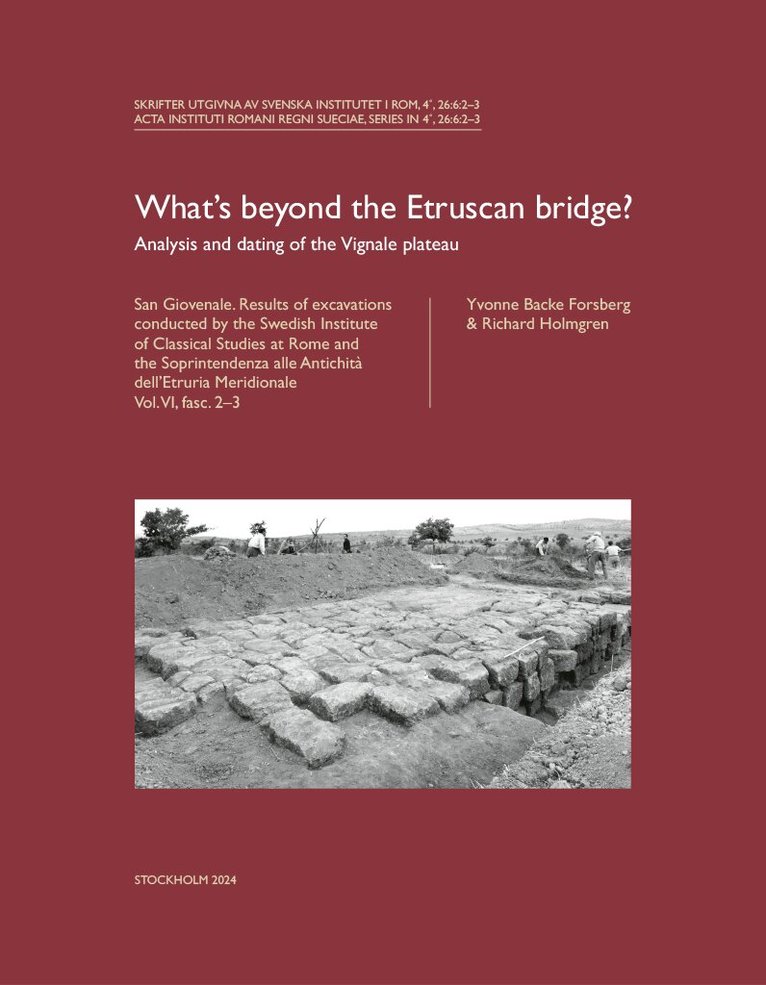
The Etruscan site of San Giovenale has been excavated periodically since 1956. From the beginning the main focus has been the question of settlement remains. However, a fundamental area within the site had still not undergone the inquiry necessary for a complete understanding of the site as a whole. The Vignale plateau, connected to the main site by an Etruscan bridge, was surveyed and partly excavated in 1959–1960, but not published. The Vignale Archaeological Project (VAP) began new investigations in 2006 that aimed to answer the question of “What’s beyond the Etruscan bridge?” This publication focuses on the initial investigations of 1959–1960, augmented by new ground- and aerial remote sensing surveys. The current volume is divided in six chapters. Through an introduction, and geological/topographic and historical/archaeological settings (Chapters 1–3), the reader achieves a general understanding of Vignale within a larger framework. The main archaeological studies of various features on the plateau, their function and dating are covered in Chapter 4, where Vignale from the Final Bronze Age to medieval times is approached with an emphasis on the Etruscan periods. The study of the latter investigates the connection to Vignale’s sister plateau (the Acropolis area), and the plateaus’ connection to the surrounding landscape. An intrinsic aspect of Vignale is the association with wine over time. Chapter 5 therefore elaborates on wild and domesticated vines with emphasis on production, ritual, and material remains, concluding with a summary and synthesis in Chapter 6. Two extensive appendices follow, one detailing the material remains and data connected to the southern Bridge Complex, and the other a treatise on the Etruscan awareness of their local mineral salt, alunite.