Richard Holmgren – författare
Visar alla böcker från författaren Richard Holmgren. Handla med fri frakt och snabb leverans.
2 produkter
2 produkter
752 kr
Skickas inom 5-8 vardagar
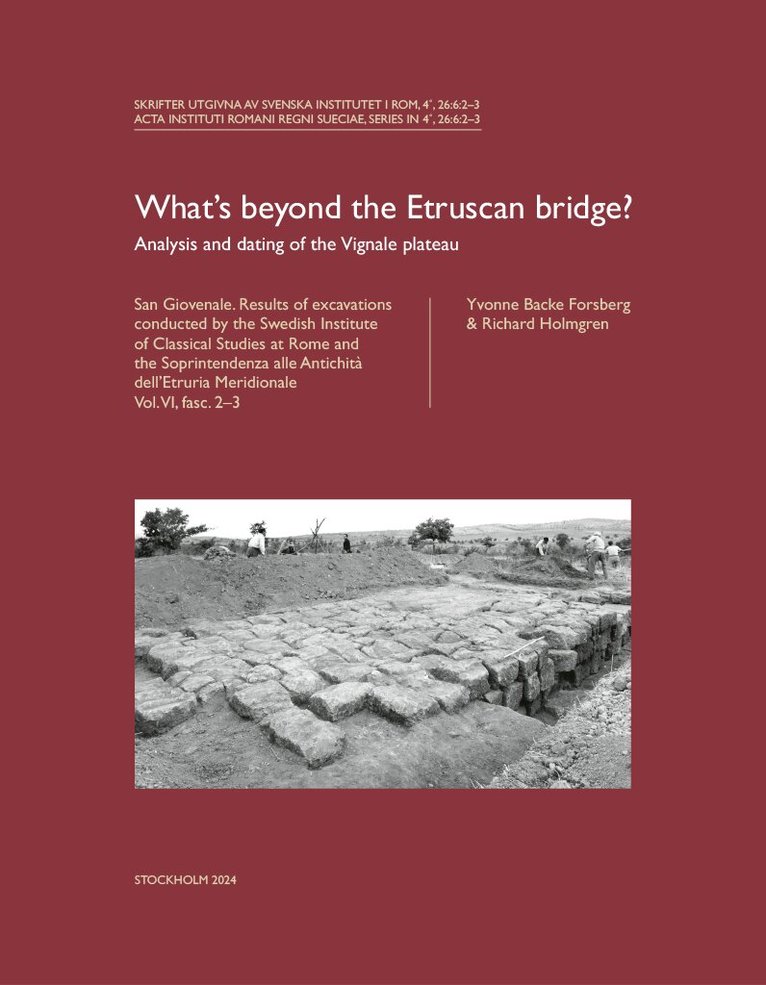
The Etruscan site of San Giovenale has been excavated periodically since 1956. From the beginning the main focus has been the question of settlement remains. However, a fundamental area within the site had still not undergone the inquiry necessary for a complete understanding of the site as a whole. The Vignale plateau, connected to the main site by an Etruscan bridge, was surveyed and partly excavated in 1959–1960, but not published. The Vignale Archaeological Project (VAP) began new investigations in 2006 that aimed to answer the question of “What’s beyond the Etruscan bridge?” This publication focuses on the initial investigations of 1959–1960, augmented by new ground- and aerial remote sensing surveys. The current volume is divided in six chapters. Through an introduction, and geological/topographic and historical/archaeological settings (Chapters 1–3), the reader achieves a general understanding of Vignale within a larger framework. The main archaeological studies of various features on the plateau, their function and dating are covered in Chapter 4, where Vignale from the Final Bronze Age to medieval times is approached with an emphasis on the Etruscan periods. The study of the latter investigates the connection to Vignale’s sister plateau (the Acropolis area), and the plateaus’ connection to the surrounding landscape. An intrinsic aspect of Vignale is the association with wine over time. Chapter 5 therefore elaborates on wild and domesticated vines with emphasis on production, ritual, and material remains, concluding with a summary and synthesis in Chapter 6. Two extensive appendices follow, one detailing the material remains and data connected to the southern Bridge Complex, and the other a treatise on the Etruscan awareness of their local mineral salt, alunite.
243 kr
Skickas inom 3-6 vardagar
Gullivers resor gjorde succé när den kom i början på 1700-talet och fängslar och fascinerar än idag. Något som varit okänt ända fram till nu är att det finns en fortsättning i vilken Gulliver kommer till det märkliga landet Navibia, ett land präglat av demokrati och generösa rättigheter.Gulliver får träffa statsministern i Navibia och blir imponerad när denne berättar om den höga utbildningsnivån i landet. Så imponerad att han godtar ett erbjudande om att som praktikant få stifta närmare bekantskap med det navibianska skolsystemet. Det visar sig dock att den navibianska skolan inte är särskilt lik den han själv gått i och Gullivers praktik som lärare blir allt annat än harmonisk.I Gulliver som magister får vi se det moderna välfärdssamhället med upplysningsmänniskan Gullivers friska ögon. Boken väcker viktiga frågor om samhället i allmänhet och skolan i synnerhet.