Alif – serie
Visar alla böcker i serien Alif. Handla med fri frakt och snabb leverans.
13 produkter
13 produkter
Häftad, Engelska, 2022
1 153 kr
Skickas inom 5-8 vardagar
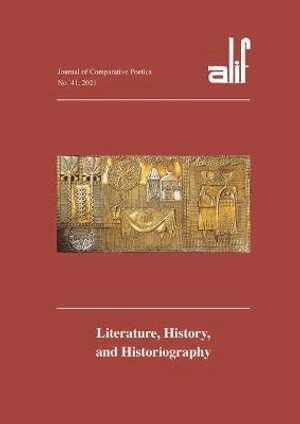
A wide-ranging exploration of the relationship between history and literatureThis issue of Alif explores the relationship between literature and history. What do history and literature have to say to each other? What can literature say that history cannot, and vice versa? Do they work with or against each other? How does the literary dimension of history affect its status, and how does the historicity of literature, in turn, shape its being? What would it mean to speak of a “literariness of history” today? The terms “literature” and “history” in our title are intended to be construed in the broadest possible sense and to cover the widest possible range of genres and modalities of literary and historical writing. The recent proliferation of epithets and sub-disciplines in the study of both literature and history has fundamentally changed both fields while raising further questions about the possibility of scholarly debates that traverse them.Contributors- Balthazar I. Beckett, American University in Cairo, Cairo, Egypt- Mohamed Birairi, Beni-Suef University, Beni-Suef, Egypt, and the American University in Cairo, Cairo, Egypt- Ziad Dallal, Bard College, Annandale-on-Hudson, New York, USA- Karim Elsaiad, Cairo University, Cairo, Egypt- Itzea Goikolea-Amiano, SOAS, University of London, London, UK- Rebecca Ruth Gould, University of Birmingham, Birmingham, UK- Magdi Guirguis, Kafrelsheikh University, Kafr al-Sheikh, Egypt- Isabelle Hesse, University of Sydney, Sydney, Australia- Abdullah Ibrahim, literary critic- Madonna Kalousian, independent scholar- Céza Kassem, independent scholar- Ahmed F. Khaleel, University of York, York, UK- Tarif Khalidi, American University of Beirut, Beirut, Lebanon- Peter Kornicki, University of Cambridge, Cambridge, UK- Wen-chi Li, University of Zurich, Zurich, Switzerland- Azza Madian, Cairo Conservatoire and American University in Cairo, Cairo, Egypt- Francesca Orsini, SOAS, University of London, London, UK- Daniel Rivet, Université Paris 1 Panthéon-Sorbonne, Paris, France- Anne C. Vila, University of Wisconsin-Madison, Madison, Wisconsin, USA
Häftad, Arabiska, 2026
1 252 kr
Skickas inom 3-6 vardagar
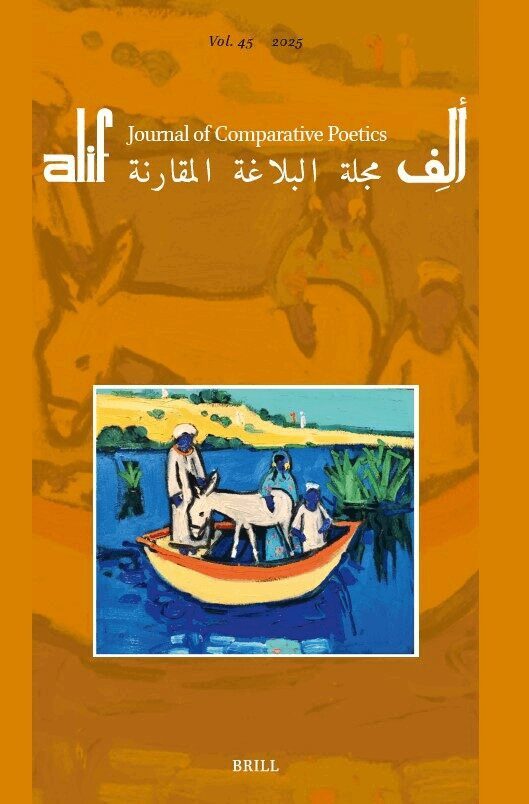
This volume brings us “Cultural Perceptions of Animals: Old and New.” The contributors explore how the representation of animals can help shape humans’ understanding of nature and themselves in literature, art, and the sciences. Animals have always figured into human storytelling – written, visual, and oral. How have animals been represented, undervalued, lionized, personified? How do animals open up a nuanced space for representation and embodiment culturally, politically, and socially during times of censorship, enlightenment, scarcity, abundance, and so forth? The following articles take up these questions in English, Arabic, and French, and in settings traversing multiple hemispheres.يُقدّم لنا هذا المجلد "التصورات الثقافية للحيوانات: القديمة والحديثة." يستكشف المساهمون فيه كيف يُمكن أن يُساهم تمثيل الحيوانات في تشكيل فهم الإنسان للطبيعة ولنفسه في الأدب والفن والعلوم. لطالما كان للحيوانات حضورٌ في السرد البشري - المكتوب والمرئي والشفهي. كيف تمّ تمثيل الحيوانات، وكيف تمّ التقليل من شأنها، وكيف تمّ تمجيدها، وكيف تمّ تجسيدها؟ كيف تُتيح الحيوانات مساحةً دقيقةً للتمثيل والتجسيد ثقافيًا وسياسيًا واجتماعيًا في أوقات الرقابة والتنوير والندرة والوفرة، وما إلى ذلك؟ تتناول المقالات التالية هذه الأسئلة باللغات الإنجليزية والعربية والفرنسية، وفي سياقاتٍ تمتدّ عبر قاراتٍ مُتعدّدة.
Häftad, Engelska, 2023
1 153 kr
Tillfälligt slut
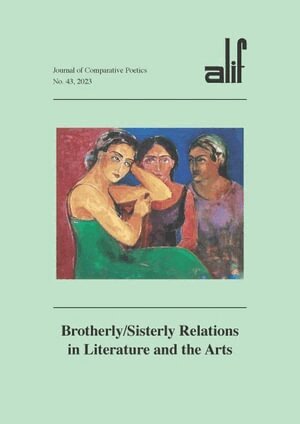
A rich exploration of sibling bonds in literature and the artsThis issue of Alif explores representations of brotherhood/sisterhood in literature and the arts. What does it mean to be part of a brotherly/sisterly bond? And what do such bonds entail, positively or otherwise? These questions have been extensively posed and revisited in a variety of traditions old and new. Sibling relations, here defined, can also transcend kinship and blood relations to include shared causes and values, such as political solidarity and gender equality.Contributors:Shereen Abouelnaga, Cairo University, EgyptAbdelrahman Abuabed, independent scholar, Doha, QatarKaram AbuSehly, Beni-Suef University, EgyptSaad Al-Bazei, King Saud University, Riyadh, Saudi ArabiaMariam Elashmawy, Freie Universität Berlin, GermanySafaa Fathy, poet, essayist, and filmmaker, FranceAnna Głowacka, independent scholar, AustriaHala K. Gomaa, independent scholar, Cairo, EgyptNoha Hanafy, The British University in Egypt, Cairo, EgyptMagda Hasabelnaby, Ain Shams University, Cairo, EgyptAmina Mansour, photographer, creative conceptualizer, and copywriter, Cairo, EgyptDalia Said Mostafa, The University of Manchester, UKManal Al-Natour, West Virginia University, Morgantown, West Virginia, USAAndrea Maria Negri, Ludwig Maximilian University of Munich, GermanyYomna Saber, Qatar University, Doha, QatarMuhammed F. Salem, independent scholar, Cairo, EgyptMary Youssef, Binghamton University, New York State, USA
Häftad, Engelska, 2006
1 090 kr
Tillfälligt slut
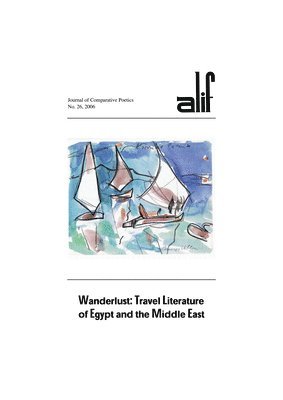
This issue of Alif is devoted to travel and travel-writing in the broadest cross-cultural sense and focuses on what Mahmoud Manzalauoui has termed indigenes, visitants, sojourners, and habitants or metics, particularly in Egypt and the Middle East. It is a tribute to Middle East scholar and acclaimed travel writer John Rodenbeck. Essays in this issue take a variety of approaches, ranging from the historical to the analytical and philosophical. Contributors include Sahar Sobhi Abdel-Hakim, Fadwa Adbel Rahman, Michael Haag, JDF Jones, Ceza Kassem, Nabil Matar, Malise Ruthven, Sarah Searight, and Terry Walz.
Häftad, Engelska, 2008
1 098 kr
Tillfälligt slut
This issue of Alif is published on the centennial anniversary of the founding the first Casa dei Bambini, a progressive educational institution for children, which seeks an alternative mode in bringing them up and nurturing their independence. An extract from the writings of the pedagogue of this innovative method, Maria Montessori, is here translated into Arabic for the first time. This collection covers the universe of children through interviews, photo-essays, testimonies, and articles in psychology, philosophy, law, music, fiction, media, poetry, and drama, addressing varied aspects of childhood: from Shakespeare for children to puppet theater in Egypt; from plays for dispossessed camp children to children enlisted in militias; from the affluent and leisurely childhood of Virginia Woolf to the wonders of the early years of a poet like Muhammad Afifi Matar. Essays also explore heroism and ethical values in children’s literature, as well as musical adaptations of children’s literature and the art and craft of making books for children. Alif Volume 27Contributors: Abdelfattah Abusrour, Saeed Alwakeel, Nasseif Azmy, Mia Carter, Sharif S. Elmusa, Adib Fattal, Stephannie S. Gearhart, Ferial J. Ghazoul, Amanie Fawzi Habashi, Gala El Hadidi, Thomas Hartwell, Sayyid Hegab, Nadia El Kholy, Mohieddin al-Labbad, Muhammad Afifi Matar, Tanya M. Monforte, Maria Montessori, Yasmine Motawy, Naomi Shihab Nye, Michal Oklot, Mounira Soliman, Wiam El-Tamami, Matthew Whoolery.
Häftad, Engelska, 2008
1 114 kr
Tillfälligt slut
This issue of Alif: Journal of Comparative Poetics addresses literary and artistic adaptations comprehensively. It offers articles on adaptations and appropriations of textual and visual material, focusing on adapting works from one genre to another, from one discourse to another, and from one medium to another. Transformation, modification, and ‘writing back’ in the process of adaptation are analyzed and contextualized.The volume covers adaptation of, among other things, novels into films, sacred texts into literary works, rituals into installation art, historical documents into narrative texts, art objects into poetic discourse, folk legends into dramatic works, ideological positions into fables, erotic verses into Sufi lessons, and e-mails and personal diaries into performances. The contributors are from Africa, America, Asia, and Europe. Between them they cover postcolonial adaptations, gendered appropriations, and literary rewriting of the past, as well as theoretical and esthetic dimensions of such artistic adaptations. Examples are given from Egyptian, Iraqi, Kuwaiti, Pakistani, American, British, Andalusian, and sub-Saharan African works. There are also translations related to the topic of adaptation, and testimonies by writers who have adapted works across genres. Alif 28.
Häftad, Engelska, 2009
974 kr
Tillfälligt slut
This issue of Alif: Journal of Comparative Poetics explores how universities have always borne the task of questioning, and how the role and status of the university itself has been put into question: the very idea of a university has been open to contestation, revision, and crisis. In today’s world, how do universities preserve their capacity for social critique and independent thought when their campuses and research facilities have been both literally and figuratively infiltrated by corporate interests and “support”? How does the tradition of the liberal arts square with today’s technically—and vocationally—minded students? How do the university’s institutions and ideals, born in Medieval cultures inspired by classical learning, fare in a world where everything, education included, is computer mediated, virtualized, globalized? What is the role of literature in this struggle for identity, given that so many writers now make universities their professional home? Original articles addressing a variety of issues from differing disciplinary and theoretical points of view are included in this volume, illuminating higher education concerns in Egypt and the rest of the world.Contributors: Steve Nimis, Sara Nimis, Henry Giroux, Steve Germic, Karyn Ball, Barbara Harlow, John Kress, Peter Cook, Bob Frodeman, Bruce Foltz, Jennifer Rowland, Magda Hasabelnaby, Bayoumi Kandil, Muhsin Mahdi, Doaa Embabi, Madiha Doss, Mohammed Abul Ghar, Ali Mabrouk, Nasr Abu Zayd, Faten Morsy, Mona Tolba, Anwar Moghith, Kamal Mougheeth, Samy Soliman.
Häftad, Engelska, 2010
1 098 kr
Tillfälligt slut
This issue of Alif focuses on trauma and loss and their presence in collective and individual memory. The question of traumatic events has been recognized in psychology, psychoanalysis, and literature, but scholarly studies have mostly concentrated on traumas enacted in the West—World Wars and the Holocaust. Contributors to this volume attempt to extend the field of trauma and memory studies to include other parts of the world: Algeria, Egypt, Iraq, Iran, India, Ireland, Lebanon, Palestine, Pakistan, multi-ethnic America, and ancient Greece. The Lebanese civil war or the Peloponnesian war, the Nakba of 1948 or the Naksa of 1967: the articles and personal testimonies in this issue explore the impact of such tragic events on literary genre, films, fiction, folk culture, poetry, drama, and visual arts. Alif: Journal of Comperative Poetics 30Contributors: Nasr Hamid Abu-Zayd, Galal Amin, Gaber Asfour, Mohammed Berrada, Céza Kassem-Draz, Sabry Hafez, Barbara Harlow, Malak Hashem, Wolfhart Heinrichs, Richard Jacquemond, Andrew Rubin, Doris Enright-Clark Shoukri, and Hoda Wasfi.
Häftad, Engelska, 2012
1 098 kr
Tillfälligt slut
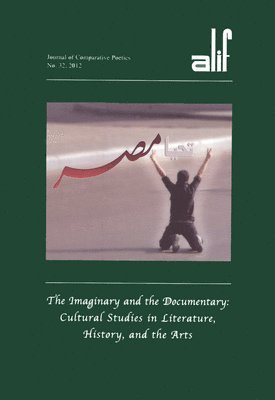
This issue of Alif: Journal of Comparative Poetics is devoted to the intersection of the imaginary and the documentary, the fictional and the cultural in the three genres of literature (poetry, fiction, and drama), in history, in film (feature and documentary), in photography, in plastic arts, and in architecture. Collage in art, portrait paintings, political poetry, archival footage in films, the historical novel, and the metaphors of historiography are some of the examples that demonstrate the interfacing between the imaginary and the documentary. Subjectivity and ideology of the artist and scholar might be couched in a flight of fantasy or in a rational argument, but in both cases they are joined to a specific worldview that is analyzed and discussed.Contributors: Abdel Rahman El Abnoudy, Emad Abdel Latif, Saeed Alwakil, Tamim El Barghouti, Judith Butler, Safaa Fathy, Tahany El Gebaly, Ahmed Haddad, Sabry Hafez, Chouaib Halifi, Stuart Hall, Barbara Harlow, Ahmed Heakl, Jeffrey Herlihy, Ahmed Abdel Mo‘ty Higazi, Abdullah Ibrahim, Walid El Khachab, Jalal Uddin Khan, Hasna Lebbady, Iman Mersal, Helmi Salem, Stephanie Schwerter, Basheer El Sibaei, Larbi Touaf, John Carlos Rowe, Angela Vaupel, Elizabeth Wickett, Shaaban Yusuf.
Häftad, Engelska, 2013
1 107 kr
Tillfälligt slut
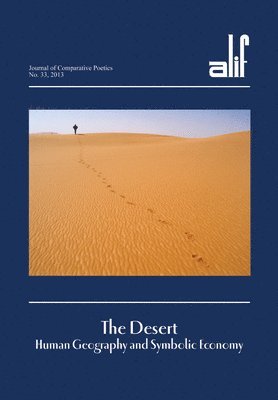
This interdisciplinary issue of the literary journal Alif is devoted to the desert—as a geographical locus and symbolic image—and to various texts related to it, drawn from literature and the arts, history and anthropology, film and environmental studies.Scholars from the Middle East, Africa, Europe, and North America contribute articles in Arabic, English, and French related to the visual representation of the desert in medieval iconography and in contemporary cinema, in American poetry and in pre-Islamic poetics, in human geography and in sociological thought, in French novels and in Arabic novels, in religious traditions and in ecological approaches, in travel literature and in critical discourse.Includes contributions by Saeed Alwakeel, Saad El Bazei, Sharif Elmusa, Jehan Farouk, Naglaa Hassan, Abdullah Ibrahim, Salma Mobarak, Senayon Olaoluwa, Yasmine Ramadan, Nathalie Roman, Randa Sabry.
Häftad, Engelska, 2014
1 098 kr
Tillfälligt slut
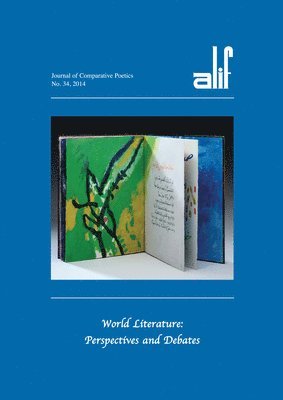
As one of the first non-European journals to critically address the category of Weltliteratur bilingually from the perspective of the Global South, this special issue of Alif addresses this problem theoretically and empirically. The critical conversation about the problem of the category of Weltliteratur is not only extended beyond the European and North American sphere that has largely dominated and framed the discussion of Weltliteratur, but is juxtaposed formally in a way that permits us to understand that there are other “world literatures” that allow us to reexamine the contending theories, practices, and underlying assumptions of Weltliteratur. Essays in this volume emphasize in different ways the inherent tension between postcolonial studies and “world criticism,” and to that extent open up new realms for the discovery of new knowledges, new epistemes, modes of conversation, and communication.
Häftad, Engelska, 2004
1 081 kr
Tillfälligt slut
This issue of Alif investigates the different strata constituting texts, and the presence of older material (myths, classics, hymns, rituals, romance, philosophical fragments, etc.) as subtexts in literature. Articles explore the processes and modalities of such inclusions in a given work or the corpus of an author. The issue also includes critical essays on the nature of continuity and correspondence in plots, characters, and styles as well as redeployment of older motifs in modern and postmodern works.Contributors: English section: Walid Bitar, Leslie Croxford, Ananya Kabir, Rondo Keele, Steven Nimis, John Rodenbeck, Edward Said, Doris Shoukri, Mounira Soliman, Steffen Stelzer.Arabic section: Mohammed ‘Ajina, Mohammed Birairi, Ayman Al-Desouky, Hasab al-Sheikh Ja‘far, Scheherazade Hassan, Sami Mahdi, Samia Mehrez, Mai Muzaffar/Rafa Nasiri, Lamis Al-Nakkash/Doris Shoukri, Nagwa Sha‘ban.
Häftad, Engelska, 2003
1 098 kr
Tillfälligt slut
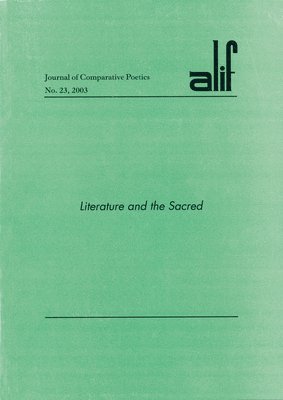
Studies in this collection treat varied aspects of the relationship between literary discourses and ideas of the sacred in different cultures and epochs. Contributions by established and emerging scholars from the Arab world, South Asia, Europe, and North America examine issues such as the treatment of the sacred in literary texts and traditions, the literary dimensions of sacred texts, the impact of the sacred on literary imagination, the role of the literary in sacred experience, and the contestations between the respective projects of literature and the sacred over the constitution of cultural and social norms. Alif vol. 23Contributors:English and French sections: Nasr Abu Zaid, Karen Campbell, Angelica DeAngelis, Markus Dressler, Michael Frishkopf, Scott Kugle, Heba Machhour, Olivier Sécardin, Marla Segol. Arabic section: Farid Abu Si’da, Boutros Hallaq, Ahmed Taher Hassanein, Anwar Ibrahim, Richard Jacquemond, Salah Kamel, Ali Mabrook, Sa’id Tawfiq.