Brandeis Series on Gender, Culture, Religion, and Law – serie
Visar alla böcker i serien Brandeis Series on Gender, Culture, Religion, and Law. Handla med fri frakt och snabb leverans.
4 produkter
4 produkter
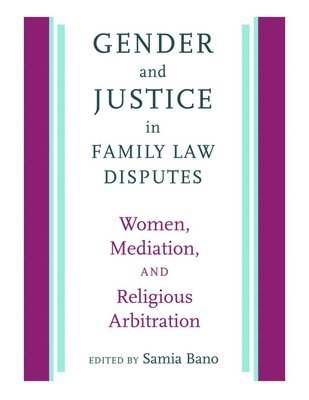
Gender and Justice in Family Law Disputes
Women, Mediation, and Religious Arbitration
Häftad, Engelska, 2017
334 kr
Skickas inom 7-10 vardagar
Recently, new methods of dispute resolution in matters of family law—such as arbitration, mediation, and conciliation—have created new forms of legal culture that affect minority communities throughout the world. There are now multiple ways of obtaining restitution through nontraditional alternative dispute resolution (ADR) mechanisms. For some, the emergence of ADRs can be understood as part of a broader liberal response to the challenges presented by the settlement of migrant communities in Western liberal democracies. Questions of rights are framed as “multicultural challenges” that give rise to important issues relating to power, authority, agency, and choice. Underpinning these debates are questions about the doctrine and practice of secularism, citizenship, belonging, and identity. Gender and Justice in Family Law Disputes offers insights into how women’s autonomy and personal decision-making capabilities are expressed via multiple formal and nonformal dispute-resolution mechanisms, and as part of their social and legal lived realities. It analyzes the specific ways in which both mediation and religious arbitration take shape in contemporary and comparative family law across jurisdictions. Demarcating lines between contemporary family mediation and new forms of religious arbitration, Bano illuminates the complexities of these processes across multiple national contexts.
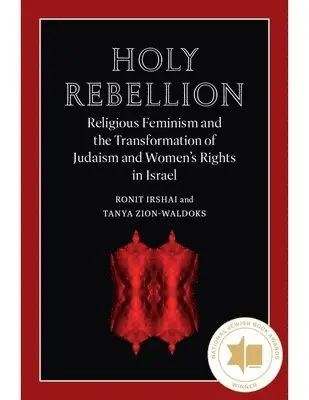
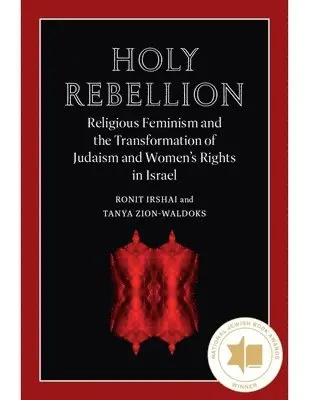
Holy Rebellion
Religious Feminism and the Transformation of Judaism and Women's Rights in Israel
Inbunden, Engelska, 2024
956 kr
Skickas inom 7-10 vardagar
An in-depth study of Jewish religion and law in Israel from a gendered perspective. In Holy Rebellion, Ronit Irshai and Tanya Zion-Waldoks examine social change in Israel through a rigorous analysis of the shifting entanglements of religion, gender, and law in times of cultural transformation. They explore theological, halakhic, political, and sociological processes and show how they interact with one another in ways that advance women’s rights, as well as how they are met with a conservative backlash in the discourses and actions of the rabbinic establishment. Irshai and Zion-Waldoks build on legal philosopher Robert Cover’s 1982 paper “Nomos and Narrative,” which explained how cultural narratives and legal norms are reciprocally enforced or transformed. Expanding on this notion, Irshai and Zion-Waldoks propose a “narrative ripeness test,” an analytic tool that evaluates the relationship between culture and law to assess how and when change within a minority cultural community may be accelerated or hindered by state intervention. Religious feminisms are emerging around the world, not solely in Israel, and this book helps elucidate how they create enduring and radical change. Many liberal states are also confronting an illiberal backlash and question the multicultural framework’s ability to serve the needs of minorities within minorities. Therefore, the theoretical framework offered by Irshai and Zion-Waldoks is applicable beyond the Israeli case, even as it offers deeper insights into an Israeli society in turmoil.
Holy Rebellion
Religious Feminism and the Transformation of Judaism and Women's Rights in Israel
Häftad, Engelska, 2024
323 kr
Skickas inom 7-10 vardagar
An in-depth study of Jewish religion and law in Israel from a gendered perspective. In Holy Rebellion, Ronit Irshai and Tanya Zion-Waldoks examine social change in Israel through a rigorous analysis of the shifting entanglements of religion, gender, and law in times of cultural transformation. They explore theological, halakhic, political, and sociological processes and show how they interact with one another in ways that advance women’s rights, as well as how they are met with a conservative backlash in the discourses and actions of the rabbinic establishment. Irshai and Zion-Waldoks build on legal philosopher Robert Cover’s 1982 paper “Nomos and Narrative,” which explained how cultural narratives and legal norms are reciprocally enforced or transformed. Expanding on this notion, Irshai and Zion-Waldoks propose a “narrative ripeness test,” an analytic tool that evaluates the relationship between culture and law to assess how and when change within a minority cultural community may be accelerated or hindered by state intervention. Religious feminisms are emerging around the world, not solely in Israel, and this book helps elucidate how they create enduring and radical change. Many liberal states are also confronting an illiberal backlash and question the multicultural framework’s ability to serve the needs of minorities within minorities. Therefore, the theoretical framework offered by Irshai and Zion-Waldoks is applicable beyond the Israeli case, even as it offers deeper insights into an Israeli society in turmoil.
323 kr
Skickas inom 7-10 vardagar
A long overdue study of agunot based on exhaustive research in rabbinic sources, memoirs, and communal records. Noa Shashar sheds light on Jewish family life in the early modern era and on the activity of rabbis whose Jewish legal rulings determined the fate of agunot, literally “chained women,” who were often considered a marginal group. Who were these men and women? How did Jewish society deal with the danger of a woman’s becoming an agunah? What kind of reality was imposed on women who found themselves agunot, and what could they do to extricate themselves from their plight? How did rabbinic decisors discharge their task during this period, and what were the outcomes given the fact that the agunot were dependent on the male rabbinic establishment? This study describes the lives of agunot, and by reexamining the halakhic activity concerning agunot in this period, proposes a new assessment of the attitude that decisors displayed toward the freeing of agunot.