• Fri frakt över 249 kr
  • •
  • Snabba leveranser
  • •
  • Billiga böcker
Kundservice

Du är på sajten för privatpersoner.

Företag, bibliotek eller offentlig verksamhet?

Du handlar på classic.bokus.com, där alla dina funktioner finns intakta.
Till classic.bokus.com
Bokus logotyp. Gå till startsidan.
  • Erbjudanden
  • Nyheter
  • Student
  • Topplistor
  • Barn & ungdom
  • Bokus Play
  • E-böcker
  • Pocketböcker
  • Spel & pussel

10% studentrabatt med kod TERM26

Sidfot

Mina sidor

    Hjälp

    • Kundservice
    • Vanliga frågor och svar
    • Frakt och leverans
    • Retur vid ångerrätt
    • Reklamera vara
    • Betalning
    • Köpvillkor
    • Allmänna villkor
    • Information om webbplatsens tillgänglighet

    Om Bokus

    • Om oss
    • Pressrum
    • För studenter
    • För företag
    • För bibliotek och offentlig verksamhet
    • För leverantörer
    • Hållbarhet

    Populärt

    • Aktuella erbjudanden
    • Presentkort
    • Studentlitteratur
    • Nya böcker
    • Topplistor
    • Signerade böcker
    • Engelska böcker

    Inspiration

    • Boktips
    • BookTok
    • Populära bokserier
    • Barnbokskaraktärer
    • Populära författare
    Logotyp för Bokus
    Följ oss på Facebook (extern länk)Följ oss på Instagram (extern länk)Följ oss på YouTube (extern länk)Följ oss på TikTok (extern länk)
    bokus @ CookiesAnpassa cookiesIntegritetspolicyKöpvillkor
    Till Citymail hemsida (extern länk)Till Budbee hemsida (extern länk)Till Postnord hemsida (extern länk)Till Schenker hemsida (extern länk)Till Early Bird hemsida (extern länk)Till Walleys hemsida (extern länk)
    1. Filosofi och religion
    2. Religion och tro
    3. Religion: allmänt

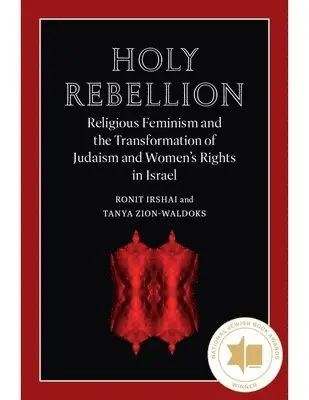
    Holy Rebellion

    Religious Feminism and the Transformation of Judaism and Women's Rights in Israel

    AvRonit Irshai,Tanya Zion-Waldoks

    Häftad, Engelska, 2024

    Del i serien Brandeis Series on Gender, Culture, Religion, and Law

    334 kr

    Beställningsvara. Skickas inom 5-8 vardagar. Fri frakt över 249 kr.

    Fler format och utgåvor

    Inbunden

    987 kr

    Beskrivning

    An in-depth study of Jewish religion and law in Israel from a gendered perspective.  In Holy Rebellion, Ronit Irshai and Tanya Zion-Waldoks examine social change in Israel through a rigorous analysis of the shifting entanglements of religion, gender, and law in times of cultural transformation. They explore theological, halakhic, political, and sociological processes and show how they interact with one another in ways that advance women’s rights, as well as how they are met with a conservative backlash in the discourses and actions of the rabbinic establishment. Irshai and Zion-Waldoks build on legal philosopher Robert Cover’s 1982 paper “Nomos and Narrative,” which explained how cultural narratives and legal norms are reciprocally enforced or transformed. Expanding on this notion, Irshai and Zion-Waldoks propose a “narrative ripeness test,” an analytic tool that evaluates the relationship between culture and law to assess how and when change within a minority cultural community may be accelerated or hindered by state intervention.   Religious feminisms are emerging around the world, not solely in Israel, and this book helps elucidate how they create enduring and radical change. Many liberal states are also confronting an illiberal backlash and question the multicultural framework’s ability to serve the needs of minorities within minorities. Therefore, the theoretical framework offered by Irshai and Zion-Waldoks is applicable beyond the Israeli case, even as it offers deeper insights into an Israeli society in turmoil.

    Produktinformation

    • Utgivningsdatum:2024-05-16
    • Mått:152 x 229 x 30 mm
    • Vikt:626 g
    • Format:Häftad
    • Språk:Engelska
    • Serie:Brandeis Series on Gender, Culture, Religion, and Law
    • Antal sidor:378
    • Förlag:Brandeis University Press
    • ISBN:9781684582099

    Utforska kategorier

    • Religion: allmänt inom Filosofi och religion
    • Genusvetenskap inom Samhälle och politik
    • Judendom inom Filosofi och religion

    Mer om författaren

    Ronit Irshai is associate professor and the head of the Gender Studies Program at Bar Ilan University, and a research fellow at the Shalom Hartman Institute in Jerusalem. Tanya Zion-Waldoks is assistant professor in the Seymour Fox School of Education at the Hebrew University in Jerusalem.

    Recensioner i media

    “This volume is a true beacon of light at a time when Israeli society faces profoundly complex questions about its identity, in both its democratic and its Jewish character.”

    Innehållsförteckning

    • PREFACE The heroines of this story Authors’ positionality and Methodology INTRODUCTION Who and what is this book about?A note on terminologyThe Dati (Jewish National-Religious/Modern Orthodox) community in Israel Dati feminists – Who are they? Gender, religion, and the Jewish-democratic State Overview of the book and its main argumentCHAPTER 1: JEWISH FEMINIST CRITIQUES OF RELIGIOUS NARRATIVE AND NOMOS Theoretical frameworks Applying Cover CHAPTER 2: HOMES - FEMINISM RESHAPES ORTHODOX JUDAISMStrategies of “Change from Within” and Struggles over Collective Homes Beit Midrash (Torah Study)Beit Knesset (Religious Rituals) Beit Din (Adjudication: Agunot and get Refusal) Bayit Leumi (National Home) Bayit Yehudi (Jewish Family and Female Body) Postscipt: Alternative Homes CHAPTER 3: NARRATIVE BACKLASH: THEOLOGICAL, DISCURSIVE AND POLITICAL ORTHODOX OBSTACLES TO DATI FEMINISMThe Sacrificial Imperative: “Aqedah” Theology as the Basis for Religious Subjectivity“Gender Essentialism” “Slippery Slope” Nationalism “Normalcy” and Family ValuesCHAPTER 4: JUDICIAL ENCOUNTERS BETWEEN DATI FEMINISTS AND THE STATE Introduction “Minority within minority”: Unpacking the Multi-culturalism DebatesA New Theoretical Model: The “Narrative Ripeness” TestThe Human Dignity Test: The Limits of “Narrative Ripeness” Dati Feminists and Israel’s Supreme Court: Applying the Narrative Ripeness Test .Acute Cases: Human Dignity Supercedes Narrative Ripeness AFTERWORD Viva la revolución? Our argument Where do we go next? Looking to the future