City as Place: Emotions, Experiences, and Meanings - Böcker
Visar alla böcker i serien . Handla med fri frakt och snabb leverans.
2 produkter
2 produkter
Del 1 - City as Place: Emotions, Experiences, and Meanings
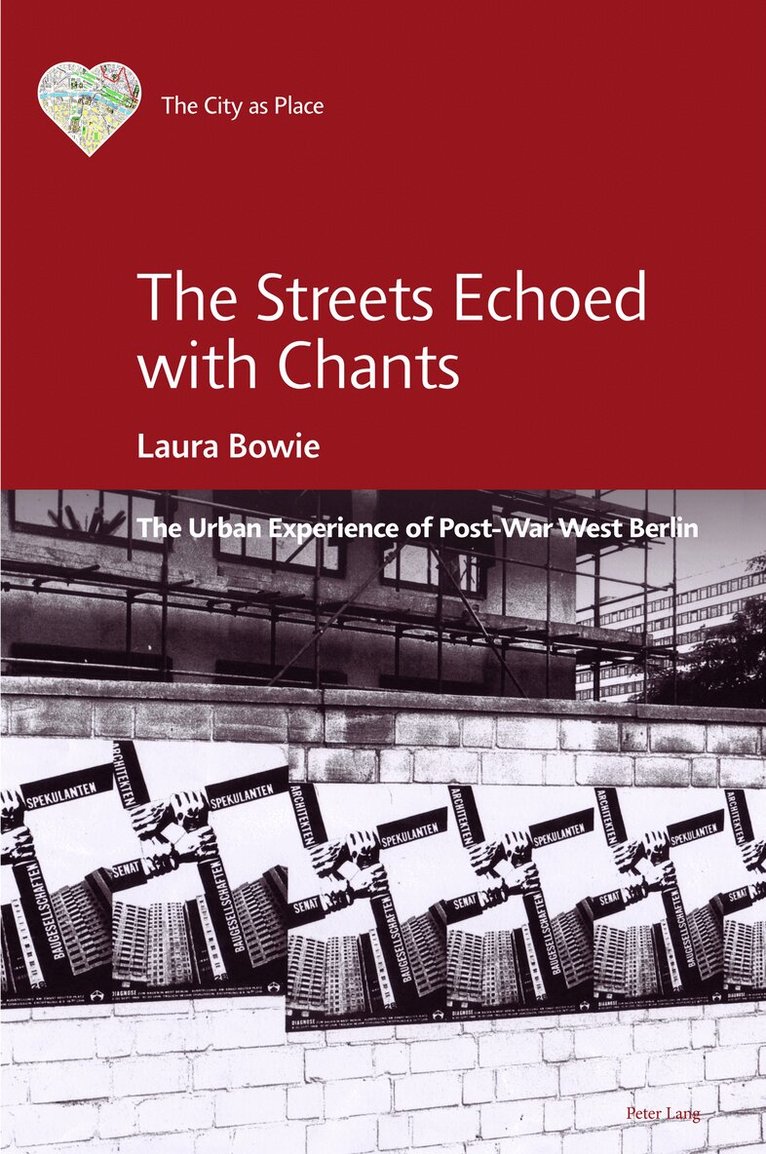
Streets Echoed with Chants
The Urban Experience of Post-War West Berlin
Häftad, Engelska, 2021
714 kr
Skickas inom 5-8 vardagar
«As a trained architectural historian, Bowie is absolutely on top of her game in bringing the post-war architectural debates to life; moreover, through the integration of critical theory, artistic and cultural practice, emotion and urban theories, the book is an interdisciplinary joy for readers. Using Action 507 and the Diagnose exhibition as a structural hinge to delve into a myriad of themes proves an ingenious approach to understanding the challenges and societal shifts around the 1968 student movement through its urban entanglement. […] Bowie’s book is a remarkable achievement, a thorough, unique and most timely intervention and interdisciplinary contribution to urban humanities research. Anyone with an interest in Berlin, architecture, political activism, and cultural and urban studies should consider this book highly recommended!» – Stephan Ehrig, Monatshefte 116:1 (2024)«The history of the 1968 movement is well-trodden territory, and finding a novel view is an ambitious task. One of the strengths of Bowie’s monograph is its new, albeit niche, perspective on the 1968 movement by using local debates in West Berlin over architecture, construction, and housing to illustrate residents’ concerns about authoritarianism. At the same time, the book does not always connect West Berlin to global discussions. Rather, the book shines when it emphasizes the micropolitical. It illuminates how social problems in areas such as the Märkisches Viertel developed and how Aktion 507 sought to ameliorate these social ills. From this angle, Bowie’s monograph offers a significant contribution to the field that will please scholars interested in the history of West Berlin.» – Alexandria N. Ruble, German Studies Review 46:3 (October 2023)What would it have been like to live in the island of West Berlin during the 1960s? What impact did the experience of the post-war context have on the global student movement in the city? By reconstructing the cultural atmosphere of the time and considering the site of West Berlin not only as a city, but also as a home, this book seeks to understand how the world was viewed by the protesting students, how the urban space they were living in influenced their political viewpoint, and how the cultural outputs of the generation created a uniquely symbiotic relationship with the world. This book paints a picture of the transfer of ideas between a variety of intellectual and cultural sources by combining theories that influenced the students’ perception of the world with the events centred around the key year of 1968. The intention is to come to an understanding of how the experience of living in West Berlin combined with architecture, and the arts more generally, to form the critique of urban planning and, by extension, society as a whole.
Del 2 - City as Place: Emotions, Experiences, and Meanings
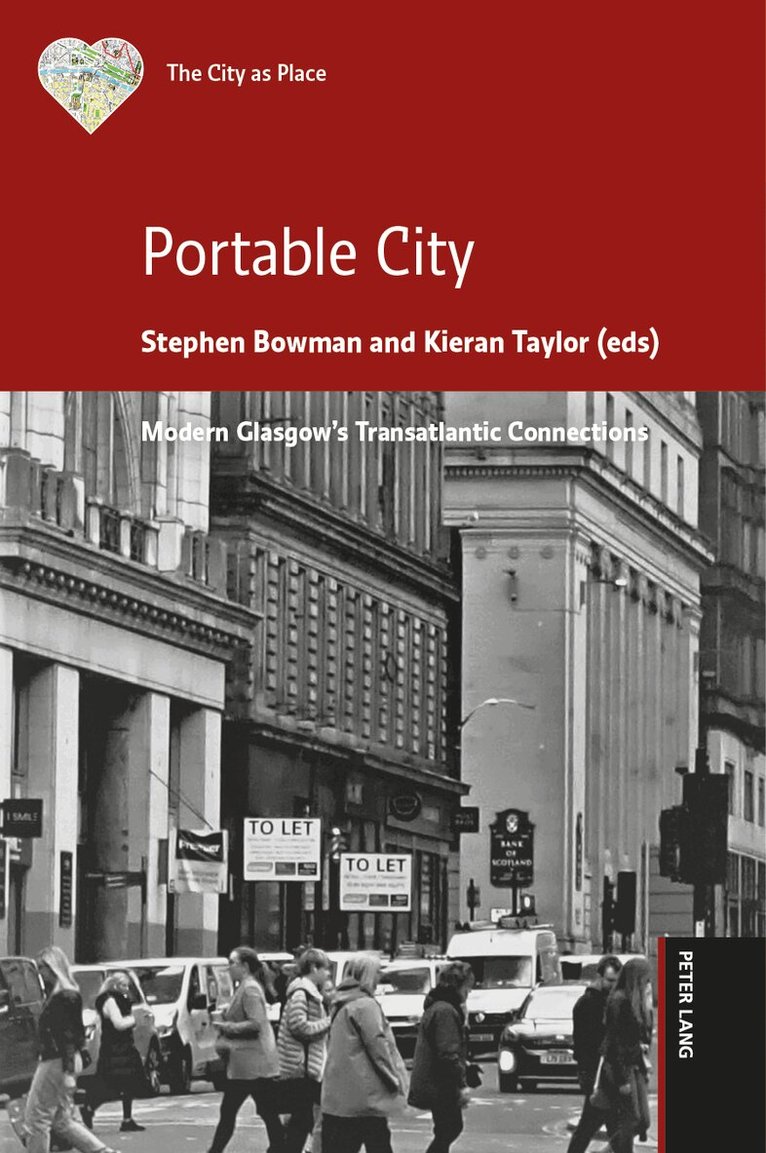
Portable City
Modern Glasgow’s Transatlantic Connections
Häftad, Engelska, 2026
713 kr
Skickas inom 5-8 vardagar
‘Portable City: Modern Glasgow’s Transatlantic Connections is a gem of a book. Like the modern city at the centre of its multi-faceted gaze, this wonderful volume offers us a highly original set of chapters on modern Glasgow's many different faces and facets. From an eclectic sense of expansive connections, new readings of Glasgow's reputation for grime, crime, and chronic ill-health, to thoughtful reinterpretations of its post-imperial and transatlantic aligned municipal, diasporic, and socio-cultural makeup, this new volume should be required reading for those wishing to understand Scotland's largest metropolis and, arguably, its first truly de-globalised city.’ – Professor Andrew Mackillop, University of GlasgowGlasgow is Scotland’s metropolis. It has long been the country’s largest city and the place where the challenges and changes wrought by modernity emerged most clearly. As this book shows, many of these challenges and changes were shaped by Glasgow’s status as a transatlantic city and by its historical entanglements with North America in the eighteenth, nineteenth and twentieth centuries. Drawing together contributions from new and established scholars on both sides of the Atlantic, this edited collection is about the tangible and intangible significance of transatlantic Glasgow as muse, as site of personal and collective memory, as imperial and industrial metropolis, as home for new immigrants, as bigoted slum, and as pioneering provider for the poor.Portable City combines traditional archival research with cultural approaches to provide the most original urban history of Glasgow in a generation and the first to offer a reappraisal of Bernard Aspinwall’s seminal 1984 book, Portable Utopia: Glasgow and the United States, 1820–1920.