Beta Phi Mu Monograph Series - Böcker
Visar alla böcker i serien Beta Phi Mu Monograph Series. Handla med fri frakt och snabb leverans.
5 produkter
5 produkter
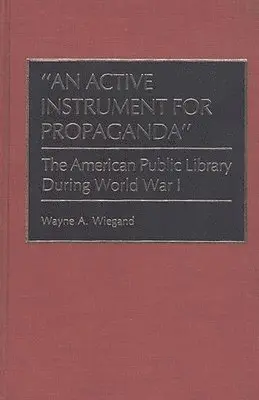
Active Instrument for Propaganda
The American Public Library During World War I
Inbunden, Engelska, 1989
1 060 kr
Skickas inom 10-15 vardagar
This study effectively addresses the question: What was the involvement of the American public library community in The Great War? A comprehensive introduction provides an overview of public library history prior to World War I, touching on such topics as the growth of the public library from the genteel, early nineteenth-century social libraries of New England and the Mid-Atlantic states and the founding of the American Library Association in 1876. The A.L.A. provided for an exchange of information and a means to address common problems encountered in librarianship. It facilitated the adoption of the Dewey classification system, pressed for the publication of periodical indexes, and began publishing its own collection guides. Wiegand details the socioeconomic characteristics of turn-of-the-century library professionals and their determination to address industrialization, urbanization, and immigration as these issues came within their sphere of influence. He identifies two perplexing problems of the period: the inability of public librarians to force Americans to actually use their libraries, and the challenges posed by new forces in the cultural, intellectual, and literary worlds. It is against this background that American public librarians and their institutions responded to the call for united action during World War I.Chapter 1 deals with the response to the Great European War before the United States entered on the allied side in 1917, while Chapters 2 and 3 analyze library-initiated wartime activities on both the local and national levels. The role of the public library in food conservation and the infrequently addressed issue of censorship and book burning are scrutinized in Chapters 4 and 5. Chapter 6 outlines programs for the Americanization of immigrants. A concluding chapter offers a synthesis of the volume. An essay on primary sources is included in the bibliography. An Active Instrument for Propaganda inaugurates the Beta Phi Mu's Monograph Series that, in the tradition of the International Library Science Honor Society's Chapbooks, will add significantly to the scholarly literature of the library profession. The book will be an important addition to collections dealing with World War I, and a valuable resource for historians of that period. Because wide coverage has been given to the wartime activities of hundreds of public libraries across the nation, many local public library collections will be enriched by this important volume.
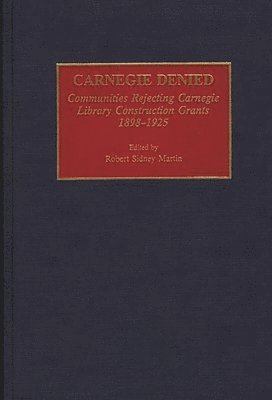
Carnegie Denied
Communities Rejecting Carnegie Library Construction Grants, 1898-1925
Inbunden, Engelska, 1993
809 kr
Skickas inom 10-15 vardagar
Andrew Carnegie was the foremost supporter of public library construction to the point that Carnegie Library became a cliche, synonymous with the public library, especially in small towns. Yet some communities that asked for Carnegie's funds to build a library later took public action to decline the funds. Because he was viewed as a robber baron, it has been assumed that these refusals were motivated by a desire not to take tainted money. This work documents that this was rarely the case. Indeed, there were many reasons for opposition to the Carnegie library grants. In some cases, local authorities remained unconvinced of the need for a public library. Some communities were under legal or financial restrictions that prevented them from taxing themselves in support of the library. In some, there was simply opposition to increasing the tax burden; in others the opposition focused on the perception that Carnegie was building memorials to himself.Experienced historians were commissioned to conduct thorough studies of regional clusters. The authors made the broadest possible use of primary sources, including public archives, manuscript collections, local newspaper accounts, and the records of the Carnegie Corporation in the Library of Congress. Of particular relevance were the files of the Carnegie Library Correspondence, documenting most of the history of first, Andrew Carnegie's--and later, the Carnegie Corporation's--program to fund library construction programs.
731 kr
Skickas inom 10-15 vardagar
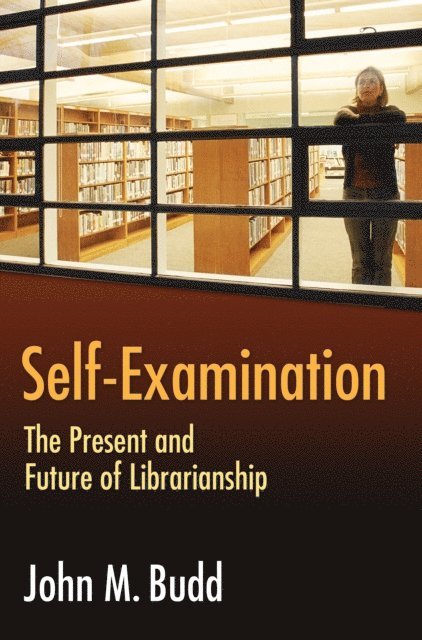
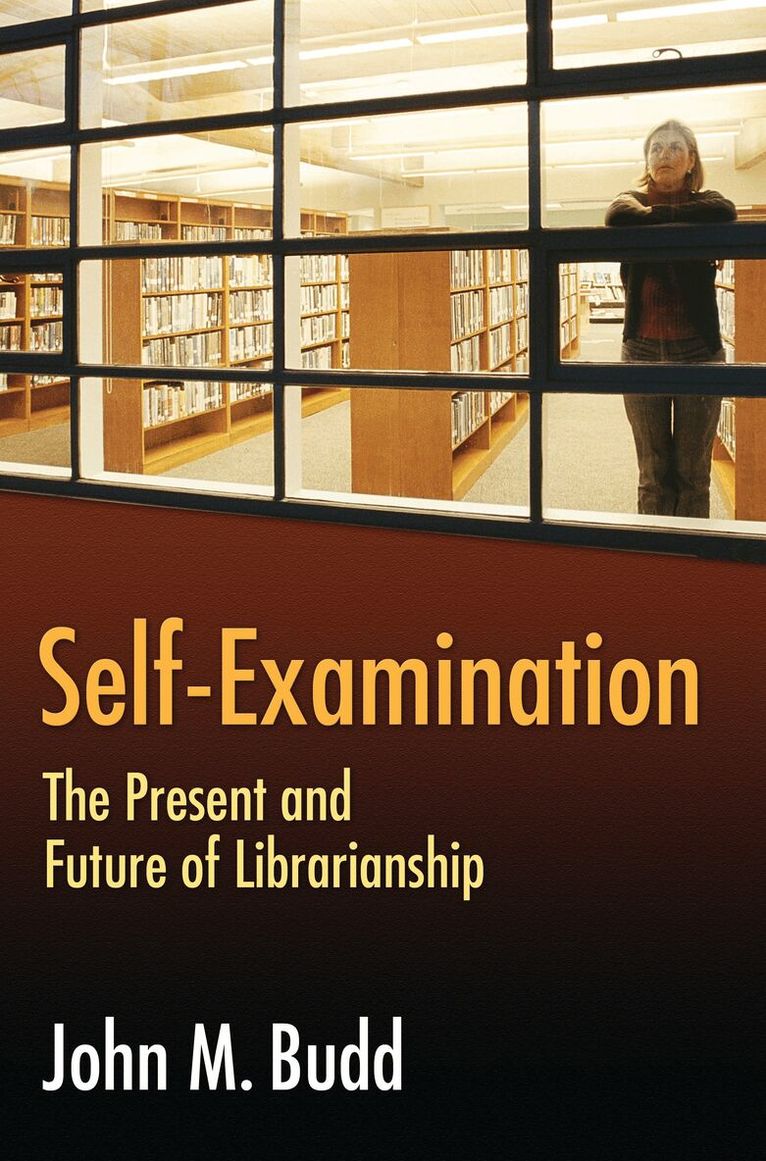
What makes us librarians? What is it we do that is indispensable? John Budd joins an august group of library-science luminaries, such as Pierce Butler, Jesse Shera, and Michael Gorman, whose works and example invite professional and critical self-examination. Here, Budd challenges us to confront the uneasy truth of whether libraries still represent people's will and intellect, or the cabalistic enclaves of an old guard? Through intellectually rich and engaging entrees into ethics, democracy, social responsibility, governance, and globalization, he makes the case that librarians who fail to grasp the importance of their heritage will never truly respond to societal change or the needs of the individual user.
665 kr
Skickas inom 10-15 vardagar
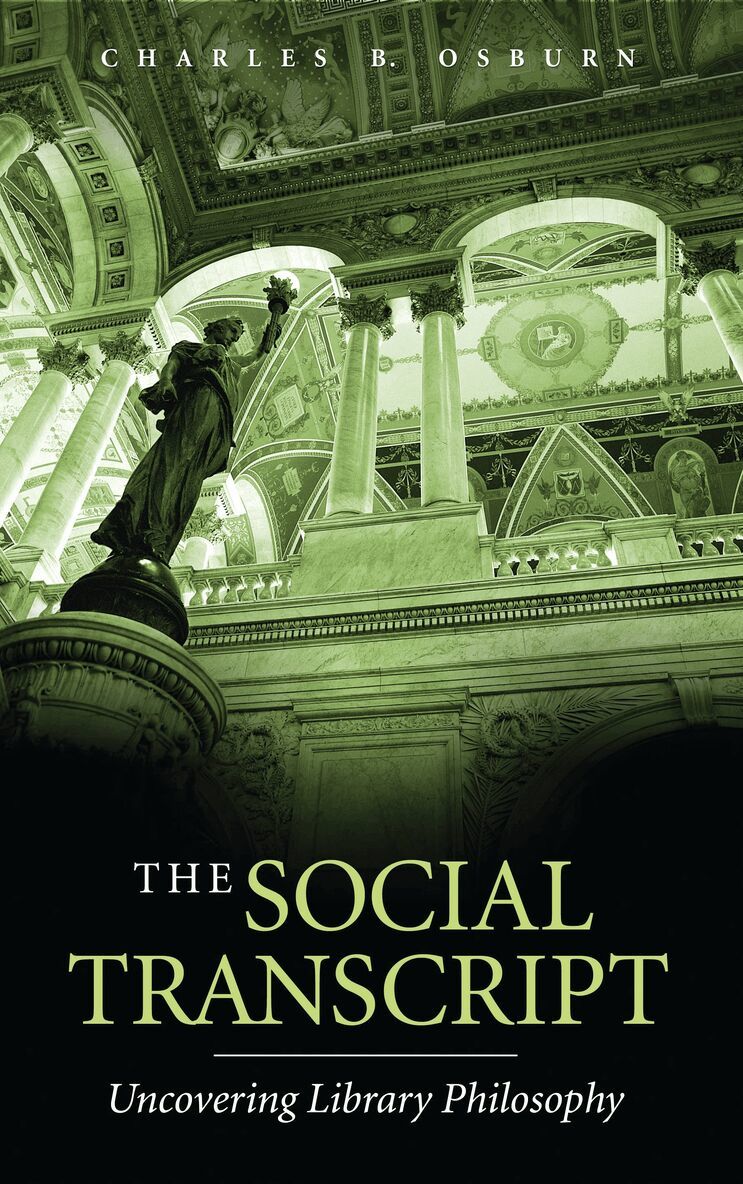
Many glimpses into what might be called library philosophy are scattered throughout the literatures of library history and library and information science, but none has coalesced as yet. Conversely, theories relative to the operation of libraries, rather than relative to why its operations are necessary in the first place, are exceedingly abundant. Not surprisingly, fundamental misunderstandings are shared among public, scholar, and librarian about what the library is and why it exists. Adapting the work of Kenneth Boulding, Osburn presents a cogent, well substantiated explanation of why the library refuses to cede its position as a cultural icon; and how it not only continues but flourishes throughout the trials and errors of civilization.The written record of the human race, as we find it in the great libraries, is a precious heritage of communication and profoundly affects the content of what we have to communicate about. Indeed, we stand on the shoulders of the past through its records. —Kenneth Boulding.On the one hand, the concept of a library reflects a rational social process, its genesis and survival the result of each succeeding generation embracing the same core values as the one before. At the same time, practice in the library is bounded by both the experiences and expectations of the public, and our choice and treatment of topic in our scholarly and professional literature. Not surprisingly, fundamental misunderstandings are shared among public, scholar, and librarian about what the library is and why it exists.Adapting the work of Kenneth Boulding, Charles Osburn presents a cogent, well substantiated explanation of why the library refuses to cede its position as a cultural icon; and how it not only continues but flourishes throughout the trials and errors of civilization.
731 kr
Skickas inom 10-15 vardagar
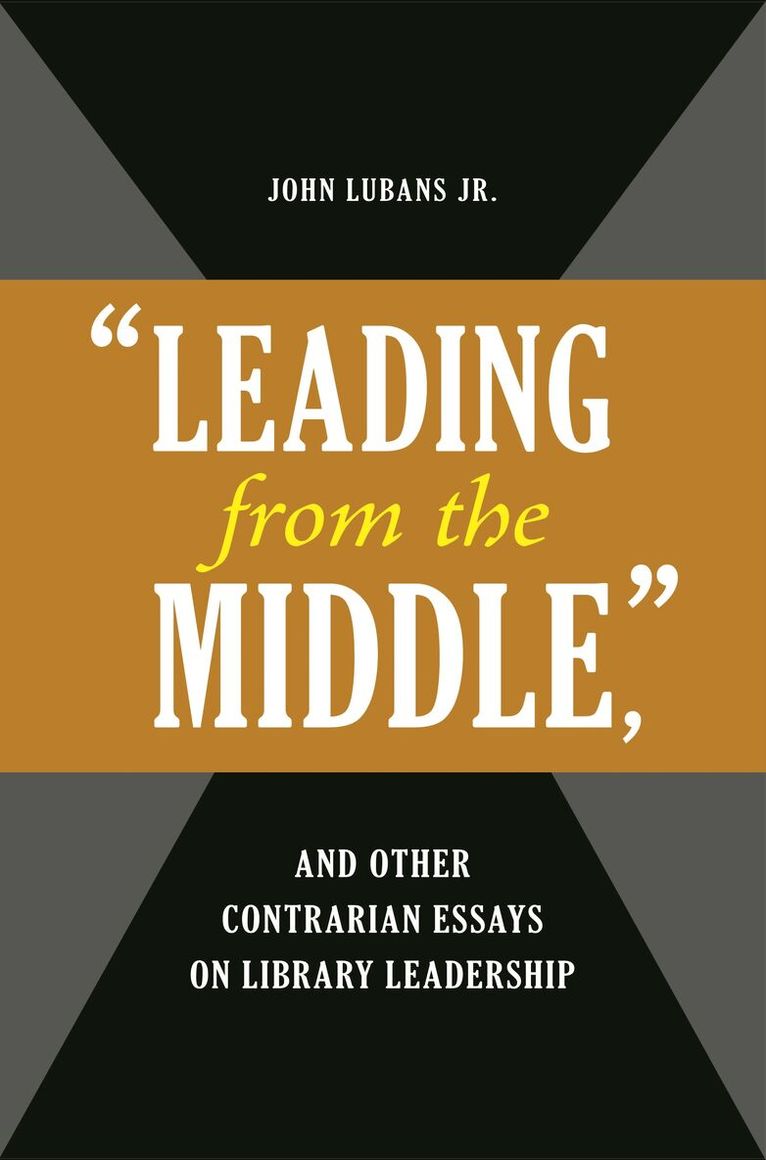
This compilation reveals how followers help an organization get better and how effective followers—leading from the middle—are essential to the best kind of leadership.In "Leading from the Middle," and Other Contrarian Essays on Library Leadership, John Lubans, Jr., argues for democratic library organizations with shared leadership and decision making by leaders and followers. His book distills 15 years worth of leadership essays to advance a theory of a collaborative and empowering leadership, touching on such subjects as teamwork, empowerment, "followership," challenges, values, coaching, self-management, collaboration, communication, and techniques and tools.Lubans's 36 essays draw new and insightful perspectives on leadership from disparate realms: travel, sports, music, retail businesses, and airlines. All of the essays have been edited and revised for this book and many have been extensively updated with new material and epilogues. The essays flow from the author's experience as a manager/leader, his teaching of the topic, and his research into and experimentation with organizational leadership. Insights and suggestions are tempered by a candid reflection on successes achieved and mistakes made.