BRIDGING THE GAP SERIES - Böcker
Visar alla böcker i serien BRIDGING THE GAP SERIES. Handla med fri frakt och snabb leverans.
10 produkter
10 produkter
929 kr
Skickas inom 7-10 vardagar
To what extent do cyberspace operations increase the risks of escalation between nation-state rivals? Scholars and practitioners have been concerned about cyber escalation for decades, but the question remains hotly debated. The issue is increasingly important for international politics as more states develop and employ offensive cyber capabilities, and as the international system is increasingly characterized by emergent multipolarity. In Escalation Dynamics in Cyberspace, Erica D. Lonergan and Shawn W. Lonergan tackle this question head-on, presenting a comprehensive theory that explains the conditions under which cyber operations may lead to escalation. In doing so, they challenge long-held assumptions about strategic interactions in cyberspace, arguing that cyberspace is not as dangerous as the conventional wisdom might suggest. In some cases, cyber operations could even facilitate the de-escalation of international crises. To support their claims, Lonergan and Lonergan test their theory against a range of in-depth case studies, including strategic interactions between the United States and key rivals; a series of case studies of the role of cyber operations in international crises; and plausible future scenarios involving cyber operations during conflict. They then apply their analytical insights to policymaking, making the case that skepticism is warranted about the overall efficacy of employing cyber power for strategic ends. By exploring the role of cyber operations in routine competition, crises, and warfighting, Escalation Dynamics in Cyberspace presents nuanced insights about how cyberspace affects international politics.
334 kr
Skickas
To what extent do cyberspace operations increase the risks of escalation between nation-state rivals? Scholars and practitioners have been concerned about cyber escalation for decades, but the question remains hotly debated. The issue is increasingly important for international politics as more states develop and employ offensive cyber capabilities, and as the international system is increasingly characterized by emergent multipolarity. In Escalation Dynamics in Cyberspace, Erica D. Lonergan and Shawn W. Lonergan tackle this question head-on, presenting a comprehensive theory that explains the conditions under which cyber operations may lead to escalation. In doing so, they challenge long-held assumptions about strategic interactions in cyberspace, arguing that cyberspace is not as dangerous as the conventional wisdom might suggest. In some cases, cyber operations could even facilitate the de-escalation of international crises. To support their claims, Lonergan and Lonergan test their theory against a range of in-depth case studies, including strategic interactions between the United States and key rivals; a series of case studies of the role of cyber operations in international crises; and plausible future scenarios involving cyber operations during conflict. They then apply their analytical insights to policymaking, making the case that skepticism is warranted about the overall efficacy of employing cyber power for strategic ends. By exploring the role of cyber operations in routine competition, crises, and warfighting, Escalation Dynamics in Cyberspace presents nuanced insights about how cyberspace affects international politics.
1 335 kr
Skickas inom 5-8 vardagar
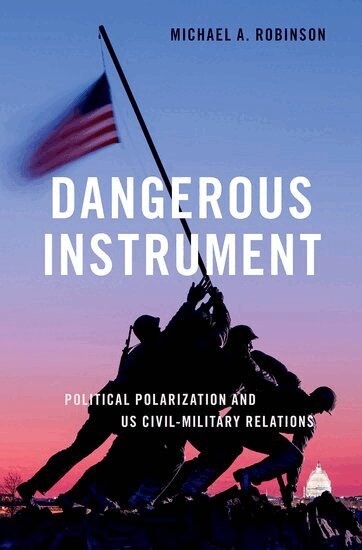
As increasingly contentious politics in the United States raise concerns over the "politicization" of traditionally non-partisan institutions, many have turned their attention to how the American military has been--and will be--affected by this trend. Since a low point following the end of the Vietnam War, the U.S. military has experienced a dramatic reversal of public opinion, becoming one of the most trusted institutions in American society. However, this trend is more complicated than it appears: just as individuals have become fonder of their military, they have also become increasingly polarized from one another along partisan lines. The result is a new political environment rife with challenges to traditional civil-military norms.In a data-driven analysis of contemporary American attitudes, Dangerous Instrument examines the current state of U.S. civil-military affairs, probing how the public views their military and the effect that partisan tribalism may have on that relationship in the future. Michael A. Robinson studies the sources and potential limits of American trust in the armed services, focusing on the interplay of the public, political parties, media outlets, and the military itself on the prospect of politicization and its associated challenges. As democratic institutions face persistent pressure worldwide, Dangerous Instrument provides important insights into the contemporary arc of American civil-military affairs and delivers recommendations on ways to preserve a non-partisan military.
301 kr
Skickas inom 5-8 vardagar
As increasingly contentious politics in the United States raise concerns over the "politicization" of traditionally non-partisan institutions, many have turned their attention to how the American military has been--and will be--affected by this trend. Since a low point following the end of the Vietnam War, the U.S. military has experienced a dramatic reversal of public opinion, becoming one of the most trusted institutions in American society. However, this trend is more complicated than it appears: just as individuals have become fonder of their military, they have also become increasingly polarized from one another along partisan lines. The result is a new political environment rife with challenges to traditional civil-military norms.In a data-driven analysis of contemporary American attitudes, Dangerous Instrument examines the current state of U.S. civil-military affairs, probing how the public views their military and the effect that partisan tribalism may have on that relationship in the future. Michael A. Robinson studies the sources and potential limits of American trust in the armed services, focusing on the interplay of the public, political parties, media outlets, and the military itself on the prospect of politicization and its associated challenges. As democratic institutions face persistent pressure worldwide, Dangerous Instrument provides important insights into the contemporary arc of American civil-military affairs and delivers recommendations on ways to preserve a non-partisan military.
1 335 kr
Skickas inom 5-8 vardagar
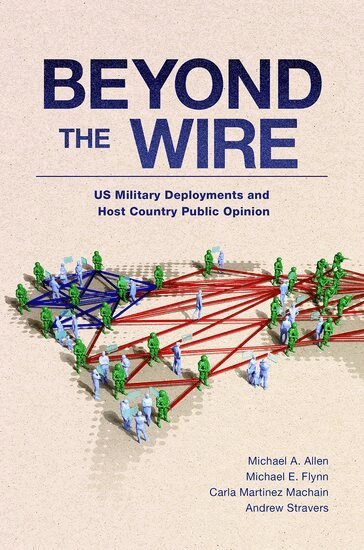
In a time where US deployments are uncertain, this book shows how US service members can either build the necessary support to sustain their presence or create added animosity towards the military presence.The United States stands at a crossroads in international security. The backbone of its international position for the last 70 years has been the massive network of overseas military deployments. However, the US now faces pressures to limit its overseas presence and spending. In Beyond the Wire, Michael Allen, Michael Flynn, Carla Martinez Machain, and Andrew Stravers argue that the US has entered into a "Domain of Competitive Consent" where the longevity of overseas deployments relies upon the buy-in from host-state populations and what other major powers offer in security guarantees. Drawing from three years of surveys and interviews across fourteen countries, they demonstrate that a key component of building support for the US mission is the service members themselves as they interact with local community members. Highlighting both the positive contact and economic benefits that flow from military deployments and the negative interactions like crime and anti-base protests, this book shows in the most rigorous and concrete way possible how US policy on the ground shapes its ability to advance its foreign policy goals.
347 kr
Skickas inom 5-8 vardagar
In a time where US deployments are uncertain, this book shows how US service members can either build the necessary support to sustain their presence or create added animosity towards the military presence.The United States stands at a crossroads in international security. The backbone of its international position for the last 70 years has been the massive network of overseas military deployments. However, the US now faces pressures to limit its overseas presence and spending. In Beyond the Wire, Michael Allen, Michael Flynn, Carla Martinez Machain, and Andrew Stravers argue that the US has entered into a "Domain of Competitive Consent" where the longevity of overseas deployments relies upon the buy-in from host-state populations and what other major powers offer in security guarantees. Drawing from three years of surveys and interviews across fourteen countries, they demonstrate that a key component of building support for the US mission is the service members themselves as they interact with local community members. Highlighting both the positive contact and economic benefits that flow from military deployments and the negative interactions like crime and anti-base protests, this book shows in the most rigorous and concrete way possible how US policy on the ground shapes its ability to advance its foreign policy goals.
386 kr
Skickas inom 5-8 vardagar
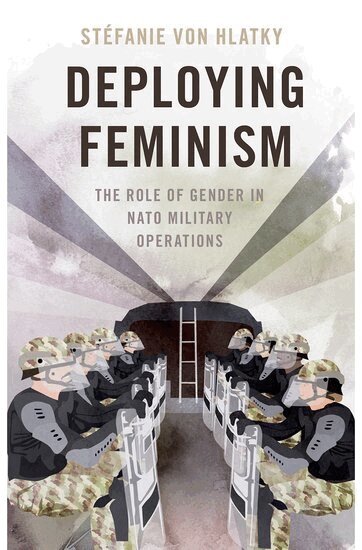
A detailed account, based on fieldwork and interviews, of how Women, Peace and Security norms are militarized and put at the service of operational effectiveness.International organizations and governments want to increase women's participation in military operations and peacebuilding. Gender equality is increasingly seen as the antidote to conflict, a key factor in achieving stability. While feminist activism inspired the emergence of these norms on gender and conflict, they were institutionalized through the Women, Peace and Security (WPS) agenda, with the military at the forefront of those changes. In Deploying Feminism, Stéfanie von Hlatky tells the story of how the military has been delegated authority to advance gender equality as part of their activities, while simultaneously tackling increasingly complex threats. Drawing upon fieldwork and interviews, she illustrates how NATO, the world's foremost alliance, has even embedded these ideas in the planning and execution of its missions. For troops deployed on NATO missions, this often means seeking out women in their operating area to improve intelligence gathering activities. While this helps the mission, does it help women and conflict-affected communities? Because of the military's focus on operational effectiveness above all else, von Hlatky argues that there is a distortion of WPS norms, as gender equality concerns fade into the background. Looking at NATO's ongoing operations in Iraq, Kosovo, and the Baltics, Deploying Feminism details the process by which Women, Peace and Security norms are militarized and put at the service of operational effectiveness. Further, it shows why an adjustment is necessary for gender equality to become a true planning priority.
512 kr
Skickas inom 3-6 vardagar
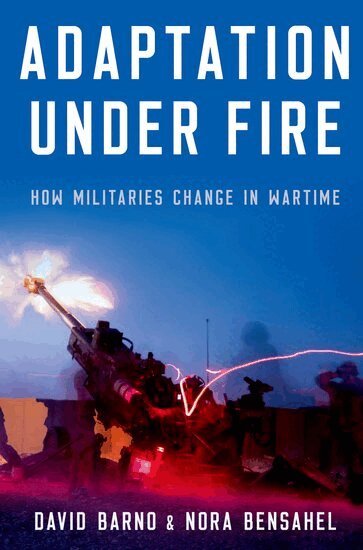
A critical look into how and why the U.S. military needs to become more adaptable.Every military must prepare for future wars despite not really knowing the shape such wars will ultimately take. As former U.S. Secretary of Defense Robert Gates once noted: "We have a perfect record in predicting the next war. We have never once gotten it right." In the face of such great uncertainty, militaries must be able to adapt rapidly in order to win. Adaptation under Fire identifies the characteristics that make militaries more adaptable, illustrated through historical examples and the recent wars in Iraq and Afghanistan.Authors David Barno and Nora Bensahel argue that militaries facing unknown future conflicts must nevertheless make choices about the type of doctrine that their units will use, the weapons and equipment they will purchase, and the kind of leaders they will select and develop to guide the force to victory. Yet after a war begins, many of these choices will prove flawed in the unpredictable crucible of the battlefield. For a U.S. military facing diverse global threats, its ability to adapt quickly and effectively to those unforeseen circumstances may spell the difference between victory and defeat. Barno and Bensahel start by providing a framework for understanding adaptation and include historical cases of success and failure. Next, they examine U.S. military adaptation during the nation's recent wars, and explain why certain forms of adaptation have proven problematic. In the final section, Barno and Bensahel conclude that the U.S. military must become much more adaptable in order to address the fast-changing security challenges of the future, and they offer recommendations on how to do so before it is too late.
Thanks for Your Service
The Causes and Consequences of Public Confidence in the US Military
Inbunden, Engelska, 2024
929 kr
Skickas inom 5-8 vardagar
A definitive study on the decades-long run of high public confidence in the military and why it may rest on some shaky foundations.What explains the high levels of public confidence in the US military and does high confidence matter? In Thanks for Your Service, the eminent civil-military relations scholar Peter D. Feaver addresses this question and focuses on what it means for the military. Proprietary survey data show that confidence is partly based on public beliefs about the military's high competence, adherence to high professional ethics, and a determination to stand apart from the bitter divisions of partisan politics. However, as Feaver argues, confidence is also shaped by a partisan gap and by social desirability bias, the idea that some individuals express confidence in the military because they believe that is the socially approved attitude to hold. Not only does Feaver help us understand how and why the public has confidence in the military, but he also exposes problems that policymakers need to be aware of. Specifically, this book traces how confidence in the institution shapes public attitudes on the use of force and may not always reinforce best practices in democratic civil-military relations.
Thanks for Your Service
The Causes and Consequences of Public Confidence in the US Military
Häftad, Engelska, 2024
268 kr
Skickas inom 5-8 vardagar
A definitive study on the decades-long run of high public confidence in the military and why it may rest on some shaky foundations.What explains the high levels of public confidence in the US military and does high confidence matter? In Thanks for Your Service, the eminent civil-military relations scholar Peter D. Feaver addresses this question and focuses on what it means for the military. Proprietary survey data show that confidence is partly based on public beliefs about the military's high competence, adherence to high professional ethics, and a determination to stand apart from the bitter divisions of partisan politics. However, as Feaver argues, confidence is also shaped by a partisan gap and by social desirability bias, the idea that some individuals express confidence in the military because they believe that is the socially approved attitude to hold. Not only does Feaver help us understand how and why the public has confidence in the military, but he also exposes problems that policymakers need to be aware of. Specifically, this book traces how confidence in the institution shapes public attitudes on the use of force and may not always reinforce best practices in democratic civil-military relations.